






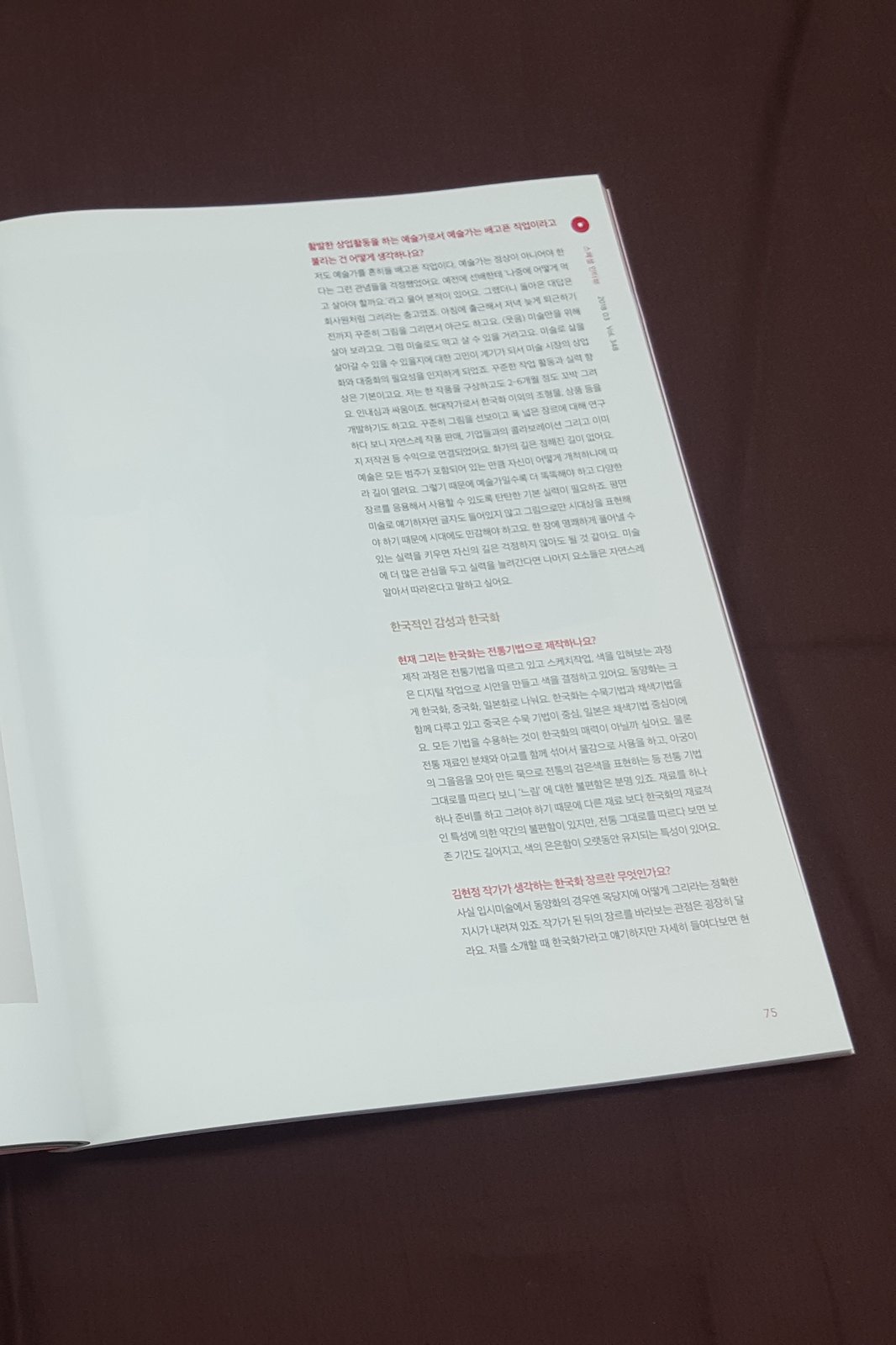
Monthly Art College Entrance Exam | Kim Hyun Jung, the Korean Painter Who Paints Naesung
In an interview with Monthly Art College Entrance Exam (March 2018, Vol. 348), artist Kim Hyun Jung discussed how she used social media and "social drawing" to overcome the limits of exhibition space as an emerging artist and to build a following, her working methods that preserve traditional Korean painting techniques, the potential for expanding the genre of Korean painting, advice for art students preparing for college entrance exams, and her future plans. Photography by Park Yu-na, materials courtesy of the Kim Hyun Jung Art Center.
View full text
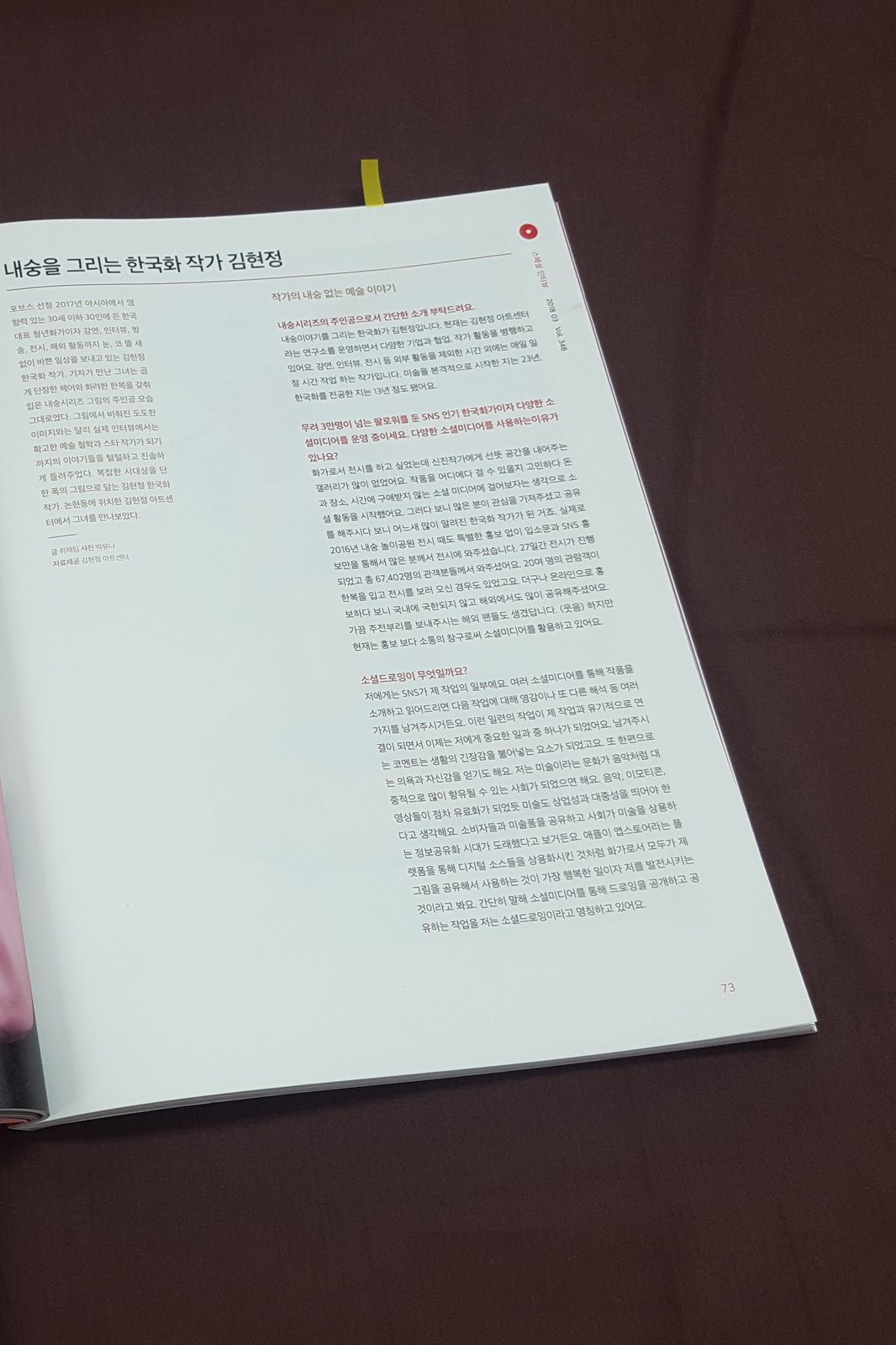
Kim Hyun Jung, a Korean painting artist named to Forbes' 2017 "30 Under 30 Asia" and one of Korea's leading young painters, is living an extremely busy daily life packed with lectures, interviews, broadcasts, exhibitions, and overseas activities. When our reporter met her, she was dressed exactly like the protagonist of her Naesung Series paintings, with her hair elegantly styled and wearing a resplendent hanbok. Unlike the aloof image projected in her paintings, in person she candidly and warmly shared her firm artistic philosophy and the story of how she became a star artist. Kim Hyun Jung, the Korean painting artist who captures the complexity of our era in a single painting — we met her at the Kim Hyun Jung Art Center in Nonhyeon-dong.
An Artist's Story, Without Any Naesung
As the protagonist of the Naesung Series, could you give us a brief introduction?
I'm Kim Hyun Jung, the Korean painter who paints the Naesung Story. I currently run a research institute called the Kim Hyun Jung Art Center, balancing collaborations with various companies alongside my own creative work. Aside from time spent on external activities like lectures, interviews, and exhibitions, I paint a set number of hours every single day. It's been about 23 years since I seriously began studying art, and about 13 years since I majored in Korean painting.
You're a popular Korean painting artist on social media with over 30,000 followers, and you run various social media channels. Is there a reason you use so many different platforms?
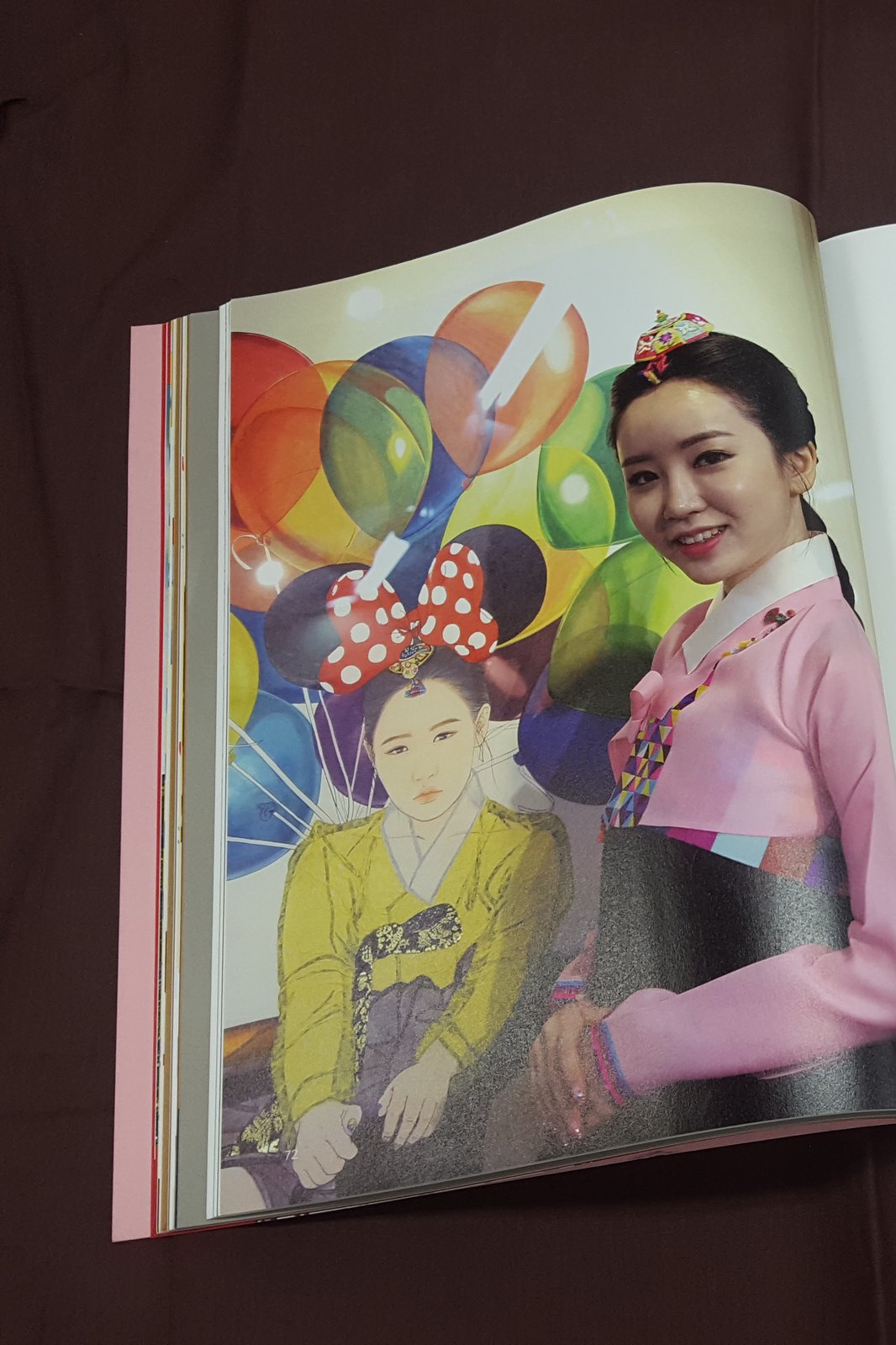
As an artist, I wanted to hold exhibitions, but there weren't many galleries willing to readily offer space to an emerging artist. While worrying about where I could hang my work, I started my social media activity with the thought, "Let's put it up on social media, which isn't constrained by money, location, or time." As a result, many people took interest and shared my work, and before I knew it, I had become a fairly well-known Korean painting artist. In fact, even for my 2016 "Naesung Amusement Park" exhibition, many people came to see the show purely through word of mouth and social media promotion, without any special advertising. The exhibition ran for 27 days and drew a total of 67,402 visitors. There were even cases where about 20 visitors came dressed in hanbok to see the exhibition. Moreover, since I was promoting it online, it wasn't limited to Korea — it was shared a lot overseas too. I even gained some overseas fans who occasionally send me snacks (laughs). But these days, I use social media more as a channel for communication than for promotion.
What is "social drawing"?
For me, social media is part of my work. When I introduce and present my work through various social media platforms, people leave me inspiration for my next piece, alternate interpretations, and various other things. This series of exchanges has become organically connected to my work, and it has now become one of my important daily routines. The comments people leave have become an element that injects a sense of tension into daily life, and on the other hand, I also gain motivation and confidence from them. I hope art can become something that is enjoyed by the public as widely as music. Just as music, emoticons, and video content have gradually become paid content, I think art also needs to embrace both commerciality and popularity. I believe we've entered an era of information-sharing in which consumers and society share and consume art, much like Apple commercialized digital sources through a platform called the App Store. As a painter, I think it would make me happiest, and would also develop me the most, if everyone could share and use my paintings. In short, the work of releasing and sharing drawings through social media is what I call "social drawing."
As an artist actively engaged in commercial activity, what do you think of the idea that artists are supposed to be a "starving" profession?
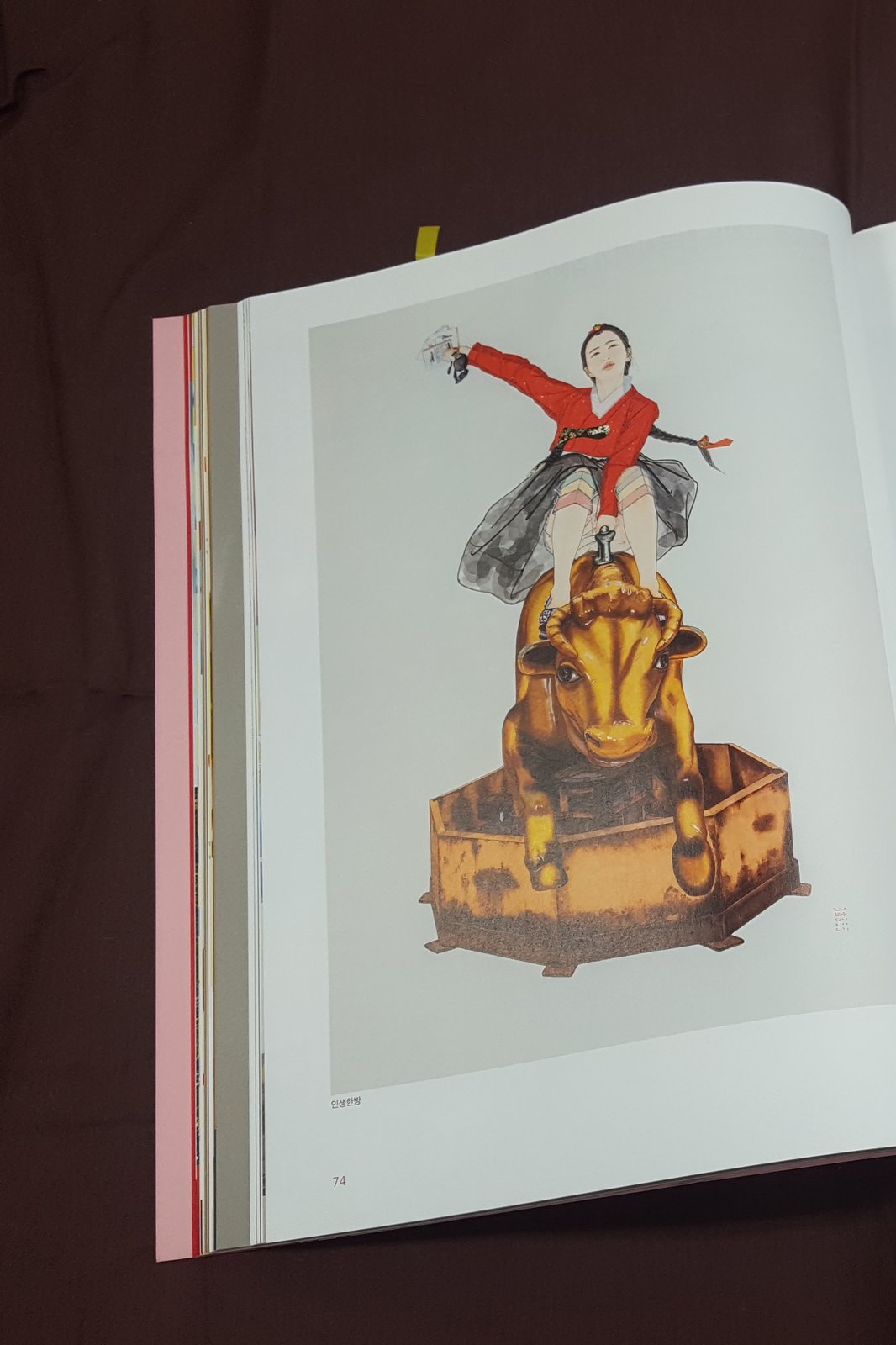
I too used to worry about that common notion that artists are a starving profession, that an artist shouldn't be "normal." I once asked a senior, "How am I supposed to make a living later on?" The answer that came back was advice to be like an office worker. To keep painting steadily from clocking in in the morning to clocking out late in the evening, doing overtime and all (laughs). To live purely for art. Then I'd be able to make a living from art too. The worry over whether I could sustain myself through art became the catalyst for realizing the need for commercialization and popularization in the art market. Consistent creative activity and improving one's skill are, of course, the basics. I spend anywhere from two to six months conceiving and completing a single work. It's a battle of patience. As a contemporary artist, I also develop sculptural objects and products beyond Korean painting itself. As I kept steadily presenting my work and researching a wide range of genres, it naturally led to sales of my work, corporate collaborations, and revenue through image licensing, among other things. There's no fixed path for a painter. Since art encompasses every category, the path opens up depending on how you pioneer it yourself. That's exactly why artists need to be even smarter, and need solid fundamental skills so they can apply a variety of genres. In terms of flat, two-dimensional art, there are no words involved — you have to express the spirit of the times through the painting alone, so you also need to be sensitive to the era. If you build the skill to resolve that clearly on a single sheet, I don't think you need to worry too much about your own path. I'd like to say that if you focus more on art and keep developing your skill, the rest will naturally follow.
Korean Sensibility and Korean Painting
Is the Korean painting you currently create made using traditional techniques?
The production process follows traditional techniques, while the sketching stage and the process of trying out colors are done digitally to create drafts and determine colors. Oriental painting broadly divides into Korean painting, Chinese painting, and Japanese painting. Korean painting handles both ink-wash technique and color technique together, while China centers on ink-wash technique and Japan centers on color technique. I think embracing all these techniques together is the charm of Korean painting. Of course, I use traditional materials — mixing traditional mineral pigments (bunchae) and glue (ajo) together as paint, and expressing the traditional black color with ink made by collecting soot from a traditional furnace — so following the traditional techniques exactly does come with a certain inconvenience of "slowness." Because you have to prepare each material individually before painting, there's a bit more inconvenience due to the material characteristics of Korean painting compared to other materials. But if you follow tradition exactly, the preservation period is longer, and the softness of the colors is maintained for a long time.
What does the genre of Korean painting mean to you?
Actually, in the entrance-exam art world, when it comes to Oriental painting, there are precise instructions on how to paint on ok-dang-ji paper. The perspective on genre changes greatly after you become an artist. When I introduce myself, I say I'm a Korean painting artist, but if you look closely, I'm also a contemporary artist. You can also see the trajectory of a pop artist crossing genres. I even make sculptural objects myself. I think it includes not only flat works but three-dimensional ones too. People say the term "Korean painting" itself is ambiguous. I think any work made by a Korean person with Korean sensibility could be considered Korean painting. When introducing it to foreign media under the name "Korean painting," you can expect Korean sensibility to come through. Since there's no fixed definition of where the boundaries of Korean painting lie, I'm confident and hopeful that the scope of the genre will become much broader and more diverse going forward. Regardless of genre, I think art itself also needs to constantly research what kind of changes it will face in step with the Fourth Industrial Revolution.
There are many students dreaming of becoming Korean painters, watching your career path. Do you have any particular advice for them?
When I was preparing for entrance exams, I thought "studying" and "painting" were separate things, but having worked as an artist and studied myself, I've felt that all my thinking and interests connect back to painting. So seeing and experiencing a lot will definitely help a great deal when preparing for entrance exams. I think what matters most for entrance exams is curiosity and perseverance, and above all, you have to truly love painting. Art entrance-exam prep is genuinely tough. Having gone through it myself and also having worked as an art-prep instructor, what I've come to feel is that that period is a time for building a solid foundation. If you say you typically start in your first year of high school, that's about three years of art-exam prep. But we're living in an age where people live to be a hundred. If you devote yourself fully to building that fundamental skill during just those three years, you can shed it or find another aptitude of your own using that foundation once you get into college. I'd like to say: take responsibility for what you've chosen, and I hope you'll do your best with it.
What are your plans going forward?
I plan to keep painting steadily, which is my main work, while also continuing collaborations and exhibitions. Currently, I'm handling a policy promotion campaign called "Seoul in My Hands" together with the City of Seoul. Rather than being labeled as any particular kind of artist, I want to be an artist who does her best in her own position and stays open to communication. I'll need to work just as hard for that too.
Kim Hyun Jung
2004 — Graduated from Sunhwa Arts Middle School, Fine Arts Department
2007 — Graduated from Sunhwa Arts High School, Fine Arts Department, Oriental Painting
2012 — Graduated from Seoul National University College of Fine Arts, Department of Oriental Painting
2015 — Master's degree, Graduate School of Fine Arts, Department of Oriental Painting, Seoul National University
Graduated from Seoul National University College of Business Administration, Department of Business Administration
2017 — PhD candidate, Graduate School of Fine Arts, Department of Oriental Painting, Seoul National University