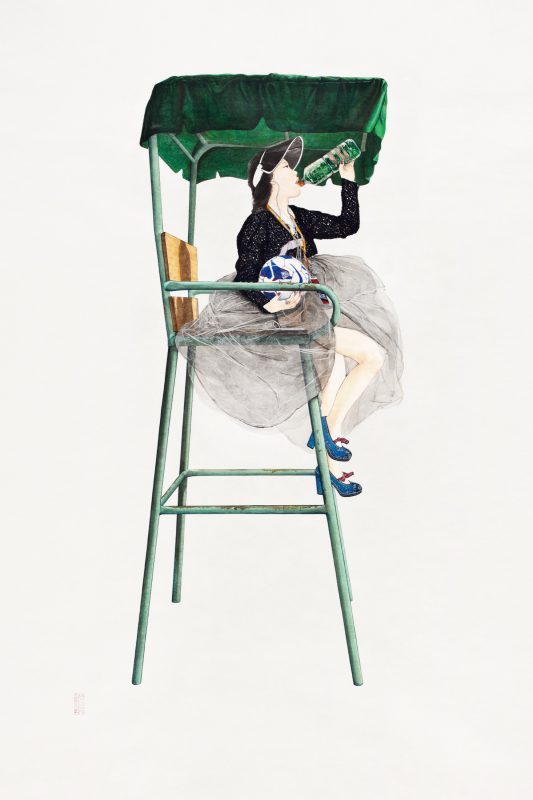
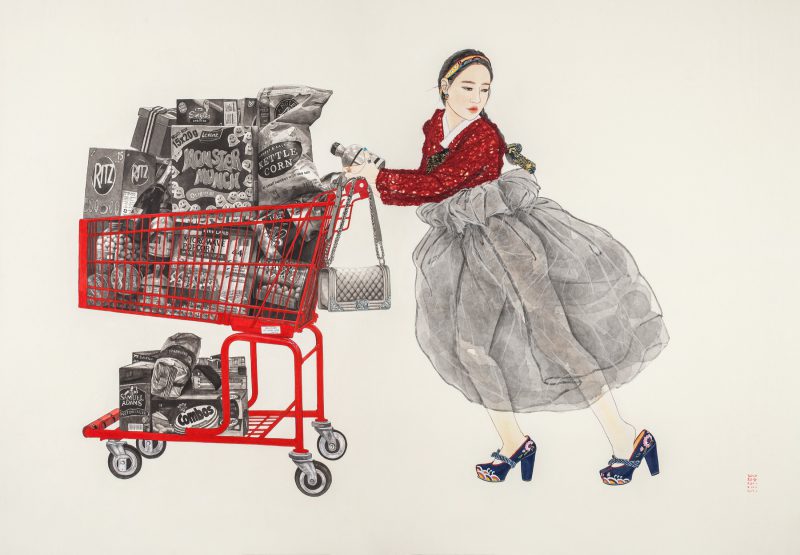
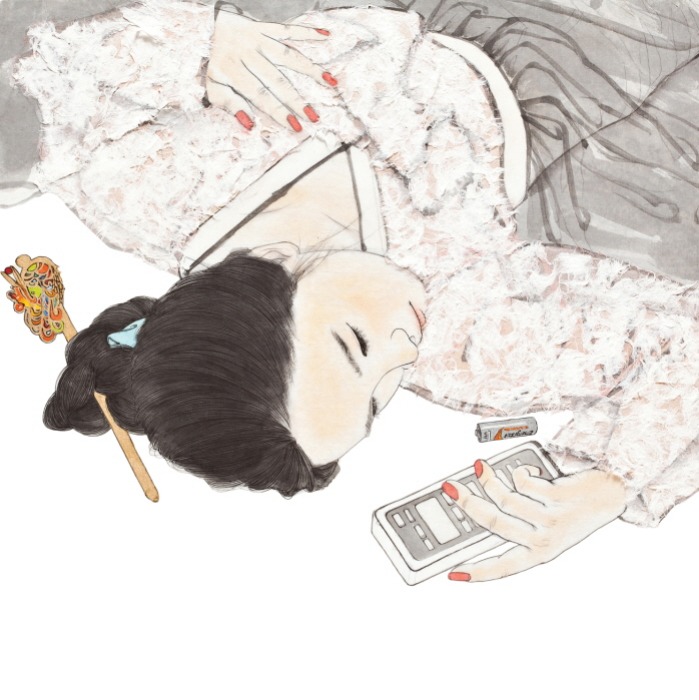
She paints the life and emotions of contemporary people with humor and satire. Her ‘Naesoong’ series in hanbok is a self-portrait of the artist herself, a 21st-century genre painting by ‘the idol of Korean painting.’
Artist
An introduction to the world of work and the background of Korean painter Kim Hyun Jung, called ‘the idol of Korean painting.’ Discover the flow of her work and her major career milestones, from the self-portraits in which she poses as her own model to their expansion into the recurring figure of ‘Naesoong.’
Kim Hyun Jung's work begins with self-observation and leads to the figure of 'Naesoong,' exploring both her inner and outer worlds. From the early Naesoong series through works on marriage and relationships to pieces that expand into diverse media, the full arc of her practice can be explored here by theme.
A record of the exhibitions where Kim Hyun Jung's work has met its audience. Centered on her solo exhibitions, explore major group and invitational shows at home and abroad in chronological order.
Projects in which Kim Hyun Jung's work extends beyond the gallery wall into brands, products, spaces, and media. See how Korean painting and the image of 'Naesoong' have taken on new forms through each collaboration.
A collection of Kim Hyun Jung's own writings and books, together with outside criticism and research, and records left through publications and press. Explore how one artist's work has been written about, interpreted, and recorded by society.
Kim Hyun Jung's activities and work as covered by newspapers, broadcast, magazines, and online media — a record of how her exhibitions, work, collaborations, and interviews have met society.
Naesoong's clothing is transparent enough to see through. Why is that?
Rendering the fabric as translucent carries the meaning of "seeing straight through to what's inside." It's meant to draw the viewer toward an insight about Naesoong herself. I think the Confucian notion that certain things are simply expected "because you're a woman" still lingers heavily in our lives, and it often forces people to hide their own genuine desires and true selves. So painting the figure nude carries an important meaning beyond the veil-like clothing she wears to adorn herself — it reveals the plain, unadorned essence of the person underneath. Through the translucent hanbok, the viewer can look into the figure's interior, and that silhouette — visible yet not quite visible — symbolizes the possibility of approaching the true nature of the person.
Why use ink on the skirt?
Rendering the skirt in ink-wash and light color is deeply meaningful to me. The inside of a woman's full skirt is like the universe itself — it holds countless secrets and its depths can never be fully known, and from that I draw an image of infinity (無窮). The ink (墨) I use in my work likewise holds the infinity of the cosmos within it. Laozi said that the true form marking the boundary between being and non-being, yin and yang, is precisely the blackness of ink — this darkness, or "hyeon" (玄) — and that this hyeon lies beyond our ordinary perception, letting us taste the profound mystery of the universe through it. Because the black of ink carries this infinite, mysterious sensibility, it feels entirely natural — even inevitable — to render a woman's skirt, which resembles the universe, in pale ink wash.
What is your working process?
I combine traditional technique with collage. The process generally moves through three stages: ① photography and underdrawing → ② coloring → ③ collage. Photography happens in two sessions. The first is to capture the silhouette of the body; the second has the model take the same pose while wearing hanbok. Because the Naesoong series dresses a figure's silhouette almost like playing with a paper doll, both sessions of photography are essential. Once the photographs are done, I trace the image onto mounting paper as an underdrawing, then begin coloring. In the coloring stage, the figure herself is rendered in light color (淡彩, damchae), while the objects she interacts with are rendered in vivid, saturated color (眞彩, jinchae). Finally, I "dress" the figure using ink-wash-and-light-color painting or hanji (traditional Korean paper) collage. Naesoong's most distinctive formal quality emerges precisely at this last stage. I wanted to convey the particular feel of a hanbok jeogori (jacket) as vividly as possible, and after much thought, hanji collage was the answer. A hanbok skirt is generously cut and has a soft, rippling quality, while the jeogori fits close and snug to the body, almost tighter than expected, giving it a crisper feel — especially along the shoulder line. Hanji collage is extremely effective at capturing that particular texture of hanbok. In the Naesoong paintings, collage functions both as an effective way to render hanbok and as a way to inject tension and vitality into the picture plane. It also shapes the overall image of the work depending on form and color. This distinctive quality of hanji collage, combined with ink-wash-and-light-color painting of the figure, produces a unique beauty.
Contact
A space for inquiries about artworks, exhibitions, collaborations, and press. Please leave the relevant details, and we will get back to you after review.