










Monthly National Theater Webzine | July Issue Celebrity of the Month: Korean Painter Kim Hyun Jung
A feature on Korean painter Kim Hyun Jung in the 'Celebrity of the Month - Notable Creator' section of the National Theater of Korea's webzine, Monthly National Theater. It introduces the satire and humor in works such as the Naesoong series and the Marriage series, her distinctive working method combining hanji collage with ink-and-wash coloring, her career history and popularity since her debut, and examples of corporate collaborations. Written by Doo Kyung-a (travel writer and interviewer).
View full text
Celebrity of the Month
Notable Creator
Korean painting, this hip?!
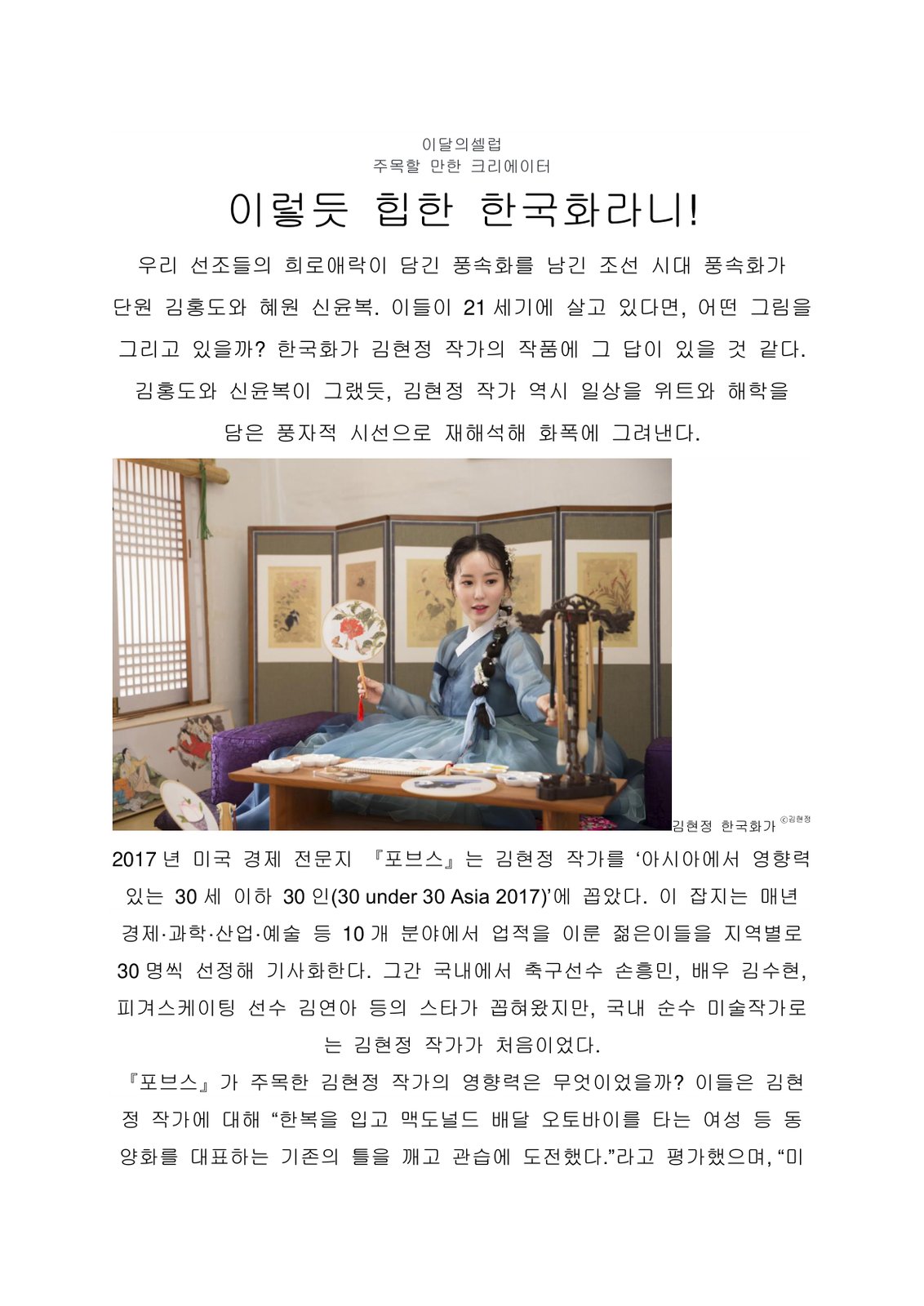
Danwon Kim Hong-do and Hyewon Shin Yun-bok, the Joseon-era genre painters who left behind paintings capturing our ancestors' joys and sorrows -- what would they be painting if they were living in the 21st century? The answer, it seems, can be found in the work of Korean painter Kim Hyun Jung. Just as Kim Hong-do and Shin Yun-bok did, Kim Hyun Jung likewise reinterprets everyday life through a satirical gaze full of wit and humor, and paints it onto her canvas.
[Photo: Korean painter Kim Hyun Jung (c) Kim Hyun Jung]
In 2017, the American business magazine Forbes named Kim Hyun Jung to its '30 Under 30 Asia 2017' list. Every year, the magazine selects 30 young people per region across ten fields -- including economics, science, industry, and the arts -- who have achieved notable accomplishments. While Korean names on the list have previously included figures such as footballer Son Heung-min, actor Kim Soo-hyun, and figure skater Kim Yuna, Kim Hyun Jung was the first pure fine artist from Korea to be selected.
What exactly did Forbes find compelling about Kim Hyun Jung's influence? The magazine described her as someone who "broke the existing mold representing Oriental painting and challenged convention, such as with a woman in hanbok riding a McDonald's delivery motorcycle," and introduced her achievements by noting that she "held a solo exhibition at the Metropolitan Museum of Art in New York, and is one of the youngest artists to have taken part in an exhibition at Korea's National Museum of Modern and Contemporary Art."
[Photo: 'Naesoong: Restraint' (c) Kim Hyun Jung]
A delightful clash between tradition and modernity, expectation and instinct
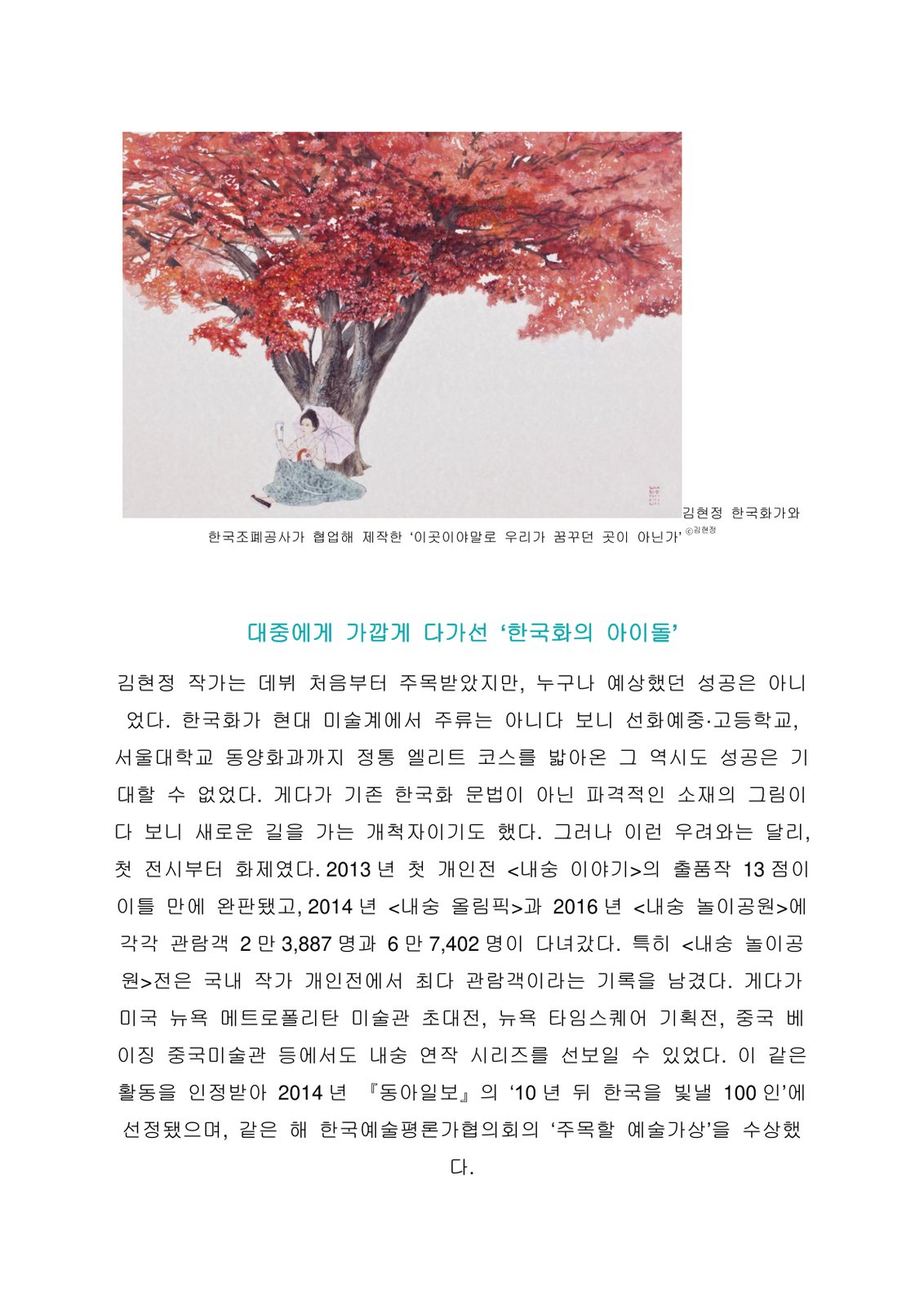
The women in Kim Hyun Jung's paintings are all elegantly dressed in hanbok, yet they reveal their desires without restraint, as if mocking others' expectations, gazes, and conventions. In 'Naesoong: Oops,' a woman boiling ramyeon on a portable gas burner looks on regretfully as coffee spills over her luxury handbag; in 'Naesoong: Restraint,' a woman crouches, looking exhausted, holding several shopping bags after a day of shopping while talking on the phone with someone; and in 'Naesoong: Isn't This the Very Place We Dreamed Of,' Shin Saimdang sits with dignified composure beneath a maple tree -- yet on closer inspection, she holds a parasol in one hand and a takeout coffee in the other, an utterly contemporary figure.
[Photo: 'Marriage: Childcare War' (c) Kim Hyun Jung]
Kim Hyun Jung also satirizes the ideals and realities of married life by parodying famous paintings. In 'Marriage: A Spring That Opens the Morning,' a woman in the pose of Ingres's 'The Source' pours out cereal from a box instead of water from a jug; in 'Marriage: Pieta,' a woman, in the pose of Michelangelo's Pieta sculpture, holds and gazes sorrowfully at another woman exhausted from housework; and in 'Marriage: Childcare War,' a woman carrying a child on her back, cleaning tools in one hand, yet still unwilling to give up her high heels, strikes a pose reminiscent of Jacques-Louis David's 'Napoleon Crossing the Alps.'
All of these are amusing at first glance, but look closer and admiration follows naturally. The clash of opposite elements -- traditional attire and modern props, others' gazes and one's own instincts, formality and the everyday -- delivers a satisfying, delightful feeling.
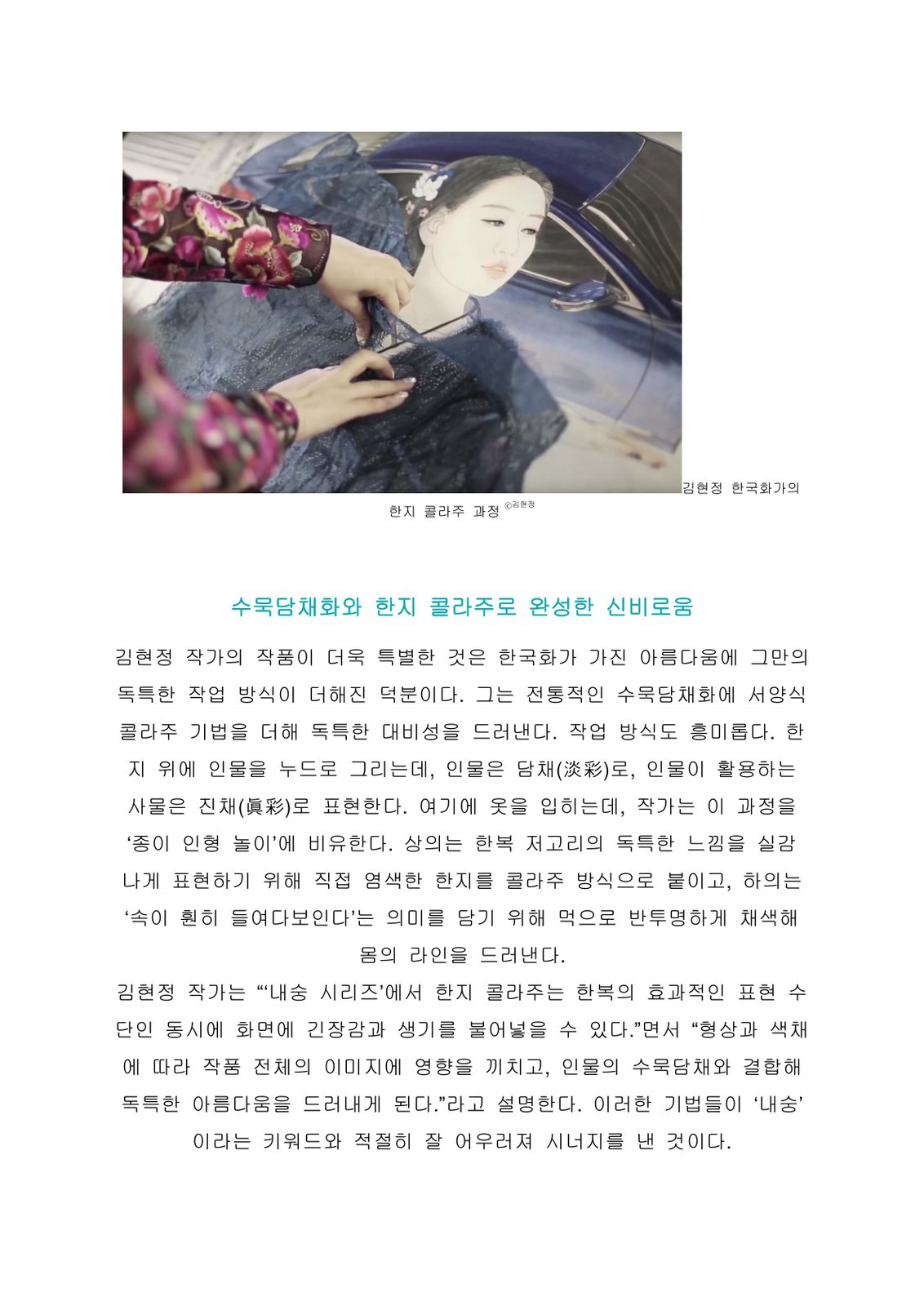
[Photo: The hanji collage process of Korean painter Kim Hyun Jung (c) Kim Hyun Jung]
A mystique completed through ink-and-wash painting and hanji collage
What makes Kim Hyun Jung's work even more special is the way her own distinctive working method is added to the beauty inherent in Korean painting. She adds Western-style collage technique to traditional ink-and-wash coloring, revealing a distinctive contrast. Her working process is fascinating too. She paints the figure nude on hanji, rendering the figure itself in light coloring (dam-chae) and the objects the figure uses in vivid, deep coloring (jin-chae). She then dresses the figure -- a process she compares to 'playing paper dolls.' For the top, she attaches hand-dyed hanji through a collage method to vividly capture the distinctive feel of a hanbok jeogori, while for the bottom, she paints it semi-transparently in ink to reveal the line of the body, conveying the sense that 'you can see right through it.'
Kim Hyun Jung explains, "In the 'Naesoong series,' hanji collage is both an effective way of expressing hanbok and a means of infusing the canvas with tension and vitality," adding that "depending on the shape and color, it influences the image of the entire work, and combined with the figure's ink-and-wash coloring, it reveals a distinctive beauty." These techniques blend well with the keyword 'naesoong,' producing a synergy.
[Photo: 'Naesoong: You, Who Move Me' (c) Kim Hyun Jung]
So what led Kim Hyun Jung to focus on 'naesoong'? She says, "I wanted to caricature the two-facedness of people, myself included." While she sharply captures the complex and subtle emotions of young women in particular, she explains that "'naesoong' is not the exclusive property of women," and that "naesoong is a universal desire to be recognized by others -- a common 'inconsistency' that appears in situations where one hides their shortcomings and tries to present a good image, and it is also part of human instinct."
Kim Hyun Jung's artistic world has been gradually expanding from herself and her own desires, as shown in the 'Naesoong series,' outward to the world surrounding her. The biggest shift came with the exhibition <A Dozen Eggs, the Age to Marry>, which she planned in 2019 to mark her thirtieth birthday. Held to commemorate winning the Korea Young Artist Award, the exhibition presented works that honestly and engagingly captured her vague fears and anxieties about marriage. Focusing on what marriage means in our society, she delved deeply into women's thoughts and feelings about marriage, childbirth, and childcare, along with critical reflections on Korea's marriage culture.
[Photo: 'Isn't This the Very Place We Dreamed Of,' created in collaboration between Korean painter Kim Hyun Jung and the Korea Minting and Security Printing Corporation (c) Kim Hyun Jung]
'The idol of Korean painting,' drawing closer to the public
Kim Hyun Jung drew attention from the very start of her career, but her success was not something everyone would have predicted. Since Korean painting is not mainstream in the contemporary art world, even someone like her, who had followed the classic elite track -- Sunhwa Arts Middle and High School, then the Department of Oriental Painting at Seoul National University -- could not have expected success. Moreover, because her subject matter broke sharply from existing Korean-painting conventions, she was also a pioneer forging a new path. Contrary to such concerns, however, she made waves from her very first exhibition. All 13 works shown in her first solo exhibition, <Naesoong Story>, in 2013 sold out within two days, and her 2014 exhibition <Naesoong Olympics> and 2016 exhibition <Naesoong Amusement Park> drew 23,887 and 67,402 visitors respectively. <Naesoong Amusement Park> in particular set the record for the most-visited solo exhibition by a Korean artist. She was also able to present her Naesoong series at an invitational exhibition at the Metropolitan Museum of Art in New York, a special exhibition in New York's Times Square, and the China National Museum of Fine Arts in Beijing. In recognition of these activities, she was named to Dong-A Ilbo's '100 People Who Will Shine Korea in 10 Years' in 2014, and in the same year received the Korean Art Critics Association's 'Notable Artist Award.'
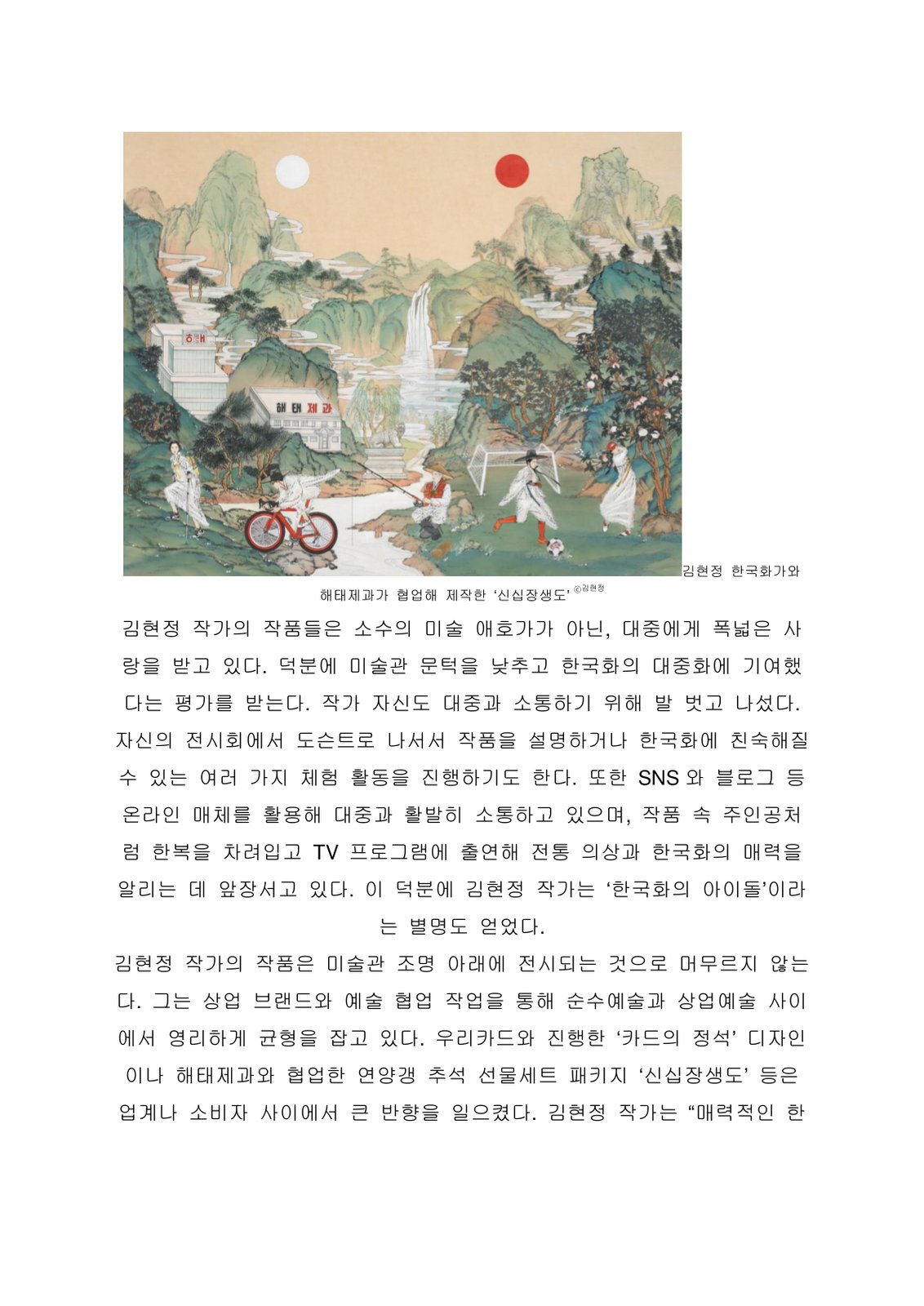
[Photo: 'New Ten Symbols of Longevity,' created in collaboration between Korean painter Kim Hyun Jung and Haitai Confectionery (c) Kim Hyun Jung]
Kim Hyun Jung's work has won broad love not just from a handful of art enthusiasts but from the general public. As a result, she is credited with lowering the threshold of the art museum and contributing to the popularization of Korean painting. She herself has taken an active role in communicating with the public. At her own exhibitions, she has served as a docent, explaining her works directly, and has run various hands-on programs to help people feel closer to Korean painting. She also actively communicates with the public through online media such as social media and blogs, and, dressed in hanbok just like the protagonists of her paintings, appears on TV programs to help spread the appeal of traditional attire and Korean painting. Thanks to all this, Kim Hyun Jung has earned the nickname 'the idol of Korean painting.'
Kim Hyun Jung's work does not stop at being displayed under a museum's lights. Through collaborations between commercial brands and art, she cleverly strikes a balance between fine art and commercial art. Projects such as the 'Card Basics' design she created with Woori Card, and 'New Ten Symbols of Longevity,' the Chuseok gift-set packaging for Yeonyanggaeng she made in collaboration with Haitai Confectionery, have created a considerable stir among both industry and consumers. Kim Hyun Jung says, "I dream of a world where captivating Korean painting is enjoyed and appreciated by everyone, just like music." As she wishes, it seems that door has already begun to open.
Written by Doo Kyung-a, travel writer and interviewer (freelance journalist). She has worked as a staff reporter for Lady Kyunghyang and Woman Chosun, co-authored Women Who Make Art (2021) as an interviewer, and published Just Follow Along: Fukuoka (2017) as a travel writer.