






Den | I Want to Pioneer My Own Korean Painting Through Satire and Wit
Lifestyle magazine DEN profiles Kim Hyun Jung, dubbed "the idol of the Korean painting world," covering the origin of the "Naesung Series," which grew out of depression; her distinctive technique combining ink-and-light-color painting with hanji collage; the inspiration she draws from everyday items such as luxury shoes and bags; her view of corporate collaboration, citing Takashi Murakami as an example; and her plans for the "21st-Century Genre Painting" series. Editor Lee Young-min, photographer Jung Young-ju, hair and makeup Nueve de Julio, wardrobe Lee Mi-ok Hanbok.
View full text
New-Generation Korean Painter Kim Hyun Jung, Drawing Attention as an SNS Star
"I Want to Pioneer My Own Korean Painting Through Satire and Wit"
Artist Kim Hyun Jung, called "the idol of the Korean painting world" for combining outstanding skill with striking looks. She has drawn Korean painting — long seen as stagnant — into the mainstream. What is it about her that has captivated people?
Editor Lee Young-min Photographer Jung Young-ju Hair/Makeup Nueve de Julio (02-3443-6880) Wardrobe Lee Mi-ok Hanbok (02-518-5371)
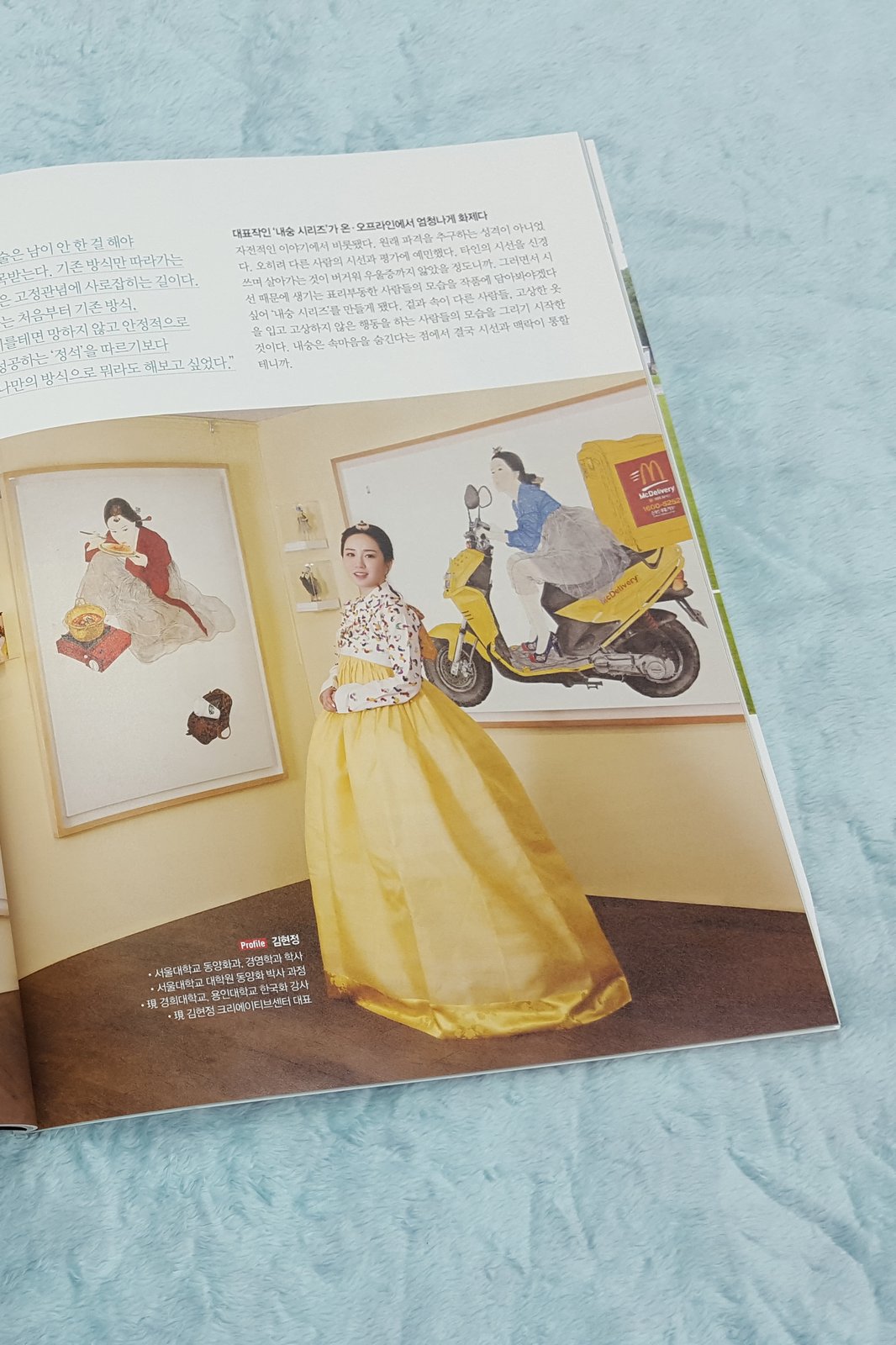
Profile: Kim Hyun Jung
• BA, Department of Oriental Painting and Department of Business Administration, Seoul National University
• PhD candidate, Department of Oriental Painting, Graduate School, Seoul National University
• Current lecturer in Korean painting at Kyung Hee University and Yong In University
• Current CEO, Kim Hyun Jung Creative Center
"To draw attention in art, you have to do what others haven't done. Simply following the existing way is a path bound by fixed ideas. From the start, rather than following the existing 'safe formula' for stable success without failure, I wanted to try something in my own way."
Kim Hyun Jung is a painter. As the common saying goes, someone who pours her artistic soul onto canvas — typically someone who meets the public through their work rather than showing their face. And yet, we see her face often. First of all, she's an SNS star with 170,000 followers. She's also appeared on TV, in newspapers, and holds buzzworthy exhibitions.
This fierce dedication to communicating with the public has also borne some fruit. She's landed on Forbes' "30 Under 30 Asia 2017," Dong-A Ilbo's "100 People Who Will Shine Korea in 10 Years," and numerous other notable-figures lists, establishing herself as one of the most closely watched young artists today. Forbes cited "an artist who challenges existing convention through her work" as the reason for her selection.
Your signature "Naesung Series" has become a huge topic both online and offline.
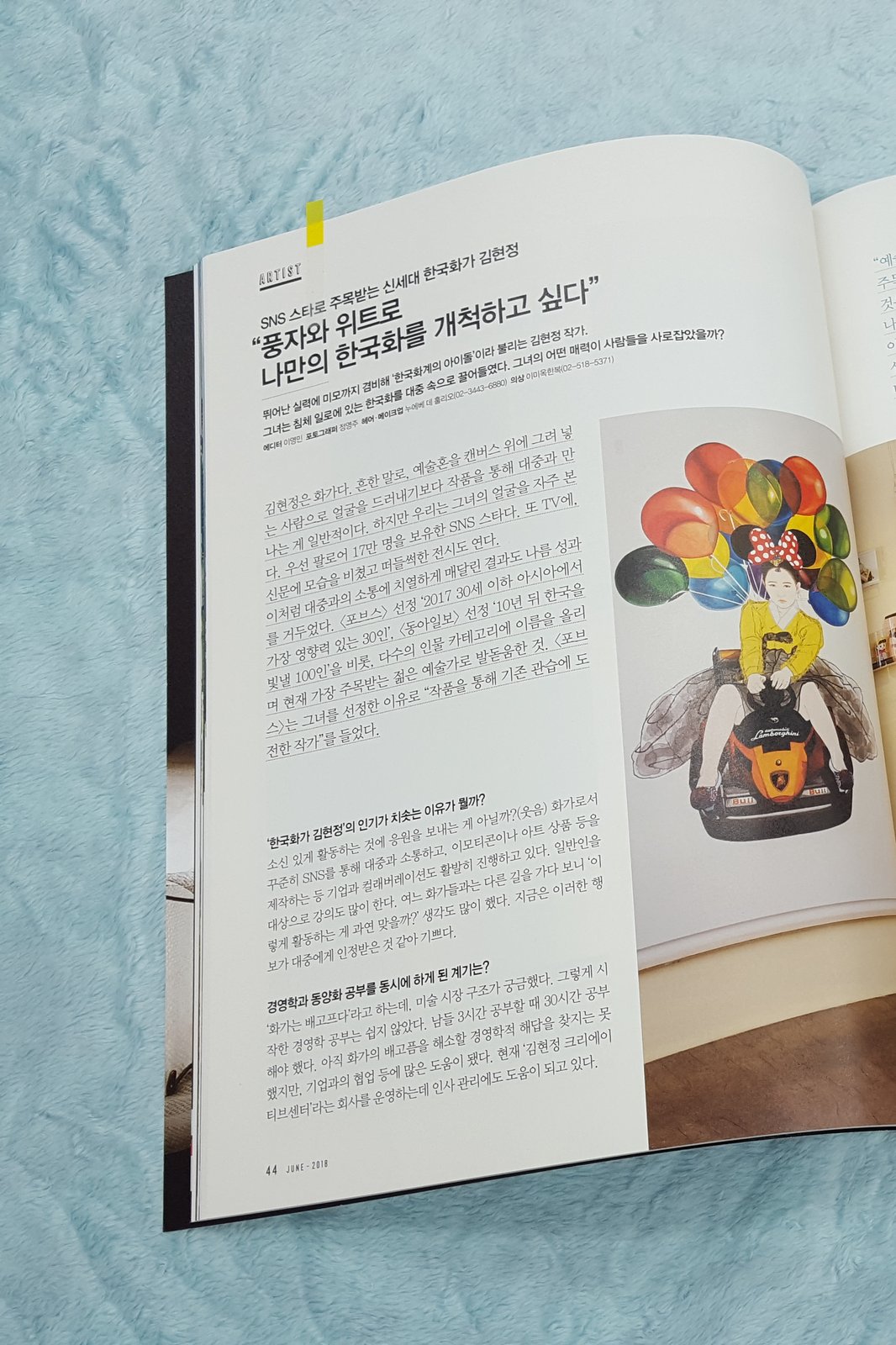
It started from an autobiographical story. I wasn't originally someone inclined toward boldness. If anything, I was sensitive to other people's gaze and judgment. Being burdened by caring about others' perception even led me to depression at one point. From that, I thought I should capture, in my work, the duplicity people show because of that gaze — and that's how the "Naesung Series" came about. I began painting people whose outside differs from their inside — people who wear elegant clothes while doing unrefined things. Since Naesung is ultimately about hiding one's true feelings, it connects with the theme of gaze in the end.
Why do you think "Korean painter Kim Hyun Jung" has grown so popular?
Maybe it's people cheering on someone acting according to her own convictions? (laughs) As a painter, I've steadily communicated with the public through SNS, produced emoticons and art merchandise, and actively collaborated with companies. I also give a lot of lectures to the general public. Since I've walked a different path from most painters, I've thought a lot about whether this way of working is really right. Now I'm glad this path seems to have been recognized by the public.
What led you to study business administration alongside Oriental painting?
There's a saying that "artists go hungry," and I became curious about the structure of the art market. Studying business turned out to be no easy task. While others studied 3 hours, I had to study 30. I still haven't found a business-school answer that solves the hunger of artists, but it's helped a lot with things like corporate collaborations. I currently run a company called "Kim Hyun Jung Creative Center," and it's also been helpful with HR management.
How would you describe your own style of Korean painting?
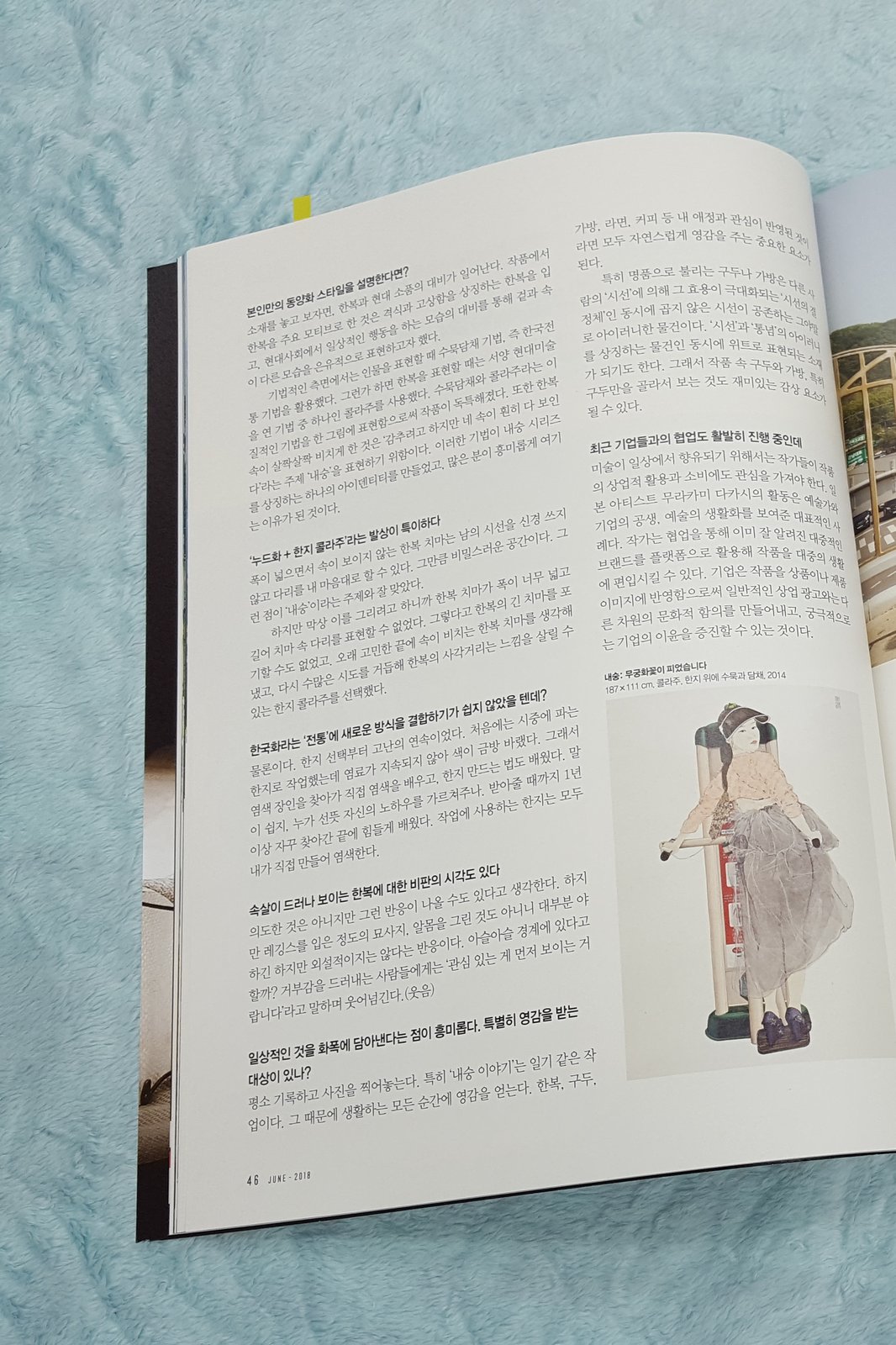
In terms of subject matter, there's a contrast between hanbok and contemporary items. Hanbok became the main motif in my work because I wanted to express — through the contrast between wearing hanbok, which symbolizes formality and elegance, and performing everyday, mundane actions of contemporary life — the metaphorical gap between outside and inside.
In terms of technique, when depicting figures I used ink-and-light-color technique, a traditional Korean method. Meanwhile, to depict hanbok, I used collage, one of the techniques that opened up Western modern art. Combining these two disparate techniques — ink-and-light-color and collage — in a single painting made the work distinctive. And letting the hanbok slightly reveal what's underneath is meant to express the theme "Naesung" — the idea that "you're trying to hide it, but I can see right through you." This technique created an identity symbolizing the Naesung Series, and I think that's part of why many people find it interesting.
The idea of "nude painting + hanji collage" is unusual.
A hanbok skirt that's wide but doesn't reveal anything underneath lets you move your legs freely without worrying about others' gaze. It's that much of a secretive space. That quality fit well with the theme of "Naesung."
But when I actually tried to paint it, the hanbok skirt was too wide and long, so I couldn't depict the legs underneath. Yet I also couldn't give up the long hanbok skirt. After much deliberation, I came up with the idea of a hanbok skirt that lets what's underneath show through, and after numerous further attempts, I settled on hanji collage, which could capture the rustling texture of hanbok.
It must not have been easy to combine a new approach with the "tradition" of Korean painting.
Of course not. Even choosing the hanji was a series of hardships. At first I worked with commercially available hanji, but the dye wouldn't hold and the color faded quickly. So I sought out a master dyer and learned to dye it myself, and also learned how to make hanji itself. It's easy to say, but who readily teaches their own know-how to someone else? I kept visiting for over a year until they finally accepted me, and learned it the hard way. All the hanji I use in my work, I dye myself.
There's also a critical perspective on the exposed flesh under the hanbok.
It wasn't intentional, but I think that kind of reaction can happen. Still, it's more like the coverage of leggings — it's not like I'm painting nudity outright — so most reactions are that it's suggestive but not obscene. Maybe it's right on that edge. To people who show discomfort, I like to laugh it off and say, "What you notice first says something about your own interest." (laughs)
It's interesting that you capture everyday things on canvas. Is there a particular source of inspiration?
I usually keep records and take photos. "Naesung Story" in particular is like a diary. That's why I draw inspiration from every moment of daily life. Hanbok, shoes, bags, ramyeon, coffee — anything reflecting my affection and interest naturally becomes an important source of inspiration.
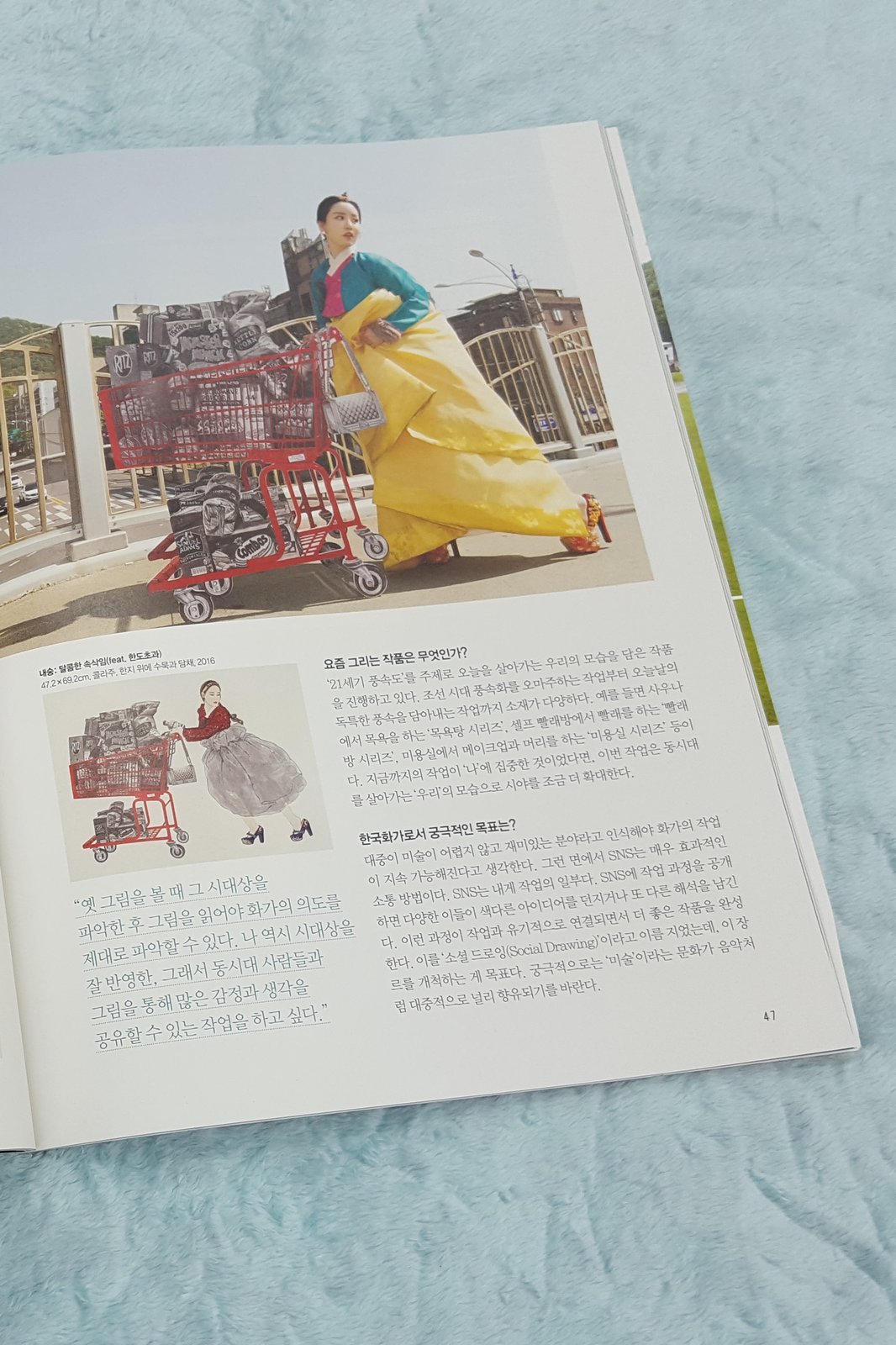
In particular, so-called luxury shoes and bags are the "crystallization of gaze," whose value is maximized through others' attention, while simultaneously being ironic objects that coexist with a not-so-favorable gaze. They symbolize the irony of "gaze" and "convention," while also becoming subject matter expressed with wit. So picking out just the shoes and bags in a work and looking at them can be an enjoyable way to appreciate it too.
You're also actively collaborating with companies these days.
For art to be enjoyed in daily life, artists need to pay attention to the commercial use and consumption of their work as well. Japanese artist Takashi Murakami's activities are a representative example showing the symbiosis of artist and company, and art's integration into daily life. Through collaboration, an artist can use an already well-known, popular brand as a platform to embed her work into people's daily lives. Companies, meanwhile, can reflect the work in their product or brand image, creating cultural meaning of a different dimension from ordinary commercial advertising, and ultimately boosting corporate profit.
What are you working on these days?
I'm working on pieces that capture how we live today, under the theme "21st-Century Genre Painting." The subject matter ranges from work that pays homage to Joseon-era genre painting to work capturing today's unique customs. Examples include a "Bathhouse Series" of women bathing at a sauna, a "Laundromat Series" of women doing laundry at a self-service laundromat, and a "Hair Salon Series" of women getting makeup and their hair done at a salon. If my past work focused on "me," this new work widens the lens a bit further to "us," living in the same era.
What is your ultimate goal as a Korean painting artist?
I believe an artist's work becomes sustainable only when the public recognizes that art isn't difficult and is actually enjoyable. In that sense, SNS is a very effective way to communicate. SNS is part of my work. When I share my creative process on SNS, various people throw in different ideas or leave alternate interpretations. This process organically connects with my work, helping me complete better pieces. I've named this "Social Drawing," and pioneering this genre is my goal. Ultimately, I hope the culture of "art" comes to be enjoyed as widely by the public as music.
"When viewing an old painting, you have to grasp the spirit of that era first, and only then can you read the painting and properly understand the artist's intent. I too want to create work that reflects the spirit of the times well, so that I can share many emotions and thoughts with people of my own era through my paintings."
Naesung: Sweet Whisper (feat. Over the Limit)
47.2×69.2cm, collage, ink and light color on hanji, 2016
Naesung: The Mugunghwa Flower Has Bloomed
187×111cm, collage, ink and light color on hanji, 2014