






Art & Design | Utterly Honest and Transparent, Naesoong
An interview with Korean painter Kim Hyun Jung published in the 'Department Guide — Working Professionals' section of the November 2015 issue of Art & Design. It covers the background of the 'Naesoong' series, her distinctive process of dressing nude figures in hanbok, and her plans for social media communication and 'social drawing.'
View full text
Utterly Honest and Transparent, Naesoong
Artist Kim Hyun Jung
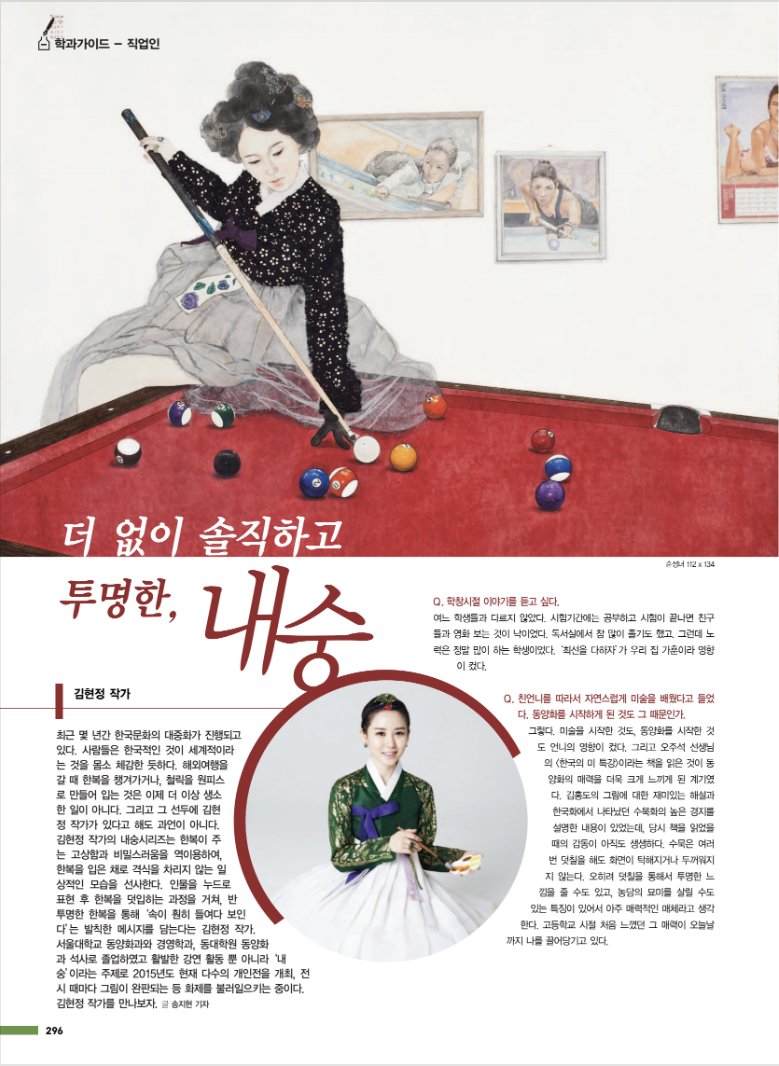
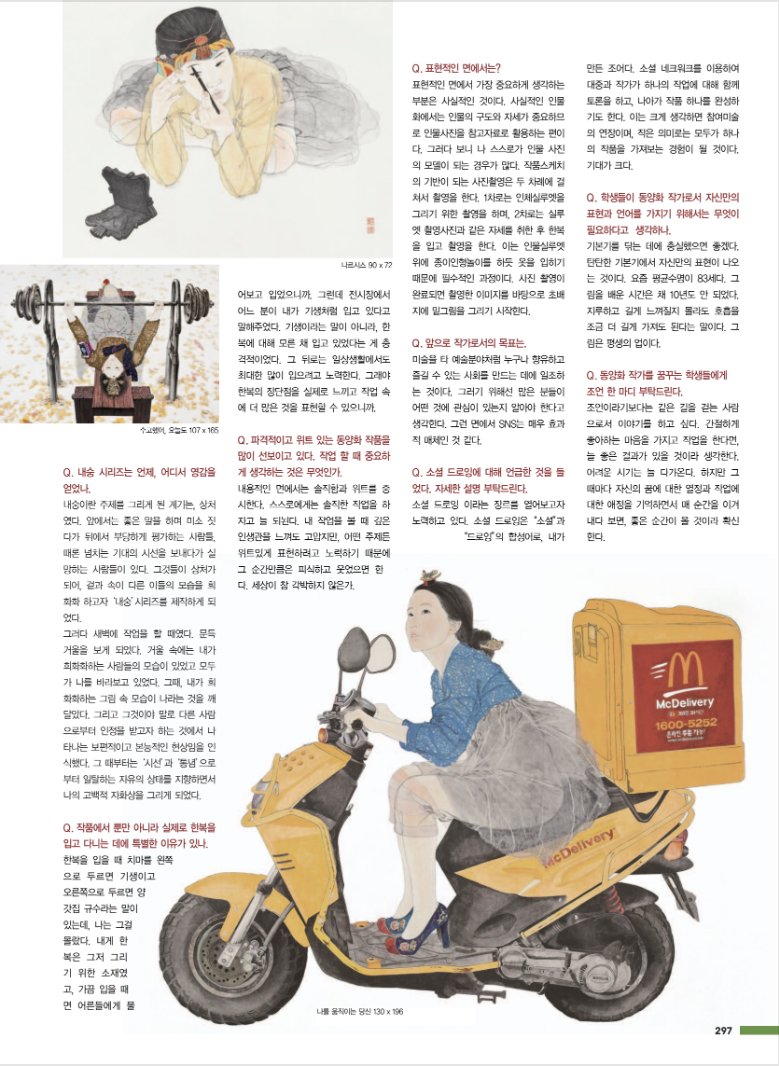
Over the past several years, the popularization of Korean culture has been underway. People seem to have felt, firsthand, that what is distinctly Korean can also be global. Packing hanbok for an overseas trip, or turning a cheollik into a dress — these are no longer unfamiliar sights. And it would hardly be an exaggeration to say that artist Kim Hyun Jung stands at the forefront of that trend. Kim Hyun Jung's Naesoong series turns the elegance and secrecy of hanbok back on itself, presenting the wearer in relaxed, everyday, informal moments while still dressed in hanbok. She draws the figure nude and then dresses it in hanbok, so that through the translucent hanbok, she conveys the audacious message that "you can see right through her." A graduate of Seoul National University's Oriental Painting and Business Administration departments, and holder of a master's degree in Oriental Painting from the same graduate school, she is currently active not only as a lecturer but is also, as of 2015, holding multiple solo exhibitions under the theme of "Naesoong," each one selling out and stirring up conversation. Let's meet artist Kim Hyun Jung.
Q. Tell us about your school days.
I wasn't so different from any other student. My pleasure was studying during exam periods and watching movies with friends once exams ended. I dozed off plenty of times at the study room too. But I really did put in the effort. "Do your very best" is our family motto, and it had a big influence on me.
Q. I heard you naturally picked up art following your older sister. Is that also why you started Oriental painting?
Yes. My sister had a big influence on both my starting art and starting Oriental painting. And reading teacher Oh Ju-seok's book Lectures on Korean Beauty was the moment I came to feel the charm of Oriental painting even more deeply. It included an entertaining commentary on Kim Hong-do's paintings and an explanation of the high level of mastery ink wash painting reaches in Korean painting — the impression that book left on me back then is still vivid today. No matter how many times you layer ink wash, the surface doesn't turn muddy or heavy. If anything, layering it can give a transparent feeling and bring out the subtle charm of light and dark — a characteristic that makes it, I think, an utterly fascinating medium. That charm I first felt in high school is still pulling me in today.
Q. When and where did you find inspiration for the Naesoong series?
The moment that led me to paint the theme of naesoong was, in a word, hurt. There are people who smile and say pleasant things to your face but judge you unfairly behind your back; sometimes people who look at you with overflowing expectation only to suddenly show disappointment. These experiences became wounds, and I began making the "Naesoong" series to caricature the way such people looked one way outside and another inside.
Then, working late one night, I happened to look in a mirror. In the mirror was the very figure of the people I was caricaturing — and everyone was looking at me. That's when I realized the figure in my own painting, the one I was caricaturing, was me. And I recognized that this was itself a universal, instinctive phenomenon that arises from wanting to be recognized by others. From then on, aiming for a state of freedom that breaks away from "gaze" and "convention," I began painting confessional self-portraits of myself.
Q. Is there a particular reason you actually wear hanbok in daily life, not just in your paintings?
There's a saying that if you wrap the skirt of a hanbok to the left it means you're a gisaeng, and to the right it means you're a daughter of a good family — I didn't know that. To me, hanbok was simply subject matter to paint, and whenever I wore it occasionally, I asked older people how to wear it properly. But at an exhibition, someone once told me I was wearing it "like a gisaeng." It wasn't the word "gisaeng" itself that shocked me — it was the fact that I'd been wearing it without knowing anything about it. Since then, I've tried to wear it as much as possible even in daily life. That way I can really feel hanbok's strengths and weaknesses firsthand and express more of that in my work.
Q. You've shown a lot of bold, witty Oriental paintings. What do you consider important when you work?
In terms of content, I place great importance on honesty and wit. I keep telling myself to make honest work. I'm grateful if people feel a deep philosophy of life looking at my work, but since I try to express any subject with wit, I hope people at least crack a smile in that moment. The world can be pretty harsh, can't it?
Q. And in terms of technique?
In terms of expression, the most important thing to me is realism. In realistic figure painting, the figure's composition and pose matter, so I tend to use portrait photographs as reference. As a result, I often end up as the model myself. The photo shoot that forms the basis of a work's sketch happens twice. The first shoot is to draw the body's silhouette, and the second is done wearing hanbok, in the same pose as the silhouette shot. This is essential because I dress the figure over the silhouette, like playing with paper dolls. Once the photography is done, I start drawing the underdrawing on backing paper based on the photographed image.
Q. What are your goals as an artist going forward?
To help build a society where anyone can enjoy and partake in art, the way people enjoy other art forms. For that, I think it's important to know what many people are interested in. In that sense, social media seems like a very effective medium.
Q. I heard you mentioned social drawing. Could you explain further?
I'm trying to open up a genre called social drawing. "Social drawing" is a compound of "social" and "drawing," a term I coined myself. Using social networks, the public and the artist discuss a single piece of work together, and go on to complete a piece together. On a larger scale, this is an extension of participatory art; in a smaller sense, it will be an experience where everyone gets to own a piece of the same work. I have high hopes for it.
Q. What do you think students need in order to develop their own means of expression and voice as Oriental-painting artists?
I hope they focus on building solid fundamentals. Your own expression comes out of solid fundamentals. These days, average life expectancy is 83 years. The time spent learning to paint is less than 10 years. It may feel tedious and long, but that just means you can afford to take a longer breath. Painting is a lifelong vocation.
Q. A word of advice for students who dream of becoming Oriental-painting artists?
Rather than advice, I'd like to speak as someone walking the same path. If you work with a heart that truly, desperately loves what you do, I believe good results will always follow. Difficult times will always come. But if you can get through each moment by remembering your passion for your dream and your love for the work, I'm certain good moments will come.