









Korea.net | Interview: Artist Kim Hyun-jung, modern women through Integrating traditional Korean art into daily life
An email interview with artist Kim Hyun Jung published on Korea.net, the multilingual policy site run by the Korean Culture and Information Service (2023.3.10, conducted by Egyptian honorary reporter Alaa Atef Ebada). Held to mark Women's History Month in March, the interview covers the background and techniques of her 'Naesoong' series, which reinterprets the social conditions of contemporary women by combining traditional Korean ink-wash technique with collage, and the stories behind representative works such as 'Fighting Spirit,' 'Narcissus,' and 'Shall We Dance?'
View full text
[Interview] Artist Kim Hyun Jung Reinterprets the Social Conditions of Modern Women by Integrating Traditional Korean Art into Everyday Life
2023-03-10
Egyptian Honorary Reporter Alaa Atef Ebada. Photos courtesy of Kim Hyun Jung. All rights reserved.
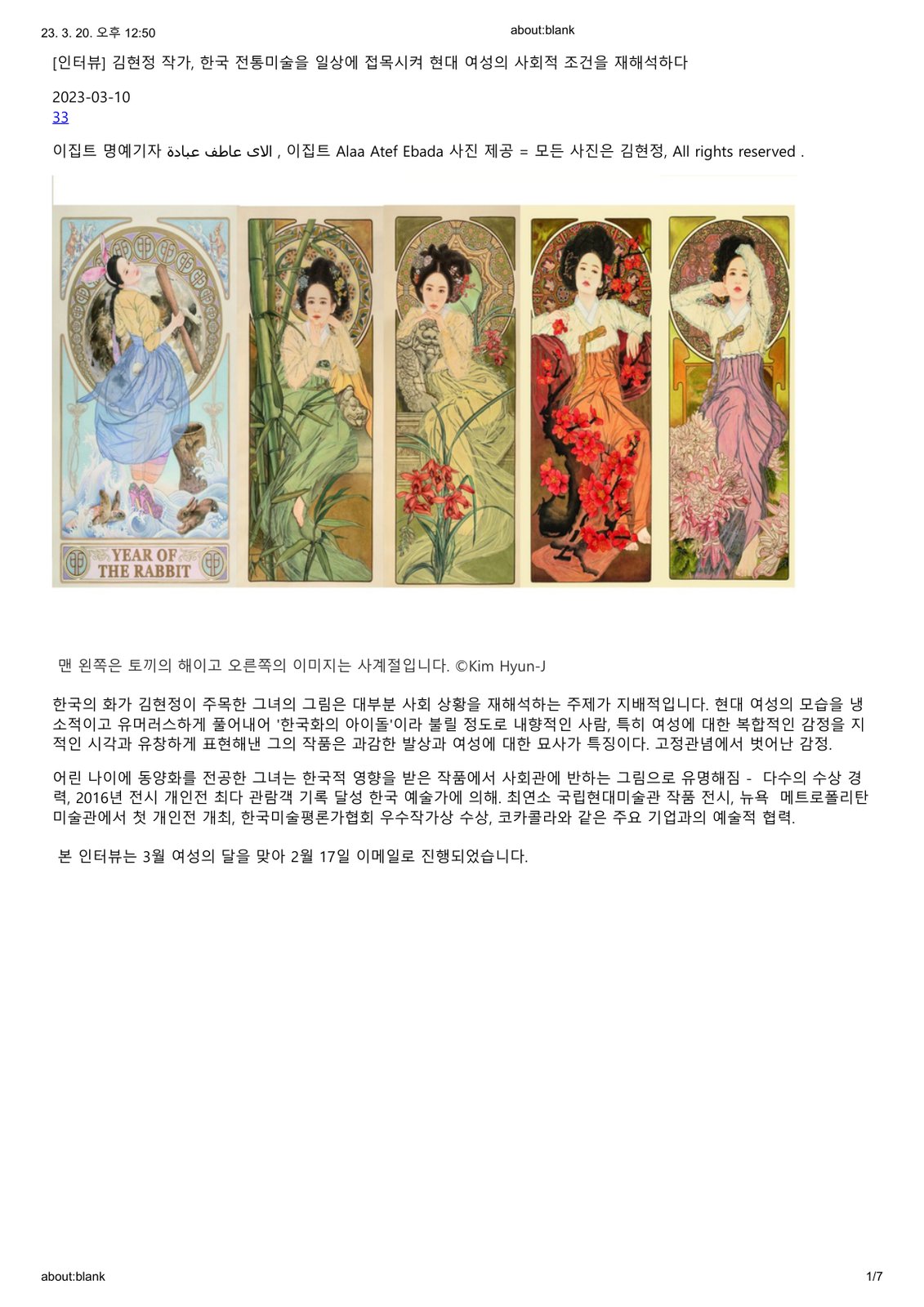
On the far left is the Year of the Rabbit, and the image on the right shows the four seasons. (c)Kim Hyun-J
The paintings of Korean artist Kim Hyun Jung are dominated by themes that reinterpret social situations. Rendering the image of contemporary women with a cynical, humorous touch, she is called 'the idol of Korean painting' for her intellectual, fluent expression of complex emotions toward introverted people, particularly women -- her work is marked by bold ideas and depictions of women, feelings that break free from stereotypes.
Having majored in Oriental painting from a young age, she became known for paintings that push back against social norms while drawing on Korean influences -- earning numerous awards, including setting the record for the most-visited solo exhibition by a Korean artist in 2016. She has held the youngest-ever exhibition of her work at the National Museum of Modern and Contemporary Art, held her first solo exhibition at New York's Metropolitan Museum of Art, received the Excellent Artist Award from the Korean Art Critics Association, and carried out artistic collaborations with major companies such as Coca-Cola.
This interview was conducted by email on February 17, to mark Women's History Month in March.
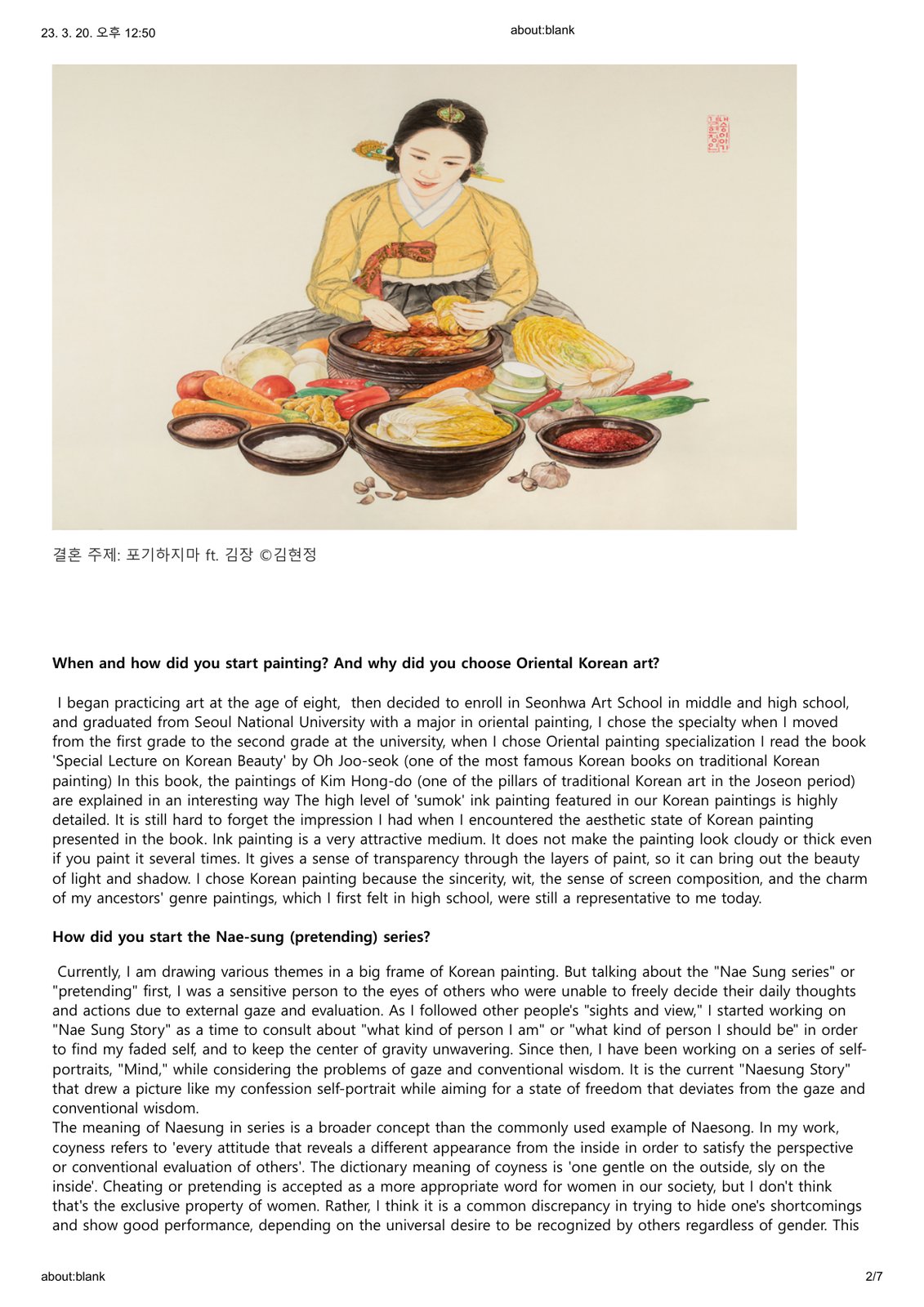
Marriage theme: Don't Give Up ft. Making Kimjang (c)Kim Hyun Jung
When and how did you start painting? And why did you choose Oriental Korean art?
I began practicing art at the age of eight, then decided to enroll in Seonhwa Art School in middle and high school, and graduated from Seoul National University with a major in oriental painting, I chose the specialty when I moved from the first grade to the second grade at the university, when I chose Oriental painting specialization I read the book 'Special Lecture on Korean Beauty' by Oh Joo-seok (one of the most famous Korean books on traditional Korean painting) In this book, the paintings of Kim Hong-do (one of the pillars of traditional Korean art in the Joseon period) are explained in an interesting way The high level of 'sumok' ink painting featured in our Korean paintings is highly detailed. It is still hard to forget the impression I had when I encountered the aesthetic state of Korean painting presented in the book. Ink painting is a very attractive medium. It does not make the painting look cloudy or thick even if you paint it several times. It gives a sense of transparency through the layers of paint, so it can bring out the beauty of light and shadow. I chose Korean painting because the sincerity, wit, the sense of screen composition, and the charm of my ancestors' genre paintings, which I first felt in high school, were still a representative to me today.
How did you start the Nae-sung (pretending) series?
Currently, I am drawing various themes in a big frame of Korean painting. But talking about the "Nae Sung series" or "pretending" first, I was a sensitive person to the eyes of others who were unable to freely decide their daily thoughts and actions due to external gaze and evaluation. As I followed other people's "sights and view," I started working on "Nae Sung Story" as a time to consult about "what kind of person I am" or "what kind of person I should be" in order to find my faded self, and to keep the center of gravity unwavering. Since then, I have been working on a series of self-portraits, "Mind," while considering the problems of gaze and conventional wisdom. It is the current "Naesung Story" that drew a picture like my confession self-portrait while aiming for a state of freedom that deviates from the gaze and conventional wisdom.
The meaning of Naesung in series is a broader concept than the commonly used example of Naesong. In my work, coyness refers to 'every attitude that reveals a different appearance from the inside in order to satisfy the perspective or conventional evaluation of others'. The dictionary meaning of coyness is 'one gentle on the outside, sly on the inside'. Cheating or pretending is accepted as a more appropriate word for women in our society, but I don't think that's the exclusive property of women. Rather, I think it is a common discrepancy in trying to hide one's shortcomings and show good performance, depending on the universal desire to be recognized by others regardless of gender. This is almost instinctive, and in the end, I think it is a phenomenon in which individuals give up their identity according to the conventional wisdom of society.
Some of Nae Sung theme paintings (c)Kim Hyun-Jung
What are the techniques you use at work?
Because the series shows the meeting between the East and the West. The reason for using Western collage techniques with Korean ink-and-wash techniques, naturally came to mind as I decided to express 'Naesung'. The ink-and-wash technique is a method of using the concentration of ink, and the collage technique means sticking with glue. These two techniques represent the costumes of the figures.
The main character is always a woman in hanbok, but the atmosphere is modern. How do you usually get inspiration and utilize the elements of Hanbok and accessories?
It's a self-portrait, so it's really inspired by every single moment of everyday life. For example, "Tu-hon" painting means fighting soul was derived from a combative hamburger eating at the moment when I thought I was about to collapse while working while skipping meals. I was painting even if I was hungry, so I expressed eating French fries with a straw so that I don't get oil on my hands, and I'm working on it after getting inspired by my daily life.
Situations and items are very modern as they express daily life, but expression techniques and materials stick to traditional things. For example, there is a fusion of oriental and western paintings, and I think my personality is recognized not only in terms of materials but also in terms of expression techniques. I often think that when the traditional and the modern, and the Eastern and Western things harmonize, their value will stand out, and those ideas led to this material and expression. The painting of a woman wearing Hanbok, which I have always thought of as beautiful as the color, texture, and jewelry of Hanbok, is also derived from my love for Hanbok. Hanbok, a traditional Korean costume, is an effective costume that reveals the phenomenon of "dressing in a formal manner and wearing elegant clothes, but doing common and everyday behavior." Through the contrast between clothes and actions, I was able to convey the theme of 'Nae Sung' more effectively. and As the appearance of life is expressed in pictures, objects that reflect my affection and interest, such as hanbok, shoes, bags, ramen, and coffee, have naturally become important elements of inspiration. In particular, expensive shoes or bags are a "Crystal-gazing" that maximizes its utility by other people's "sights, and views" and at the same time, it is a very ironic thing that coexists with unfriendly eyes on them. In other words, it symbolizes the irony of "sight" and "conventional wisdom." And at the same time, it's also a subject that's expressed in wit. It's because I like expensive shoes and bags, but because of this interesting point, shoes and bags are indispensable elements of my work. I think it can be an interesting element of appreciation to see only shoes and bags drawn in my work, especially shoes.
Nae Song theme: Tun-ho means fighting Soul (c)Kim Hyun-Jung
What emotions do you want to convey through your art?
I hope many people can "sympathize" the story in the work through painting. I think an artist is a person who represents people's thoughts, feelings, and desires to express themselves. I think he is an expert who sharply captures the problem consciousness that ordinary people feel with sensitive sensitivity, or clearly expresses issues that many people sympathize with in an appropriate visual expression. So, I want to do a work activity that reflects the times well and can share many emotions and thoughts with contemporaries through paintings. This is because I think it is the moment when the work is completed properly when I communicate with the audience after the work. And when I see my work, I want the audience to feel "I sympathize" rather than "I want you to feel this way." Being "sympathetic" means being "communicated" correctly, so the fact that "communication" with many people I have pursued so far is the best. One of my mottoes as a writer is "Communicating with the public as art." That's why I think it's more important to communicate than anything else.
What is your favorite painting?
It takes about six months to complete one work, so I'm attached to all the works. It's like giving a child a birth name, so much so as giving a birth name. So it's hard to pick one of them, but if I have to choose one, I'm more attached to the work I drew in the beginning and the work that took a long time to produce. That's why I'm most attached to Narcissus and Shall we dance, and one of the early paintings, Narcissus, was the first to come up with the theme of Naesung. I thought that the moment when I was immersed in eyebrow makeup with a palm-sized hand mirror in front of me was a representative representation of meekness. This work is personally meaningful because it won the gold award at the Korean Women's Art Exhibition. And the work that took a long time to produce is 'Shall we dance'. This is a series of rock climbing at the Winter Olympics, the biggest painting I've ever done, and it's a masterpiece that's over 5 meters tall. [Shall we dance] Let's enjoy life step by step, enjoying the high and rough walls of the world! That's what it means. Doesn't it look like you're dancing?
Narcissus won the Gold Award at the Korean Women's Art Exhibition (c)Kim Hyun-Jung
"Shall We Dance?" with height of 5 meters (c)Kim Hyun-Jung
What do you feel about your artistic achievements, like being selected by Forbes among 30 influential Asian women and more?
First of all, I'd like to thank everyone for their interest. Through Forbes, the largest economic magazine in the U.S., "30 people under the age of 30 who are influential in Asia," we have been actively engaged in activities and striving to focus on our works so that K-Art and Korean paintings can be widely known worldwide. In addition, he was selected as one of the 100 people who will shine Korea 10 years later by the Dong-A Ilbo. I dare to think that the media will pay attention to my work because many people sympathized with it and liked it. I was doing something different from other artists, and thought, "You're different from others, so is this the right way to do it?" However, I am particularly pleased that my move has been recognized through the Prime Minister. I think I was chosen to continue to be active in the future.
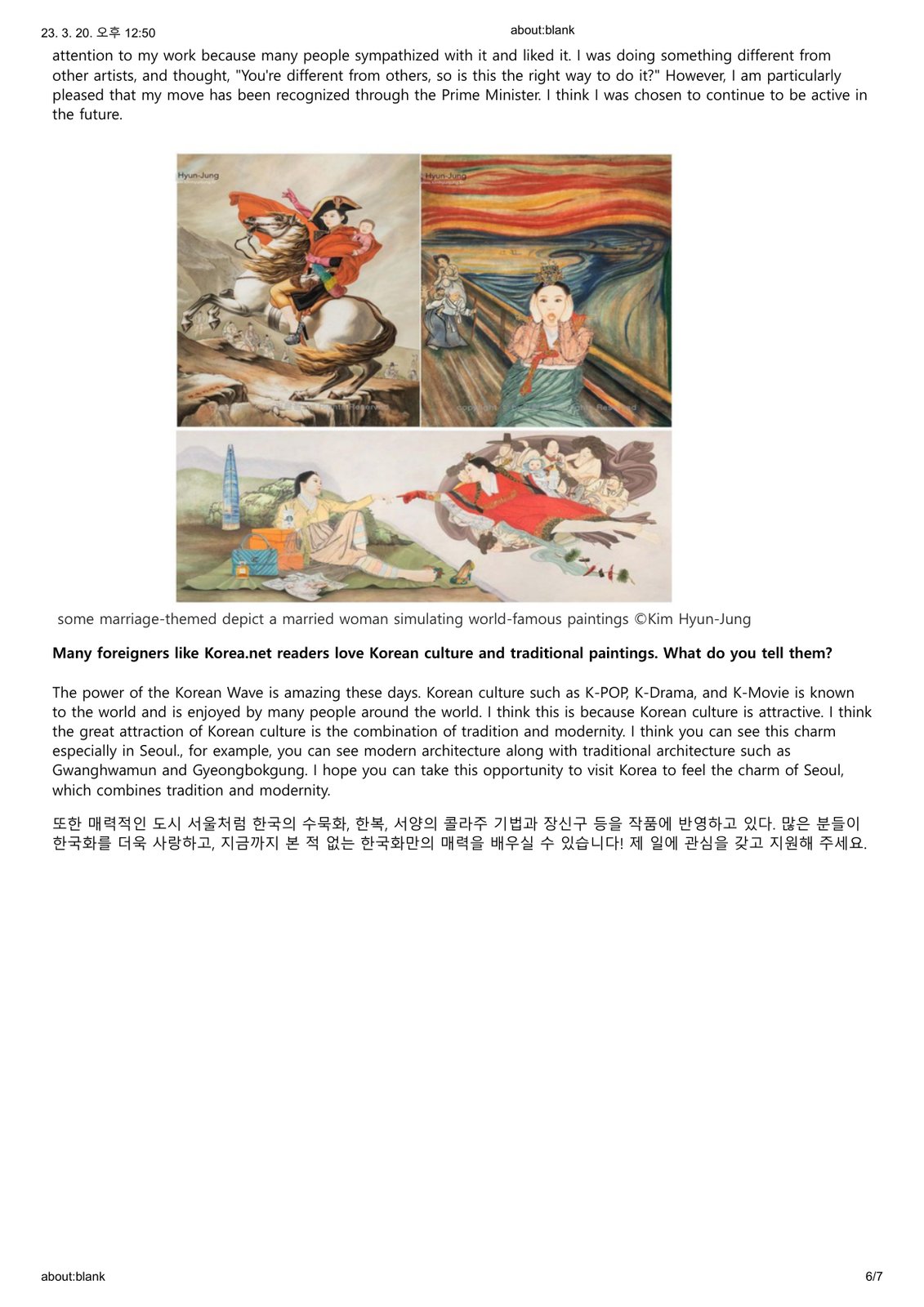
Some marriage-themed depict a married woman simulating world-famous paintings (c)Kim Hyun-Jung
Many foreigners like Korea.net readers love Korean culture and traditional paintings. What do you tell them?
The power of the Korean Wave is amazing these days. Korean culture such as K-POP, K-Drama, and K-Movie is known to the world and is enjoyed by many people around the world. I think this is because Korean culture is attractive. I think the great attraction of Korean culture is the combination of tradition and modernity. I think you can see this charm especially in Seoul., for example, you can see modern architecture along with traditional architecture such as Gwanghwamun and Gyeongbokgung. I hope you can take this opportunity to visit Korea to feel the charm of Seoul, which combines tradition and modernity.
And just like the charming city of Seoul, I reflect Korean ink-wash painting, hanbok, and Western collage techniques and accessories in my work. I hope many people will come to love Korean painting even more, and discover a charm in it they have never seen before! Please continue to take interest in and support my work.
(c) All photos: Korean painter Kim Hyun Jung
Written by: Alaa Atef Ebada