







Monthly Joongang | A Willful Young Lady Unmasks Our Society
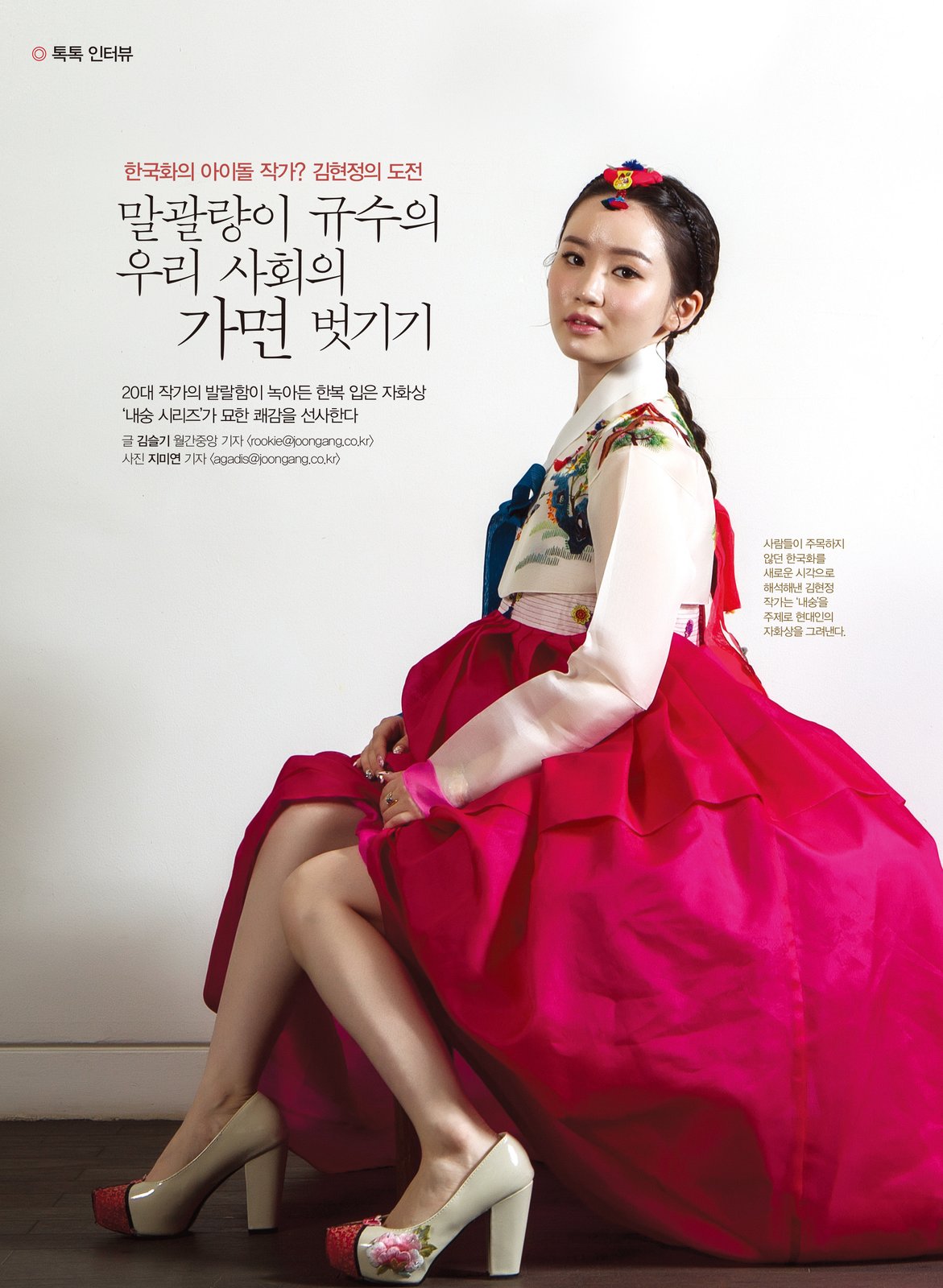
In an interview with Monthly Joongang, artist Kim Hyun Jung explained that the self-portraits in her 'Naesoong' series — a hanbok-wearing figure eating jajangmyeon or playing billiards, among other behavior unbecoming of a proper young lady — depict the two-faced nature of modern people who live conscious of others' gaze. She revealed that she once suffered from depression and began painting partly to cope with it, and said that in order to popularize art, she actively uses social media, with the goal of leaving behind as prolific a body of work as Picasso. [Photo by reporter Ji Mi-yeon]
View full text
[Talk Talk Interview] The Idol Artist of Korean Painting? Kim Hyun Jung's Challenge
A Willful Young Lady Unmasks Our Society
The self-portrait 'Naesoong series,' infused with the playfulness of an artist in her twenties, wearing hanbok, offers a peculiar thrill
Written by Kim Seul-gi, Monthly Joongang reporter (rookie@joongang.co.kr) | Photography by reporter Ji Mi-yeon (agadis@joongang.co.kr)
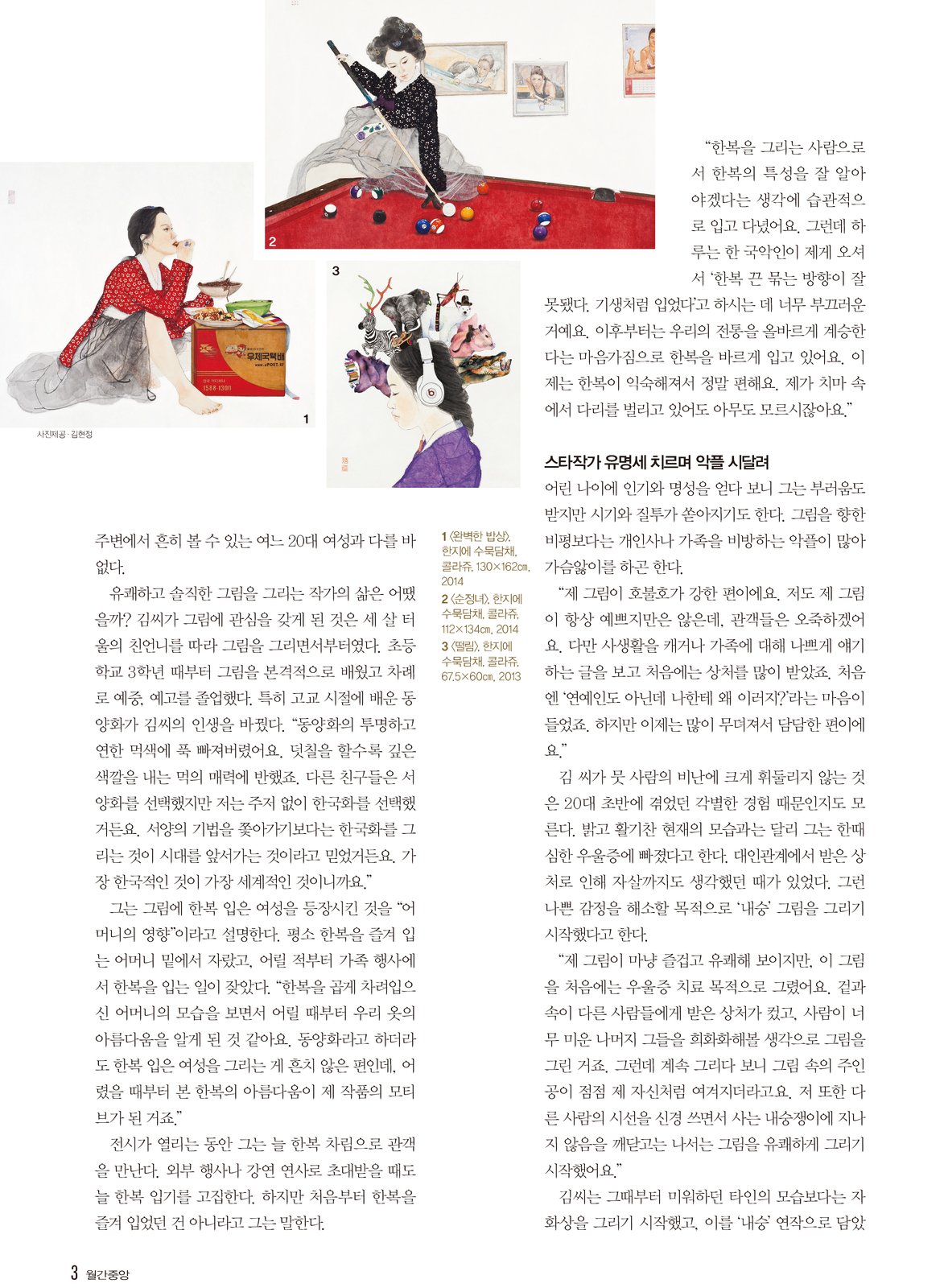
A woman in elegant hanbok sits with one leg bent, eating jajangmyeon (black bean noodles). Whether she's forgotten she's wearing hanbok or not, her behavior seems far removed from that of a demure young lady. A bowl of sweet-and-sour pork sits atop a delivery box, and while holding the noodle bowl in one hand, she chews on a fried dumpling. Judging by her expression, gazing off into the distance as she eats, this doesn't seem to be the first time she's eaten this way.
This is a scene from 'The Perfect Meal,' displayed at the 'Naesoong Olympics' exhibition held at Insa Art Center in Seoul this past June — a painting by artist Kim Hyun Jung (26), known as 'the idol of Korean painting.' Kim bears a striking resemblance to the woman in the painting; the pretty face, the way she wears hanbok — identical. That's because the painting uses the artist herself as the model.
Kim is an artist the art world has recently taken notice of. Critics have consistently praised her self-portraits. Every one of her works features the artist herself, distinguished by the hanbok she wears. And yet the freewheeling behavior of the woman in the painting — behavior one couldn't get away with while wearing hanbok — brings a smile to viewers' faces. In one piece, she does indoor rock climbing in a skirt; in another, she does sit-ups with a designer bag tucked under her arm. A painting showing her striking a sultry pose with a billiard cue in a pool hall — a setting utterly mismatched with hanbok — offers viewers a delightfully unexpected twist.
Under the theme of 'naesoong' (coy pretense), Kim paints behaviors and scenes rarely found in daily life. "The naesoong I have in mind isn't limited to women. Being conscious of others' eyes and putting on airs is something people of all ages and genders do. My paintings express, through imagery, the honest emotions and behavior hidden behind that naesoong."
Her work has also captured the public eye. She first drew attention when every piece in her 'Naesoong Story' exhibition at the Seoul Arts Center last year sold out — a feat even established artists rarely manage during an exhibition's run, let alone an emerging one.
This latest exhibition, 'Naesoong Olympics,' is her fourth solo show. An extension of 'Naesoong Story,' it takes everyday sports and recreation as its theme, wittily depicting scenes that unfold in venues like pool halls and gyms.
"Everyone Puts On Airs and Pretends to Be Refined"
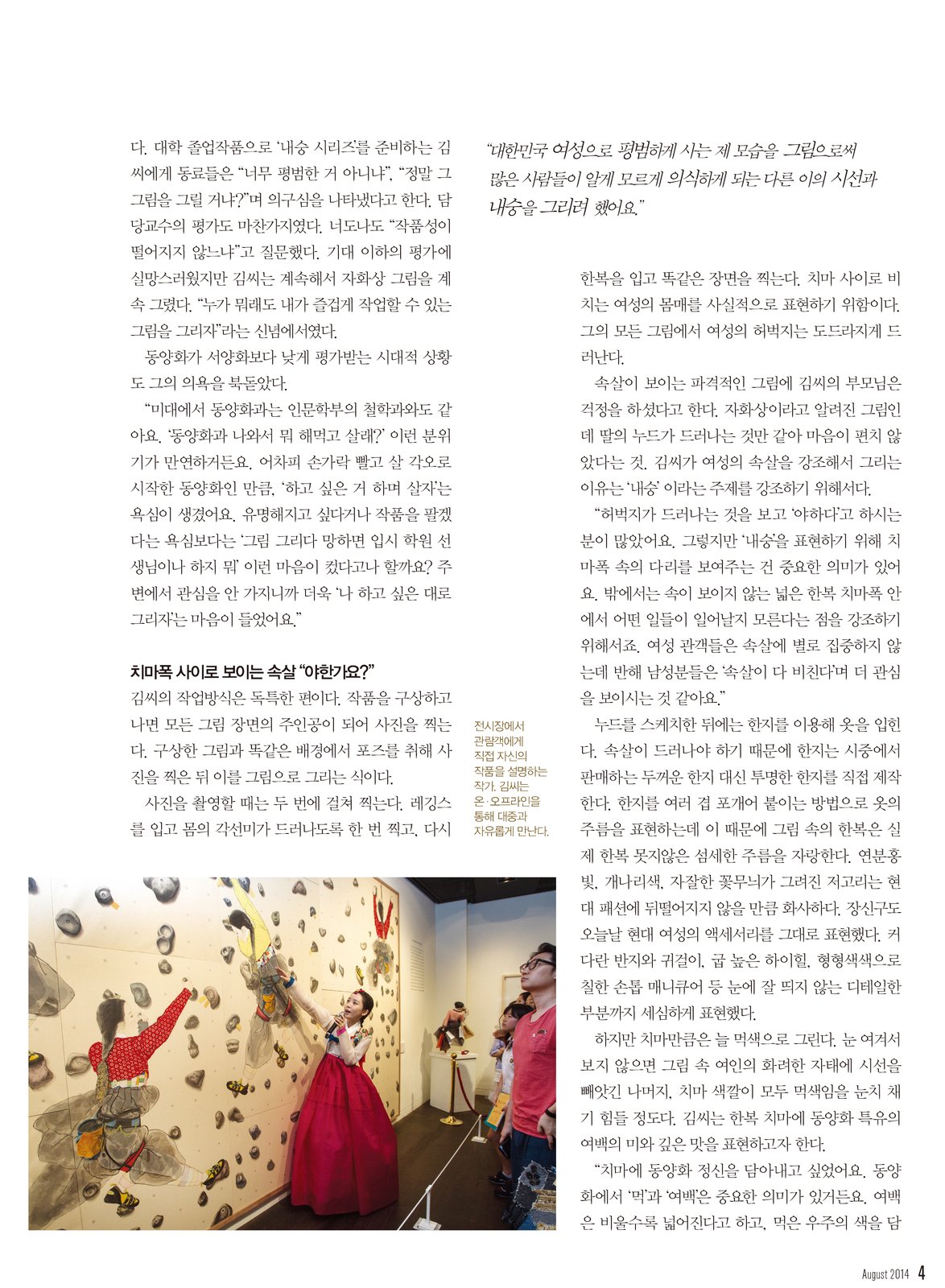
Throughout the exhibition, many visitors came specifically to see Kim, the subject of her own paintings. She hosted a 'Conversation with the Artist' program, personally introducing the works on display, and welcomed visitors every day. Attendees ranged from high schoolers to young adults to middle-aged and older visitors, a testament to Kim's broad popularity. Celebrities also flocked to the show — actor Kim Su-ro visited and purchased one of her works on the spot.
When the 'Naesoong series' first appeared in the world, the reception was quite different from today. Rumors circulated that it was "a painting depicting a Korean-style 'doenjang-nyeo' (materialistic consumer)" or that it was "made to demean Korean women." Kim explains that, contrary to these misconceptions, the paintings honestly portray her own shortcomings.
"By painting myself, an ordinary Korean woman, I tried to capture the naesoong and the awareness of others' gaze that many people carry, whether they realize it or not. Some say that because a designer bag appears in my painting, I must be portraying a materialistic woman — but it's actually my own bag, and I genuinely like designer bags, so I painted it. Is that so bad?"
Honesty about desire runs through Kim's paintings. The work 'Emptiness (空)' realistically captures the expression of a woman deliberating over which of several pairs of shoes to wear. Her sulky expression, as if no choice would satisfy her, resonates strongly with female viewers. Another work, 'Narcissus,' depicts a woman crouched, carefully applying eyebrow makeup. Holding a palm-sized mirror, utterly absorbed in her makeup — it's no different from any ordinary young woman you might see around you.
What kind of life has this artist, who paints such cheerful, candid work, led? Kim first developed an interest in painting by following the example of her older sister, three years her senior. She began learning to paint in earnest from third grade and went on to graduate from an arts middle school and arts high school in sequence. It was Korean painting, which she studied in high school, that changed the course of her life in particular. "I fell completely for the transparent, light ink tones of Korean painting. I was captivated by the charm of ink, which deepens in color the more layers you apply. Other friends chose Western painting, but I chose Korean painting without hesitation — I believed that painting Korean-style, rather than chasing Western technique, was actually ahead of its time. What's most Korean is what's most universal."
She explains that featuring women in hanbok in her paintings came from "my mother's influence." She grew up with a mother who enjoyed wearing hanbok regularly, and wore it herself often at family events from a young age. "Watching her dressed elegantly in hanbok, I think I came to appreciate the beauty of our traditional clothing from an early age. Even within Korean painting, depicting women in hanbok isn't especially common — the beauty of hanbok I saw growing up became the motif for my work."
During exhibitions, she always meets visitors dressed in hanbok. She also insists on wearing it whenever invited to outside events or as a guest lecturer. But she says she didn't enjoy wearing it from the very start.
"As someone who paints hanbok, I felt I needed to understand its characteristics well, so I made a habit of wearing it. But one day, a traditional Korean music performer came up to me and said, 'You've tied the ties the wrong way,' and 'You're wearing it like a gisaeng' — I was mortified. From then on, I've worn hanbok properly, with the mindset of correctly carrying on our tradition. Now it's become second nature and genuinely comfortable to wear. No one can tell if I've got my legs spread apart underneath the skirt, after all."
Paying the Price of Stardom: Enduring Malicious Comments
Having gained popularity and fame at a young age, Kim receives envy along with her fair share of jealousy and spite. More than criticism of her art, it's the malicious comments targeting her personal life or family that weigh on her.
"My paintings tend to provoke strong love-it-or-hate-it reactions. Even I don't find my own work beautiful all the time, so I understand why some viewers wouldn't either. But comments that dig into my personal life or speak badly of my family hurt a great deal at first. My initial reaction was, 'I'm not a celebrity — why is this happening to me?' But I've grown numb to it now, and take it more in stride."
Perhaps the reason Kim isn't easily shaken by criticism from others traces back to a particular experience in her early twenties. Contrary to her current bright, energetic image, she once fell into severe depression. There was a time, hurt by relationships with others, when she even considered suicide. She says she began painting 'naesoong' partly as a way to work through those dark emotions.
"My paintings might look purely fun and lighthearted, but I originally started them as a kind of self-treatment for my depression. I'd been deeply hurt by people who were two-faced, and out of resentment toward them, I began painting caricatures of them as a way to cope. But as I kept painting, the protagonist in the work gradually started to feel like myself. I realized I, too, was nothing more than someone putting on airs, conscious of others' gaze — and from then on, I began painting myself with a lighter, more cheerful touch."
From that point, Kim shifted from painting the people she resented to painting self-portraits, and gathered them into her 'Naesoong' series. While preparing the Naesoong series as her graduation project, her peers reportedly expressed doubt, asking, "Isn't this too ordinary?" and "Are you really going to paint that?" Her supervising professor's assessment was similar; everyone around her questioned whether the work lacked artistic merit. Disappointed by the underwhelming reception, Kim nonetheless kept painting self-portraits, driven by the conviction that "no matter what anyone says, I'll paint what I genuinely enjoy working on."
The era's tendency to value Korean painting less than Western painting also fueled her determination.
"Within art colleges, the Oriental Painting department is a bit like the Philosophy department within the humanities — there's a pervasive attitude of 'what are you going to do for a living with a degree in Korean painting?' Having started Korean painting fully resigned to potentially starving for it anyway, I developed a kind of ambition: 'let's just do what we want to do.' Rather than wanting to become famous or sell my work, my mindset was more, 'If painting doesn't work out, I'll just teach at a cram school.' The fact that no one around me showed much interest actually made me want to paint exactly the way I wanted, even more."
The Skin Showing Through the Folds of the Skirt — "Is It Suggestive?"
Kim's working method is distinctive. Once she conceives of a piece, she photographs herself as the protagonist of every scene in the painting. She strikes the pose in the exact setting she's envisioned, takes the photo, and then paints from that reference.
She photographs herself twice for this purpose. Once wearing leggings, so the curves of her body are visible, and again wearing hanbok in the identical pose. This is to realistically render the woman's body faintly visible through the fabric of the skirt. In all of her paintings, the woman's thighs are prominently visible.
Kim's parents reportedly worried about the boldness of these paintings, in which the skin shows through. Since the paintings are known to be self-portraits, it unsettled them to feel as though their daughter's nude form was being exposed. Kim emphasizes the visible skin specifically to underscore the theme of 'naesoong.'
"Many people call it 'suggestive' when they see the thighs showing through. But showing the legs beneath the folds of the skirt carries real meaning for expressing naesoong — it's meant to emphasize the idea that, beneath the wide hanbok skirt that hides everything from view, you never know what might be happening. I've noticed that while female viewers tend not to focus much on the exposed skin, male viewers seem to show more interest, often remarking, 'You can see right through it.'"
After sketching the nude figure, she dresses it using hanji. Since the skin needs to show through, rather than using the thick hanji sold commercially, she makes her own transparent hanji. She expresses the folds of the clothing by layering multiple sheets of hanji, which is why the hanbok in her paintings boasts delicate folds every bit as fine as real hanji. The jeogori (short jacket), painted in pale pink, forsythia yellow, and delicate floral patterns, is as vivid as anything in contemporary fashion. The accessories, too, faithfully reflect what modern women actually wear — large rings and earrings, high heels, colorfully painted nail polish — every fine detail rendered with careful attention, down to the parts easy to overlook.
But the skirt itself is always painted in ink black. Unless you look closely, the woman's flamboyant appearance so dominates the eye that it's easy to miss that every single skirt is rendered entirely in black ink. Kim intends the hanbok skirt to embody the distinctive beauty of empty space and depth found in Korean painting.
"I wanted to capture the spirit of Korean painting within the skirt. In Korean painting, 'ink' and 'empty space (yeobaek)' carry important meaning. It's said that empty space grows more expansive the more it's left empty, and that ink holds the color of the universe within its depth. To express the idea that the space beneath the skirt is a vast, cosmic realm embodying the beauty of emptiness, I paint the skirt using only black ink."
[Plates: 1. 'The Perfect Meal,' ink-wash coloring and collage on Korean paper, 130×162cm, 2014 / 2. 'Naive Lady,' ink-wash coloring and collage on Korean paper, 112×134cm, 2014 / 3. 'Trembling,' ink-wash coloring and collage on Korean paper, 67.5×60cm, 2013. Photos courtesy of Kim Hyun Jung]
The artist's dream is clear: to make art something the public can enjoy easily, and to have people embrace art in their everyday lives. To pursue that dream, she studied business administration in college. It was the question, "Why are people in the art world so often poor?" that led her to study business.
"I wanted to understand what it would take to get others to love the art I love. In our society, art is still perceived as difficult and burdensome. It saddened me that art functions less as something to be enjoyed and more as a yardstick for judgment — whether someone is 'good' or 'bad' at drawing, or whether they possess erudite knowledge of art. Studying business helped me develop an eye for reading the world, and I came to the conclusion that artists need to actively communicate with the public."
Kim also regularly communicates with the public and shares her artistic world through social media. Her blog (http://artistjunga.blog.me) is filled with images of her work and photos taken with fans, and her stated policy for the blog is, "Don't worry about copyright, share it as freely as you like." No small part of the credit for the rapid rise of her popularity goes to bloggers who 'freely' shared her paintings.
"I didn't start out being especially diligent about social media. But as I communicated with people, a sense of closeness developed. There's no greater driving force for creating new work than people responding to and enjoying my paintings. If someone encounters my work through social media and then goes out to see an exhibition in person and comes to enjoy art, they might even end up purchasing a piece. If that cycle keeps happening, artists will no longer have to go hungry, and people will no longer feel that art is difficult."
Picasso Is My Lover!! The Day Is Too Short
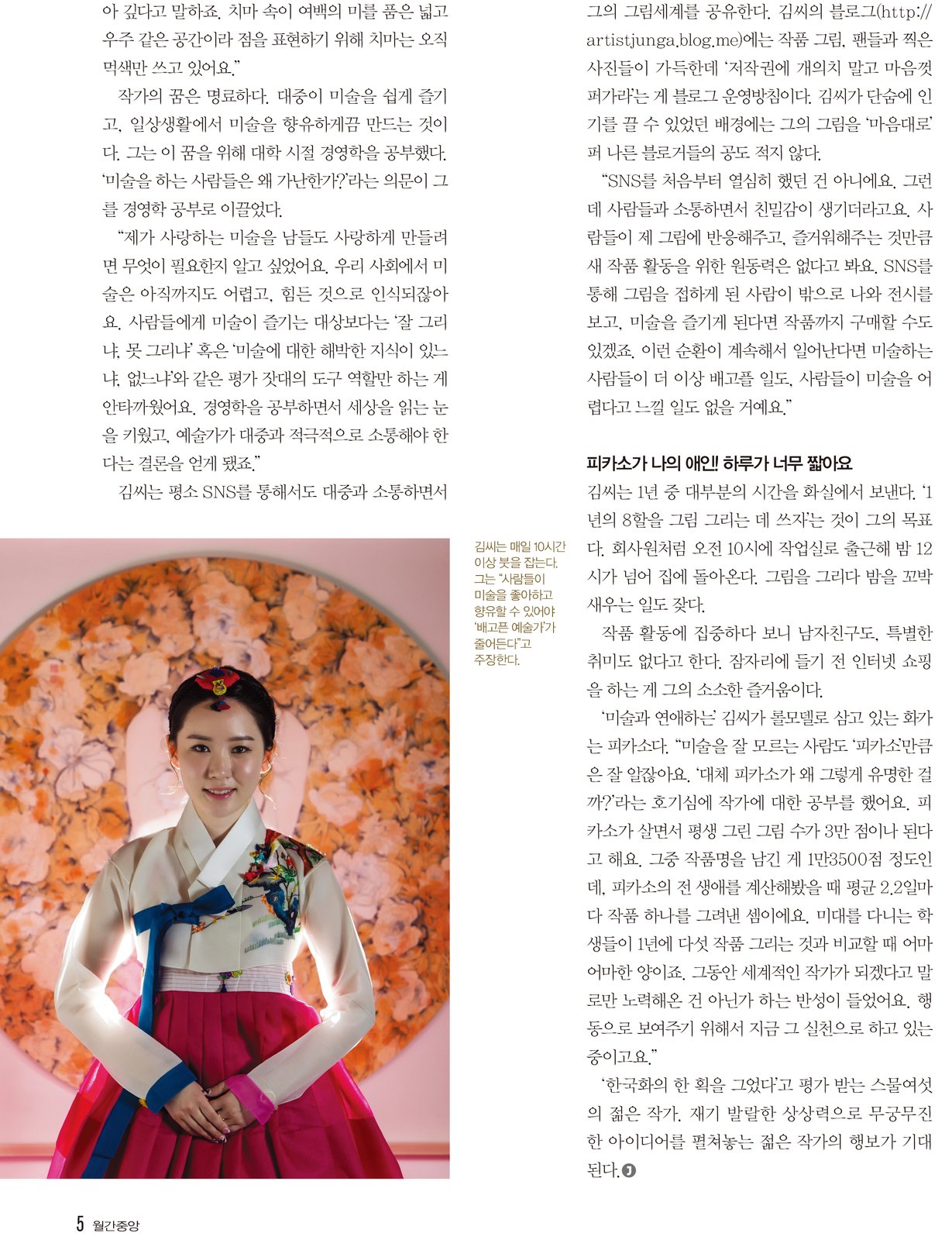
Kim spends most of her time throughout the year in her studio. Her goal is to "spend 80% of the year painting." Like an office worker, she commutes to her studio at 10 a.m. and returns home after midnight. She often pulls all-nighters while painting.
So focused on her work, she says she has neither a boyfriend nor any particular hobbies. Shopping online before bed is her one small pleasure.
Kim, who is essentially "in love with art," names Picasso as her role model. "Even people who don't know much about art at least know Picasso. Curious about why he's so famous, I studied his life. Picasso is said to have created as many as 30,000 works over his lifetime. Of those, about 13,500 have recorded titles — calculating across his entire life, that comes out to roughly one work every 2.2 days. Compared to art students who might produce five works a year, that's an astonishing volume. It made me reflect on whether I'd only been talking about wanting to become a world-class artist without actually putting in the work. I'm putting that reflection into practice now."
A young artist in her twenties, already credited with having "carved a new chapter in Korean painting." We look forward to seeing where this artist, brimming with inexhaustible ideas and playful imagination, goes next.