







Aimu.com | Kim Hyun Jung’s Portrait of Korea: Naesoong — A Perfect Rest After a Solo Meal
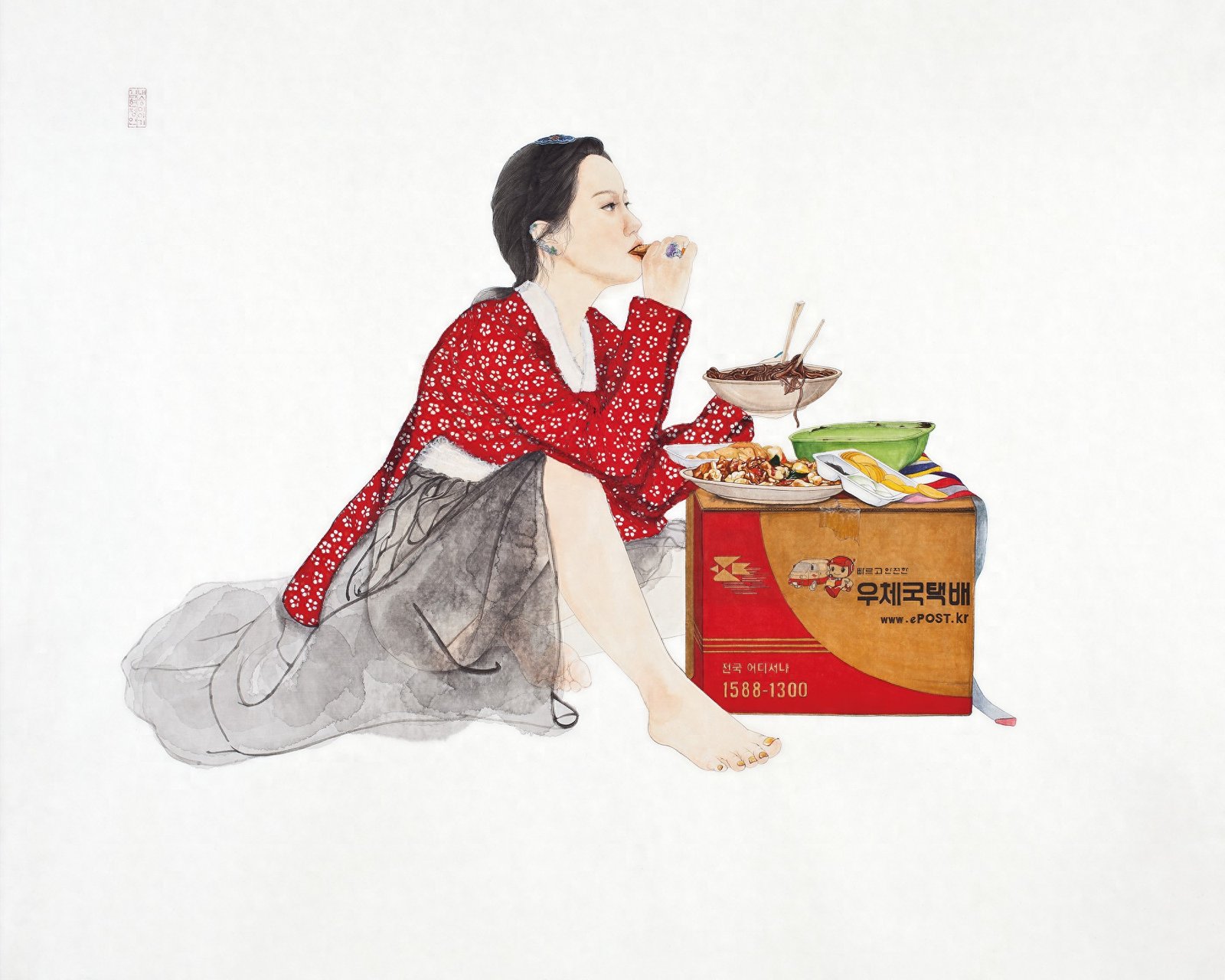
This essay by Korean painter Kim Hyun Jung introduces her work 'Naesoong: The Perfect Table,' using the image of a woman eating jjajangmyeon and sweet-and-sour pork alone at a makeshift table made from a delivery box to explore the fatigue of contemporary life hidden behind the discourse of eating alone and self-care. The artist writes that a brief moment that exists entirely for oneself, free from others' gaze, is the true 'perfect table,' and also introduces her own background — having completed her doctoral coursework in Oriental Painting at Seoul National University — along with her ongoing 'Naesoong' series.
View full text
Korean society today endlessly preaches a philosophy of life: “Even alone, eat well and live well.” Companies talk about individual work-life balance, and the media packages eating alone and drinking alone as a new-generation lifestyle. But behind this seemingly light, fashionable rhetoric lies a body and mind already worn thin with exhaustion. Eating alone is less a form of freedom than a reality people have been forced to grow accustomed to. It is also a shadow cast by today's labor structure — one that denies people even the room to share an unhurried meal with others. Society constantly urges people to “learn to take care of themselves,” yet the time, money, and energy that would actually make such self-care possible are quietly pushed back onto the individual. What the exhausted reach for is not an expensive resort or a distant escape, but simply the familiar screen of a delivery app. This society that keeps shouting “love yourself” has, in fact, reduced even the most basic rest to a question of whether an individual is skilled enough at managing themselves. This contradiction has always left me uneasy.
As a Korean painter, I wanted to translate this unease into an image of a solitary meal. Not a banquet scene on a traditional folding screen, nor a grand table symbolizing family reunion, but a woman who has turned a parcel delivery box into her table, facing jjajangmyeon and sweet-and-sour pork alone. She wears a neat, elegant hanbok jacket, yet her posture is anything but proper. She leans back on the floor at an angle, one leg stretched out carelessly, her gaze drifting absentmindedly over the short-form videos auto-playing on her phone. This is far from the “image of healing” we are used to seeing in advertisements. But I believe that the true face of rest can only emerge in moments like this — a little disheveled, a little slack, even slightly disordered. This is not a table meant to be shown to others, but a private stage reserved solely for oneself. The work ‘Naesoong: The Perfect Table’ pushes that ‘self,’ seated at the center of this stage, to the very front of the picture.
The true core of this painting is the delivery box. This disposable cardboard box exposes, almost without concealment, the temporary and improvised nature of our lives. Just like the corrugated cardboard piled up at the door today and hauled away tomorrow, our rest, too, is always built on some kind of stopgap. Coming home after working overtime, anxious about tomorrow morning, hastily swallowing a late-night meal — this is not a table carefully set for family, but the most immediate choice made simply to prop up an exhausted body. The dark, thick sauce of the jjajangmyeon and the glistening sheen of the sweet-and-sour pork are far from the repeatedly extolled virtues of “health” and “moderation.” And yet, even so, this meal remains a small but genuine ritual — one that lets a person confirm they are still alive, still maintaining some minimal sense of presence within this day-after-day exhaustion. The short-form videos auto-playing on the phone screen flicker on, faintly but persistently, like an inner signal wanting to pause all thought. Here, “perfection” does not mean a balance of taste and nutrition, nor refinement and decorum, but finally having a brief moment of mental blankness — no need to judge, no need to respond, no need to keep putting on a brave face.
The “perfect table” as society imagines it still remains, to this day, a dinner scene where a family sits together around a shared meal. And at the center of that table, there is almost always a mother — endlessly adding dishes, reheating side dishes gone cold, portioning out food one by one for family members with different tastes. Such labor is always given the name of “love,” dressed up as the virtue of “devotion.” Yet this toil is almost never truly rewarded. No one clears time for her to rest; no one shares the weight of her domestic labor. I detest this tacit acceptance for which no one takes responsibility. So in ‘Naesoong: The Perfect Table,’ this woman is no longer named as anyone's mother, anyone's wife. She is simply an ‘I’ who has made it through today, facing alone a table that belongs entirely to her own taste. Here, “perfection” no longer depends on whether others' expectations have been met, but on whether that stretch of time finally existed for herself alone. However brief, however small, as long as that moment truly belonged to her, it is already precious enough.
And the word “Naesoong” in the title quietly overturns this scene once more. In the outside world, she always manages herself with a restrained tone and a proper bearing. At group meals, she smiles and says “I'm full,” then gently sets down her chopsticks; in the office, she always maintains an expression that is busy yet composed, exhausted yet presentable. But once the door closes and she is finally alone, the appetites and preferences long held in check finally get the chance to reveal their true face. She pours the sweet-and-sour sauce over the pork without hesitation, scraping the last bit of black bean sauce from the bottom of the bowl with meticulous care. This is clearly at odds with the “gentle refinement” society expects of her. But I don't want to treat this deviation as some unspeakable lapse. On the contrary, I have always believed that human desire is at its most honest and most moving precisely in gaps like this. In ‘Naesoong: The Perfect Table,’ what is stripped away is the mask of composed self-restraint, and what is revealed is a real, hungry self. “Perfection” here is no longer a flawless, impeccable image, but the moment a person, briefly freed from others' gaze, can finally say quietly to herself: “I made it through today, too.” Reclaiming this small but genuine right is exactly the question this table poses, and exactly where this work truly hopes to arrive.
Korean painter Kim Hyun Jung (Source: Kim Hyun Jung Art Center)
Korean painter Kim Hyun Jung graduated from Sun Hwa Arts Middle and High School and studied Oriental Painting at Seoul National University, completing her doctoral coursework at the same university's graduate school. She is widely known for her Naesoong series, which depicts the everyday customs of 21st-century Korea, skillfully capturing the texture and emotional layers of contemporary Korean life with a brush that blends humor and satire, and continuing to respond to social realities and the mood of the times through the lens of ‘Portraits of Korea.’ She has appeared as the “Bun Noona (Topknot Sister)” on the EBS program “Haeyo Hwahaeyo,” and serves as a publicity ambassador for the City of Seoul and for Bridge of Hope. In recent years, she has also engaged with roughly 300,000 followers across social media, and continues to expand the boundaries and reach of Korean painting in a contemporary context through an ongoing series of exhibitions at home and abroad.