










Monthly Chungchoon | The Heart Cannot Grow Without Breaking the Mold
An interview with Kim Hyun Jung published in Monthly Chungchoon (Youth Monthly), touching on the meaning behind her 'Naesoong' series, her working process, and the record-breaking attendance at her 2014 solo exhibition 'Naesoong Olympics' at Gana Insa Art Center. The piece closes with a Q&A-style list of 15 personal keywords covering her daily life, working habits, and outlook, alongside her professional profile and awards.
View full text
People
The Heart Cannot Grow
Without Breaking the Mold
"Korean painting is a beautiful tradition. Where Western oil painting grows heavier and more finished the more layers you apply, ink-wash painting is a wonderful material that grows more delicate and transparent the more you build it up. I hope more people come to know the beauty of this exquisite medium."
Even babies barely a year old have their small moments of shouting.
Seeing something silly their mom or dad does, they probably let out an unconscious, sharp little shout, like the fizz of a soda.
Thinking of a child's behavior — utterly unguarded, utterly without calculation — a smile naturally spreads across your face.
Drawn to Korean painting by the fragrance and transparency of ink, she has, in her own laughter, that same fizzy, sharp transparency. Much like her paintings, which express a sense of transparency as the diluted ink soaks deeper and deeper into the paper the more it's applied, that same lingering, shouting laughter seemed to overlap strangely with her work.
Editor & Photography: Lee Yoon-gi
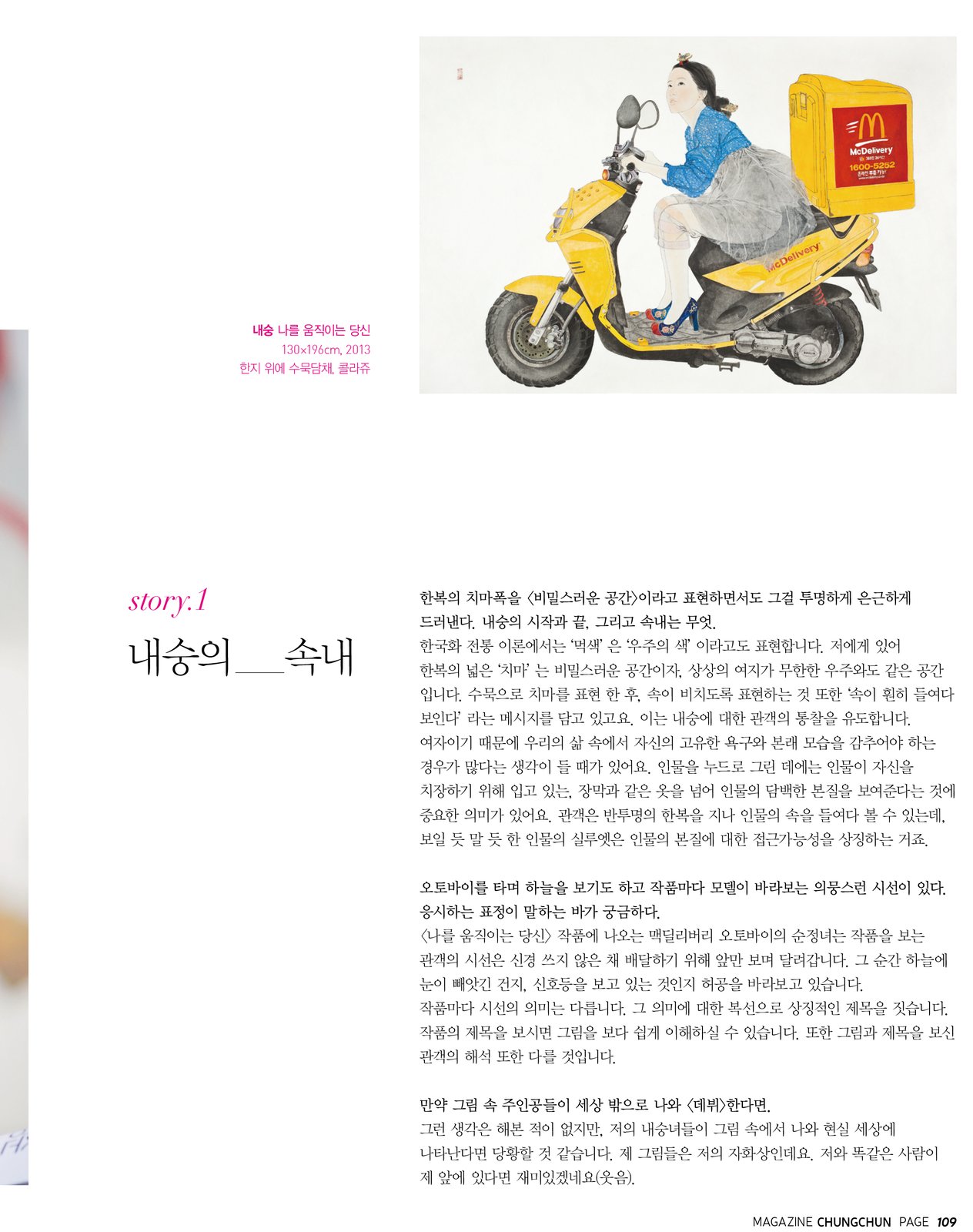
'Naesoong: You Move Me,' 130×196cm, 2013, ink-wash coloring and collage on Korean paper
story.1
The Inner Truth of Naesoong
You describe the wide skirt of a hanbok as a 'secret space,' yet render it in a way that subtly, translucently reveals what's beneath. What is the beginning, the end, and the inner truth of naesoong?
In traditional Korean-painting theory, 'ink black' is also described as 'the color of the universe.' To me, the wide 'skirt' of a hanbok is both a secret space and a space like the universe itself, with boundless room for imagination. Rendering the skirt in ink wash and then making it appear see-through also carries the message that 'you can see right through it.' This is meant to guide the viewer toward insight about naesoong. There are moments when I feel that, because we're women, we often have to conceal our own desires and true selves in daily life. Painting the figure nude carries important meaning — it lets me show the figure's plain, unadorned essence beyond the curtain-like clothing worn to dress oneself up. The viewer can look through the semi-transparent hanbok into the figure's inner self; the barely-visible silhouette of the figure symbolizes the possibility of approaching that essence.
In some works she rides a motorcycle gazing up at the sky; in each piece, the model's gaze carries a certain knowing quality. I'm curious what that expression is saying.
In 'You Move Me,' the naive lady on the McDelivery motorcycle races straight ahead to make her delivery, unconcerned with the viewer's gaze. In that moment, whether her eyes have been drawn to the sky, or she's watching for a traffic light, she gazes into empty space.
The meaning of that gaze differs from work to work. I give each piece a symbolic title as a kind of clue to that meaning. Looking at the titles makes the paintings easier to understand. And of course, different viewers, seeing the same painting and title, will each interpret it differently.
If the protagonists in your paintings stepped out into the world and made their 'debut,' what would happen?
I've never really thought about that, but if my naesoong girls stepped out of the paintings and appeared in the real world, I think I'd be quite flustered. My paintings are self-portraits, after all. It would be funny if someone identical to me were standing right in front of me. (Laughs)
Health
story.2
You Move Me
'Naesoong: You Move Me,' 195×228cm, 2013, ink-wash coloring and collage on Korean paper
'You Move Me,' showing the naive lady perched on the cargo bed of truck no. 9999, stands out with a lyrical atmosphere distinctly Kim Hyun Jung's own. Its mood differs quite a bit from your other work — what image inspired it?
The 'You Move Me' series paints, one by one, the essential things that power my life. When preparing for an exhibition, I often need a small truck to buy materials and transport works — in fact, without one, the work simply wouldn't be possible. So I thought of the truck as an important driving force in my life and made it the subject of a piece. The license plate number, '99-Gu-9999,' also carries meaning: 'the beauty of the unfinished.' As Mencius said, "He who is without greed is the wealthiest of all" — I believe the right wisdom for living is to never fill your own desires all the way, but to stop just short, in that state of slight lack, slight longing. As poets through the ages have written, "the moon wanes once it is full" — I believe that 99% moment is the most beautiful one of all.
'Naesoong Olympics' features simple yet varied movements from different sports. Do you have a favorite sport, or one you're good at?
I'm not particularly skilled at sports, but I do enjoy them. In winter especially, I love active sports that let me feel the cool wind and burn off plenty of energy. With snowboarding, the best feeling wasn't coming down a steep slope, but coming down the final stretch with a gentle incline — it felt almost like reaching a kind of utopia after getting past the hard part. The piece that captures that feeling is 'Utopia.'
'Naesoong: Utopia,' 96×130cm, 2013, ink-wash coloring and collage on Korean paper
story.3
The Perfect Meal
With a serene expression, she gazes at a designer bag while eating ramen served on a pot lid.
You clearly know your way around eating ramen. What's your usual go-to dish?
I do enjoy eating ramen regularly. It seems like the fastest, tastiest food that never gets old. Lately, the most memorable thing I've eaten is 'honggeori' (spicy stir-fried food). (Laughs) I've tried nearly every ramen dish that's ever appeared on the show Happy Together. I don't have picky eating habits either — I enjoy just about everything. I also like cooking for myself. The happiness I feel when my family enjoys a meal I've made is why I cook at home.
'Naesoong: Oops (我差),' 145×117cm, 2012, ink-wash coloring and collage on Korean paper
story.4
Comforted Through You
I'm curious about your working process. Could you walk us through it from the initial inspiration to the drawing itself, beginning to end?
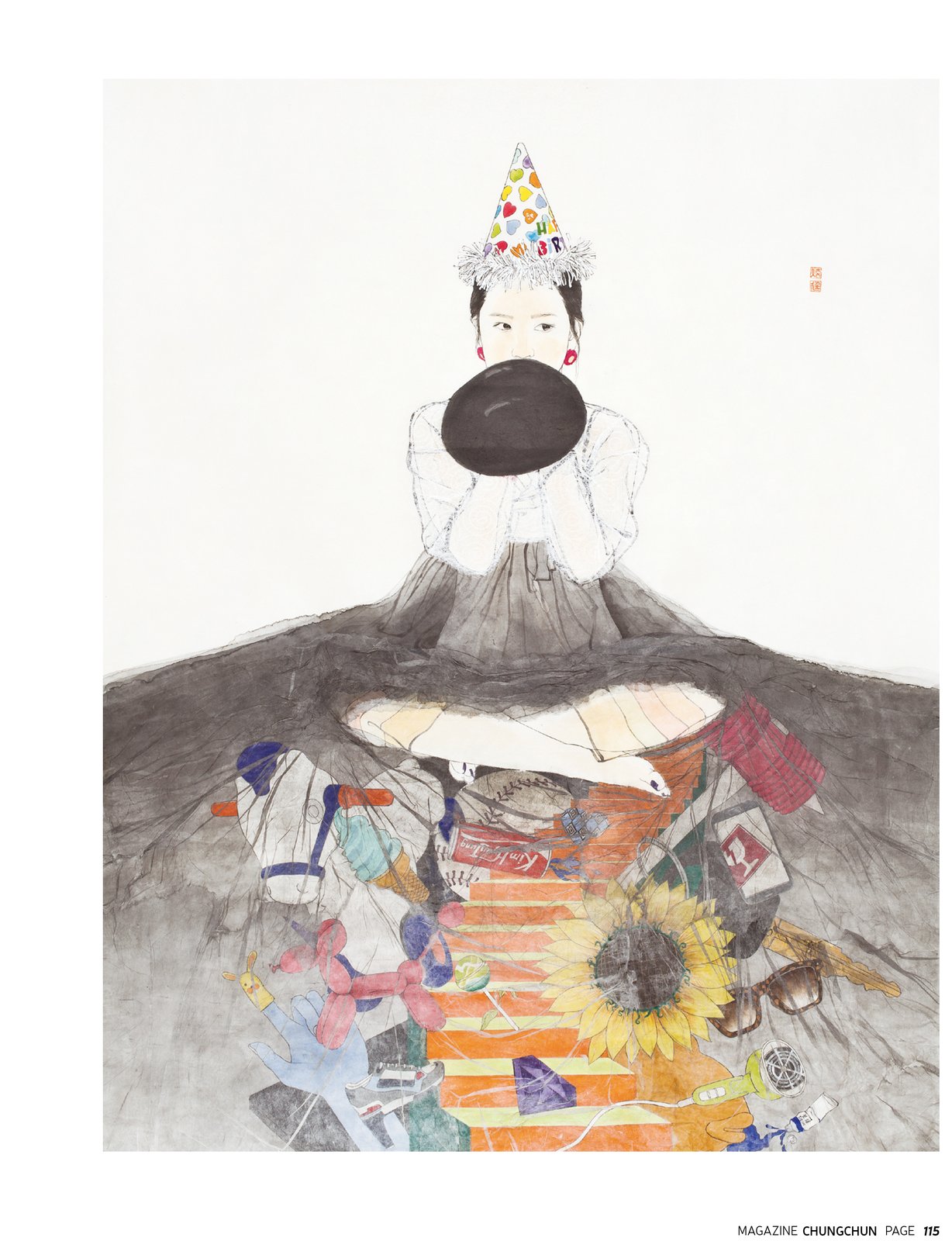
An important defining feature of my technique is the use of traditional methods together with collage. Let me walk you through my process. My work is created through three broad stages: photography and underdrawing, coloring, and collage. First, the photography that forms the basis of the sketch is done in two separate sessions. The first is to capture the outline of the body; the second, taken in the same pose as the first, is shot while wearing hanbok.
This two-step process is essential because, later in the process, I dress the figure's silhouette in hanji almost like playing with paper dolls. Once the photography is complete, I sketch the underdrawing on backing paper based on the photographed images. Once the sketch is finished, I move on to coloring — the figure is rendered in light coloring (damchae), while the objects the figure interacts with are rendered in vivid, saturated coloring (jinchae). Finally, I dress the figure in hanbok using ink and hanji collage. The most distinctive stylistic feature of the 'Naesoong' series appears right at this stage: the figure's body is first painted nude, and then, like dressing a doll, the skirt is added in light ink wash and the jeogori (jacket) is applied through hanji collage, so that the figure's silhouette remains faintly, semi-transparently visible throughout.
For people who find 'comfort through paintings' but find art intimidating, is there an easier way to approach it?
These days, music seems to play on every street you walk down, and I wish more people could share in the beauty and the pleasure of appreciation that art offers in the same way. And it doesn't necessarily have to be Korean painting. That said, as someone who works in Korean painting, I want to take the lead in helping my own genre reach a wider audience. It would be truly rewarding if, through my work and activities, more people came to take an interest in and find enjoyment in Korean painting and Korea's traditional culture. To that end, I plan to keep creating work grounded in 'empathy' — work that scratches where people itch — while also studying hard to support and deepen that work.
Is there anything that has given you the most comfort, been 'comforted through you,' recently?
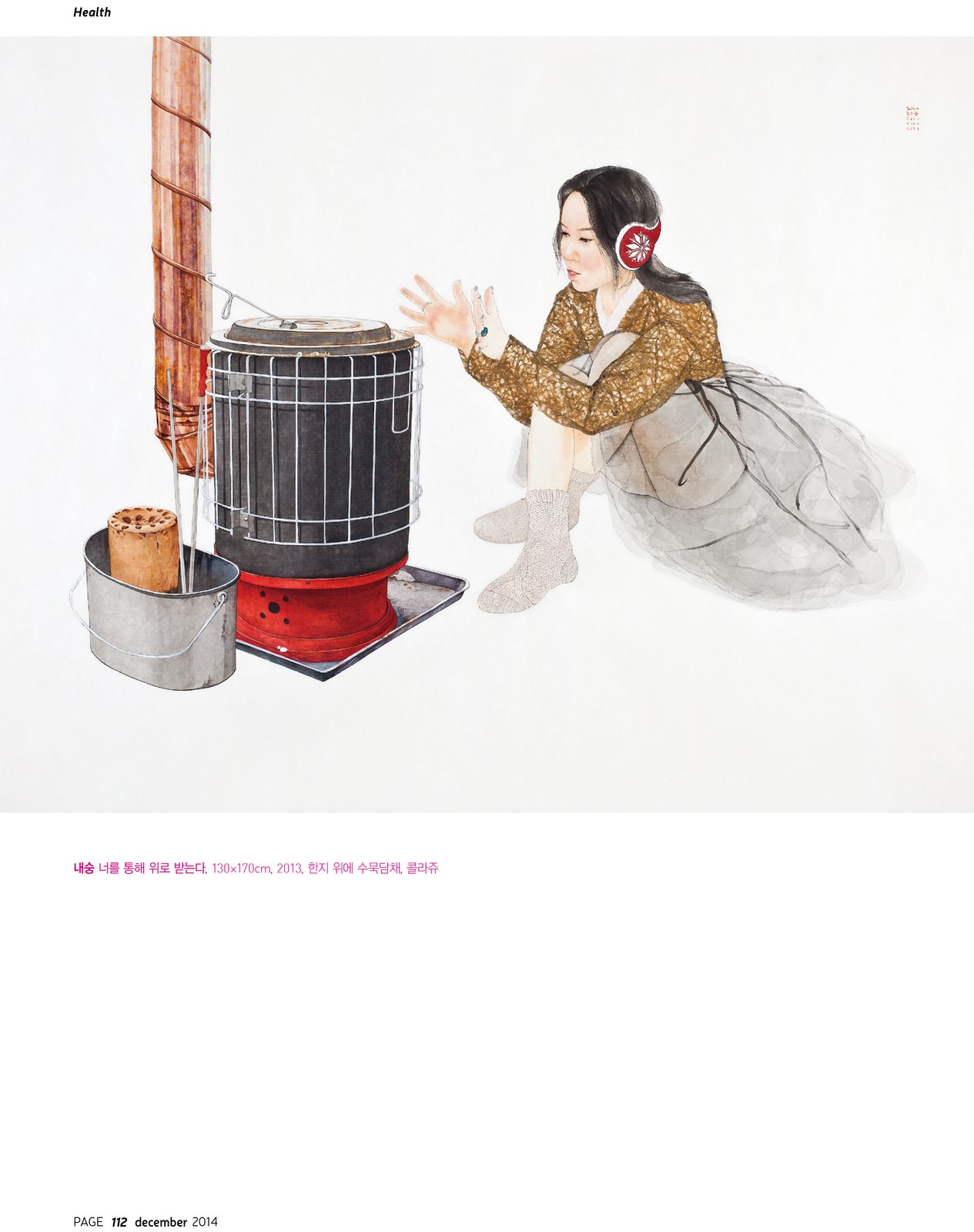
I cast a kind of spell on myself, offering myself praise and comfort. I keep telling myself, internally, that it's okay, that I'm doing well, and that even if I fail, I just need to get back up again. This is how I comfort myself, and how I receive comfort. The thing that has comforted me most recently is myself.
'Naesoong: Comforted Through You,' 130×170cm, 2013, ink-wash coloring and collage on Korean paper
Culture
story.5
HIDDEN STORY
'Naesoong: Hidden Story,' 159×128cm, 2012, ink-wash coloring and collage on Korean paper
What has been the darkest, most difficult moment of your life?
Working in art, I inevitably meet people who say things like, "Please just paint my face for me," or "Could you draw something in this illustration style?" Careless remarks people make about art, or about my work, without really meaning anything by it, do hurt sometimes. There are even moments when it makes me want to stop painting altogether. But I think overcoming that is also something I need to do.
What's the most heart-fluttering 'hidden story' of your life?
Last June, I held a solo exhibition at Gana Insa Art Center. Since I planned and prepared it entirely myself from start to finish, it's a show I'm deeply attached to. An unimaginable number of visitors came. I thought 600 people would be the most I could hope for on a busy day, but the single-day peak attendance reached 3,733 visitors. Over the ten-day run, total attendance reached roughly 24,000, setting a new record for most visitors since Gana Insa Art Center opened. I felt genuine gratitude in that moment, along with emotions I still can't quite put into words. Even now, thinking back on it, there's a dreamlike flutter that stays with me.
You seem to be living through one of the most intense periods of youth. Is there a message you'd like to share with young people living through this same era?
I'm still in the process of learning myself, and I think I'm walking alongside the young people of this country, so I'm not really in a position to preach. But if there's a friend feeling frustrated or powerless, there's something I'd like to remind them of: It's a shameful thing not to give your best effort to what you need to do. But it's even more shameful to be too afraid of the outcome to even try. This moment won't come again. Take the challenge, and give it everything!
2015: Kim Hyun Jung's Hidden Story
My dream is to create art that breathes together with the public, and art made together with fellow artists. Lately, I've also become interested in expressing my 'Naesoong' theme through installation art and video/media work. If 'naesoong' could be made into something you can actually see and touch, wouldn't it become a more intuitive, more immediate reality than encountering it only through a painting? Someday, I might abstract 'naesoong' further into the concepts of gaze or social convention, and as more time passes and the era changes, I'll need to bring forward new themes. It's a question I keep wrestling with. But right now, being able to keep holding exhibitions makes me so happy that I want to keep living this way for a while yet. I plan to keep studying hard while continuing to hold exhibitions steadily. My ultimate goal is, first, to establish myself as an accomplished artist in my own right, and beyond that, to help build a culture and structure in which art becomes woven into everyday life, a place anyone can enjoy. In that sense, I sometimes imagine myself someday becoming a kind of 'ambassador for traditional culture,' someone who can explain to the public the traditional culture that appears in our art.
Restless Thoughts
15 Keywords of Kim Hyun Jung
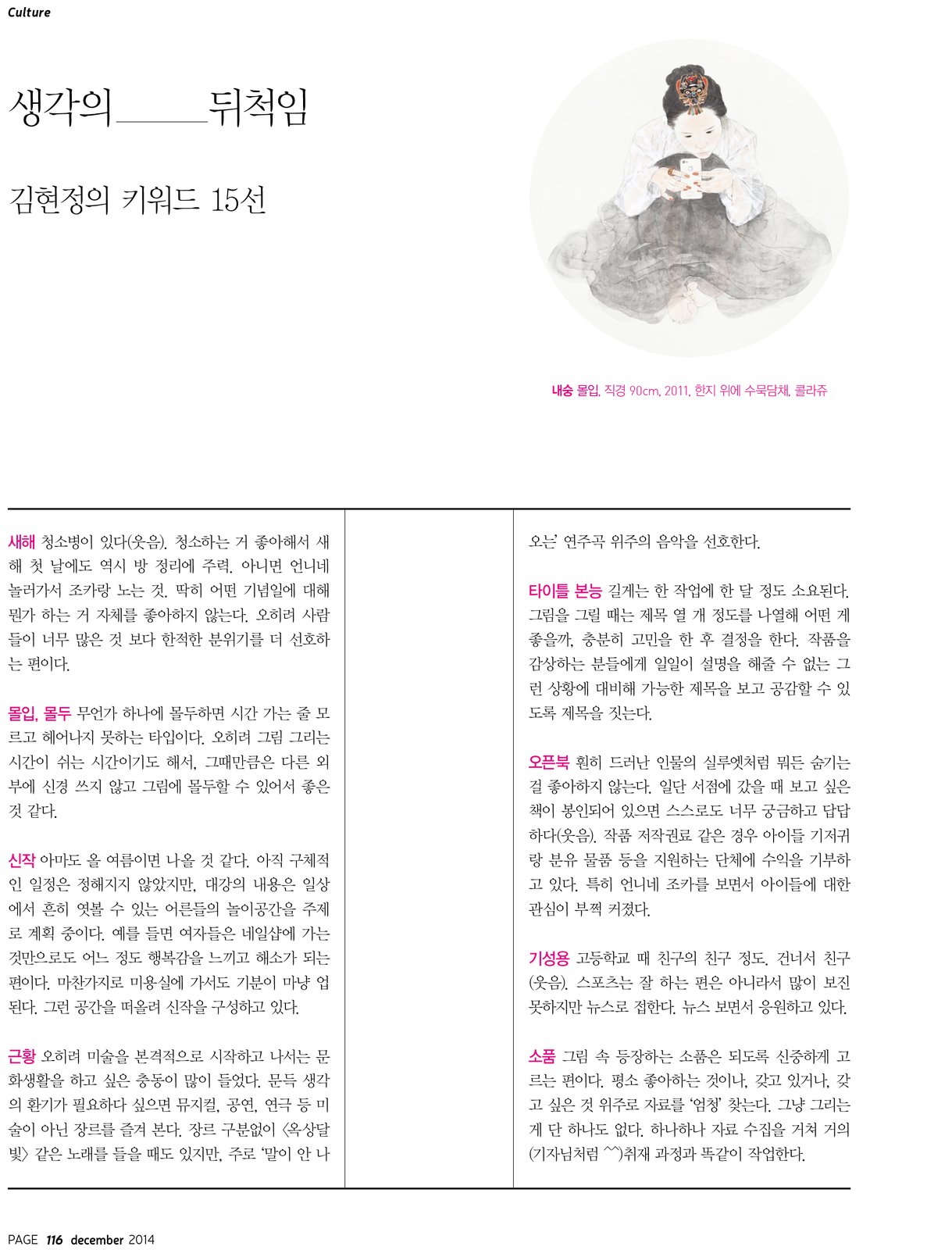
'Naesoong: Immersion,' 90cm diameter, 2011, ink-wash coloring and collage on Korean paper
Kim Hyun Jung
Art can transcend time and space through visual stimulation. In the space of imagination, there are no constraints. Visual stimulation gives me powerful energy. Through paintings like that, I want to give people a sense of being moved, a sense of trembling emotion.
2014 Completed master's coursework in Oriental Painting, Graduate School of Fine Arts, Seoul National University
2014 'Naesoong Olympics,' solo exhibition, Gana Insa Art Center
2014 34th Korean Art Critics Association 'Artist to Watch' Award
Selected for Best Award, JTBC's 'Beautiful People'
Selected for Dong-A Ilbo's '100 People Who Will Shine Korea in 10 Years'
2013 Selected as 'Artist in Her Element' for Perrier's 150th Anniversary Future Artists program
2011 Grand Prize, Korean Painting category, 14th World Peace Art Grand Exhibition
2011 Gold Prize, Korean Painting category, 12th Korea Women's Art Grand Exhibition
2011 Seoul National University Alumni Association President's Award
New Year's I have a bit of a cleaning bug. (Laughs) I like cleaning, so even on New Year's Day I focus on tidying my room, or else I go visit my sister and play with my niece or nephew. I'm not really the type to make a big deal of any particular holiday. I actually prefer a quiet atmosphere over crowds.
Immersion, absorption When I get absorbed in something, I lose all track of time and can't pull myself away. Painting time is actually my resting time too — I like that, for those hours, I don't have to worry about anything else outside and can just immerse myself in the work.
New work Probably coming out sometime this summer. No concrete schedule yet, but roughly speaking, I'm planning something themed around the recreational spaces adults commonly frequent in daily life. For example, women feel a certain sense of happiness and release just from visiting a nail salon. Going to a hair salon lifts the mood the same way. I'm building the new work around spaces like that.
Recent life Ironically, once I began pursuing art seriously, I started craving cultural activities more. Whenever I feel I need a change of pace, I enjoy genres outside visual art — musicals, performances, plays. I listen to all sorts of music, including things like Rooftop Moonlight, but I generally prefer instrumental music, the kind that 'doesn't need words.'
Instinct for titles The longer pieces take up to a month to complete. When titling a painting, I lay out about ten candidate titles, weigh which one feels right, and decide only after careful thought. Since I can't personally explain every painting to every viewer, I choose titles that let people connect with the work just by reading them.
Open book Much like the exposed silhouette of my figures, I'm not someone who likes hiding things. If I go to a bookstore and find a book I want to read shrink-wrapped shut, it drives me crazy with curiosity and frustration. (Laughs) As for royalties from image licensing, I donate the proceeds to organizations that support children with items like diapers and formula. Watching my sister's child in particular has really deepened my interest in children.
Ki Sung-yueng A friend of a friend from high school, so to speak — a friend once removed. (Laughs) I'm not especially good at sports, so I don't watch much live, but I follow the news. I cheer him on through the headlines.
Props I choose the objects that appear in my paintings quite deliberately. I do an enormous amount of research, mostly focused on things I personally like, own, or wish I owned. Nothing is ever painted at random. Each item goes through a research process, worked out almost exactly like (much like you, reporter! ^^) a reporting process.
Specifically, it's a bit like product placement in a TV drama — brand-name items sometimes blend naturally into the scene, occasionally used in a parody format, and every so often I even get a call from the company whose product ended up in one of my paintings. (Laughs)
Hanbok I've always had a strong interest in it, so I suppose I've simply grown to love it. My family happens to be quite large, so there are many family events — weddings especially, which I attended often growing up. Each time, I'd encounter different kinds of hanbok, and that's how I developed a particular attachment to it.
ASYAAF This was when I first firmly settled on becoming an artist. Like any art student, I carried a lot of fear about becoming a 'starving artist.' Watching my pieces sell, one by one, through ASYAAF (Asian Students and Young Artists Art Festival), made me realize I wouldn't have to starve outright, which gave me the confidence that I could pursue what I loved and genuinely enjoy doing it.
88-27 I was born in 1988. Since I was born in December, I have no memories connected to that year's Olympics despite the coincidence. Before settling in Seoul, my parents lived in Daegu, and I was born at Fatima Hospital in Sinam-dong. Maybe that's why I have such a strong attachment to the Gyeongsang region in particular. I've mostly visited Haeundae and Nampo-dong — apparently the wanton dumplings there are famous. (Laughs)
Oops A moment of 'oops' when it comes to health (T_T). The 'oops' I mean here refers to acknowledging my own shortcomings. I love fast food a bit too much in daily life, and it's genuinely taken a toll on my health. I try to hold back as much as I can, but I still order delivery food. (Even the same delivery containers keep showing up across different paintings.) You have to keep ordering from the same place, too — got to collect those coupons! (Laughs) Delivery food is still convenient, tasty, and affordable, so it feels like the best way to get a meal in. Aside from delivery, I'll also just steam a sweet potato and eat that.
Heart symbol I often use the act of eating as subject matter. To me, 'eating' is essentially synonymous with 'resting.' Mealtime is rest time. "Isn't that true for everyone? (Laughs)" I suppose it's just my personality. As I mentioned earlier, I'm always buried in work. Even amid the chaos of being constantly busy, the act of 'eating' is my one true form of rest, and I think it's the one moment where I genuinely feel joy.