






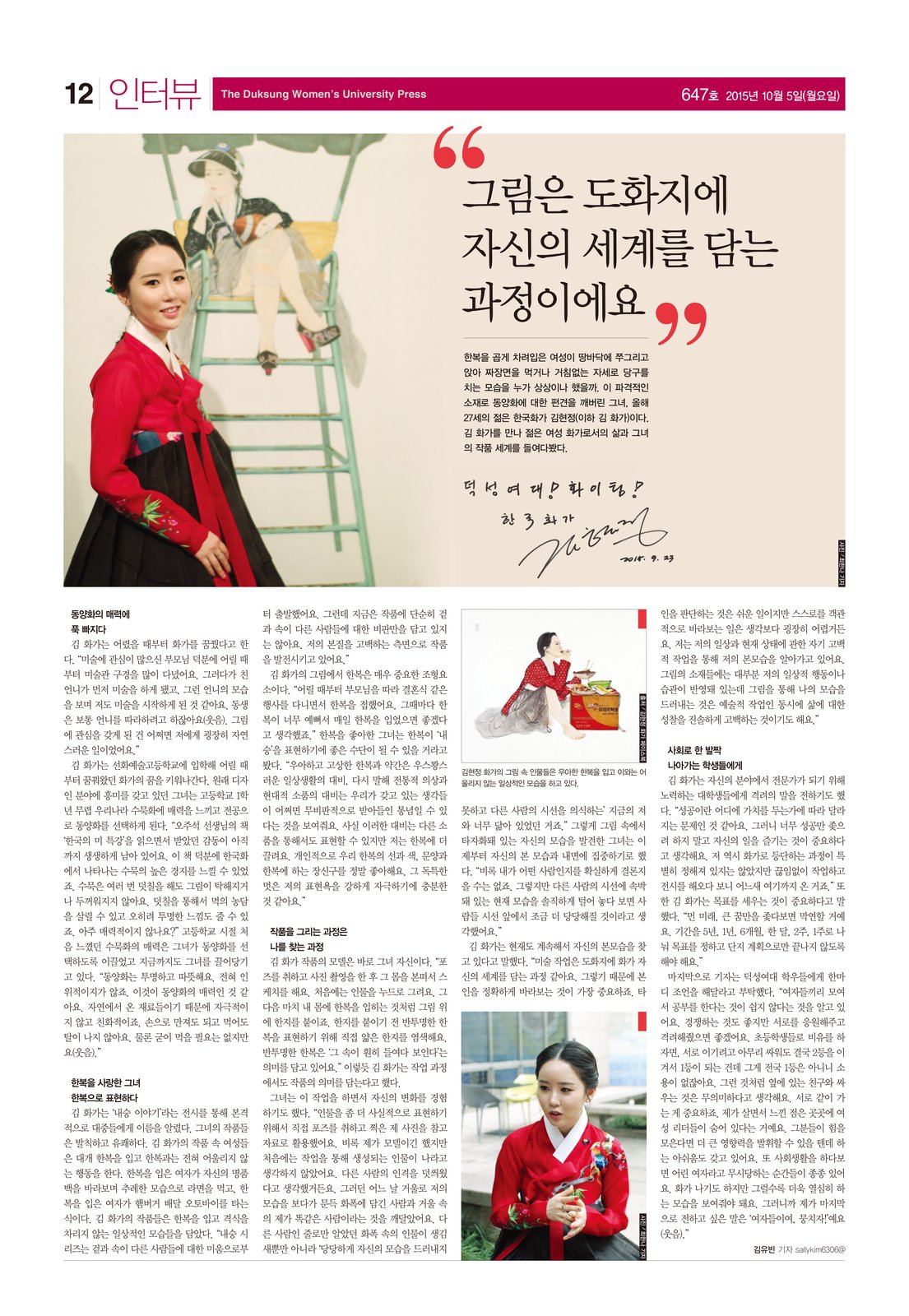
“Painting Is the Process of Putting My Own World Onto Paper”
In an interview with the Duksung Women's University newspaper, artist Kim Hyun Jung explained why she paints bold, everyday scenes — a figure in hanbok eating jjajangmyeon or playing billiards — and described her creative process. She said the figures in her work are herself, and that painting is a confessional process of finding her true self. At the end of the interview, she urged female college students to support and stand together with one another. [Photo by reporter Choi Yoon-na]
View full text
"Painting is the process of putting my own world onto paper"
A woman dressed elegantly in hanbok, crouched on the ground eating jjajangmyeon, or playing billiards with an unrestrained pose — who could have imagined such a thing? She is the one who shattered preconceptions about Oriental painting with this bold subject matter: Kim Hyun Jung (hereafter "painter Kim"), a young Korean painter, 27 this year. We met painter Kim to look into her life as a young woman artist and the world of her work.
Falling head over heels for the charm of Oriental painting
Painter Kim says she dreamed of becoming a painter since childhood. "Thanks to my parents, who had a strong interest in art, I visited museums often from a young age. Then my older sister started doing art first, and I think seeing her led me to start art too. Younger siblings usually try to follow their older siblings, don't they (laughs)? Becoming interested in painting was, in a way, a very natural thing for me."
Painter Kim entered Sunhwa Arts Middle and High School, nurturing the dream of becoming a painter that she'd held since childhood. Originally interested in design, she fell for the charm of Korean ink painting around her first year of high school and chose Oriental painting as her major. "The impression I got from reading teacher Oh Ju-seok's book Lectures on Korean Beauty is still vivid to me. Thanks to this book, I could feel the high level of mastery that ink wash reaches in Korean painting. No matter how many times you layer ink wash, the painting doesn't turn muddy or heavy. Through layering, you can bring out the subtlety of dark and light, and even give a transparent feeling. Isn't that fascinating?" The charm of ink wash painting she first felt in high school led her to choose Oriental painting and still pulls at her today. "Oriental painting is transparent and warm. It's not artificial at all. I think that's the charm of Oriental painting. Because the materials come from nature, they're not harsh, they're friendly. You can touch them with your hands, and even eating them wouldn't cause any harm. Of course, there's no need to actually eat them (laughs)."
A woman who loved hanbok, expressing herself through hanbok
Painter Kim first made her name known to the public in earnest through the exhibition 'Naesoong Story.' Her works are audacious and delightful. The women in painter Kim's work generally wear hanbok while doing things that don't suit hanbok at all. A woman in hanbok eats ramyeon in a disheveled pose while gazing at her own luxury bag; a woman in hanbok rides a hamburger delivery scooter. Painter Kim's works capture everyday, informal moments while dressed in hanbok. "The Naesoong series started from a dislike of people whose outsides and insides don't match. But now, my work isn't simply about criticizing people who are different inside and out. I'm developing my work more toward confessing my own essence."
Hanbok is a very important formal element in painter Kim's paintings. "From a young age, I encountered hanbok following my parents to events like weddings. Every time, I thought hanbok was so pretty that I wished I could wear it every day." Loving hanbok as she did, she saw it as a good vehicle for expressing 'naesoong.' "The contrast between elegant, dignified hanbok and slightly comical everyday life — in other words, the contrast between traditional dress and modern props — shows that the ideas we hold might be conventions we've accepted uncritically. In fact, this kind of contrast could be expressed through other props too, but I'm more drawn to hanbok. Personally, I really love the lines and colors of our hanbok, its patterns, and the accessories worn with it. That distinctive charm is more than enough to strongly stimulate my desire for expression."
[Photo caption: The figures in painter Kim Hyun Jung's paintings wear elegant hanbok while striking poses that don't match it at all. Source / Kim Hyun Jung's Facebook]
The process of painting is a process of finding myself
The model in painter Kim's work is herself. "I strike a pose, take a photograph, and sketch based on that body. At first I draw the figure nude. Then, as if dressing my own body in hanbok, I paste hanji onto the drawing. Before attaching the hanji, I dye thin hanji myself to express the translucent hanbok. A translucent hanbok carries the meaning that 'you can see right through her.'" In this way, painter Kim said she embeds the meaning of the work even in the working process itself.
She also experienced her own transformation through this work. "To express the figure more realistically, I used photographs of myself, taken while striking poses, as reference material. Though I was the model, at first I didn't think the figure created through the work was me. I thought I was overlaying another person's identity onto it. Then one day, looking at myself in a mirror, I suddenly realized that the person in the painting and the person in the mirror were the same person. The figure in the painting, which I'd thought was someone else, resembled me so closely — not just in appearance, but in the way she couldn't confidently show her true self and was conscious of others' gaze — the very me of today." Having discovered her own alienated self within her paintings this way, she decided to focus from then on on her true self and her inner world. "I can't definitively conclude what kind of person I am. But I thought that if I honestly revealed my current self, bound as it is by others' gaze, I would become a little more confident in the face of that gaze."
Painter Kim said she's still continuously searching for her true self even now. "Art-making feels like the process of putting an artist's own world onto paper. That's why it's most important to look at yourself accurately. It's easy to judge others, but looking at yourself objectively is, surprisingly, extremely difficult. I'm getting to know my true self through confessional work about my own daily life and current state. My subject matter mostly reflects my everyday behaviors and habits, so revealing myself through painting is, at once, an artistic endeavor and an honest confession of reflection on life."
To students taking a step toward society
Painter Kim also offered words of encouragement to college students striving to become experts in their fields. "I think success is a matter that changes depending on what you place value in. So rather than chasing success alone, I think it's important to enjoy your own work. As for me, there wasn't a particularly set path to debuting as a painter, but I ended up here after continuously working and exhibiting." Painter Kim also said setting goals is important. "If you chase only a distant future, a big dream, it will feel vague. You need to break the timeframe down — 5 years, 1 year, 6 months, a month, 2 weeks, a week — and set goals so they don't remain mere plans."
Finally, the reporter asked for a word of advice for students at Duksung Women's University. "I know it's not easy for women to gather and study together. Competing is fine, but I wish we could also cheer each other on and encourage one another. To use an analogy with elementary school students: no matter how hard you fight to beat the person next to you and become number one, if that's not number one nationwide, it doesn't mean much, does it? In the same way, I think fighting with the friend next to you is meaningless. Going forward together matters. What I've come to feel while living is that female leaders are hidden everywhere. If they joined forces, I feel they could exercise even greater influence — that's something I regret a little. Also, in social life, there are moments when you're brushed off just for being a young woman. It makes you angry, but that's exactly when you need to show that you work even harder. So the last thing I want to say is: 'Women, let's stand together!' (laughs)."
Reporter Kim Yu-bin sallykim6306@