






Magazine Hankyung | Audacious or Playful: The Reversal Aesthetics of the ‘Naesoong Girl’
In an interview with Magazine Hankyung, artist Kim Hyun Jung explained that, prompted by her solo exhibition 'Naesoong Olympics,' she paints confessional portraits of modern people who live differently in public than in private, conscious of others' gaze, through everyday yet incongruous subjects such as figures in hanbok eating ramen or playing billiards. She said each piece involves a painstaking process in which she makes and dyes the hanji paper herself, and that she donates 100% of her image-licensing income. [Photo by reporter Lee Seung-jae]
View full text
[Korean Painter Kim Hyun Jung]
Audacious or Playful: The Reversal Aesthetics of the 'Naesoong Girl'
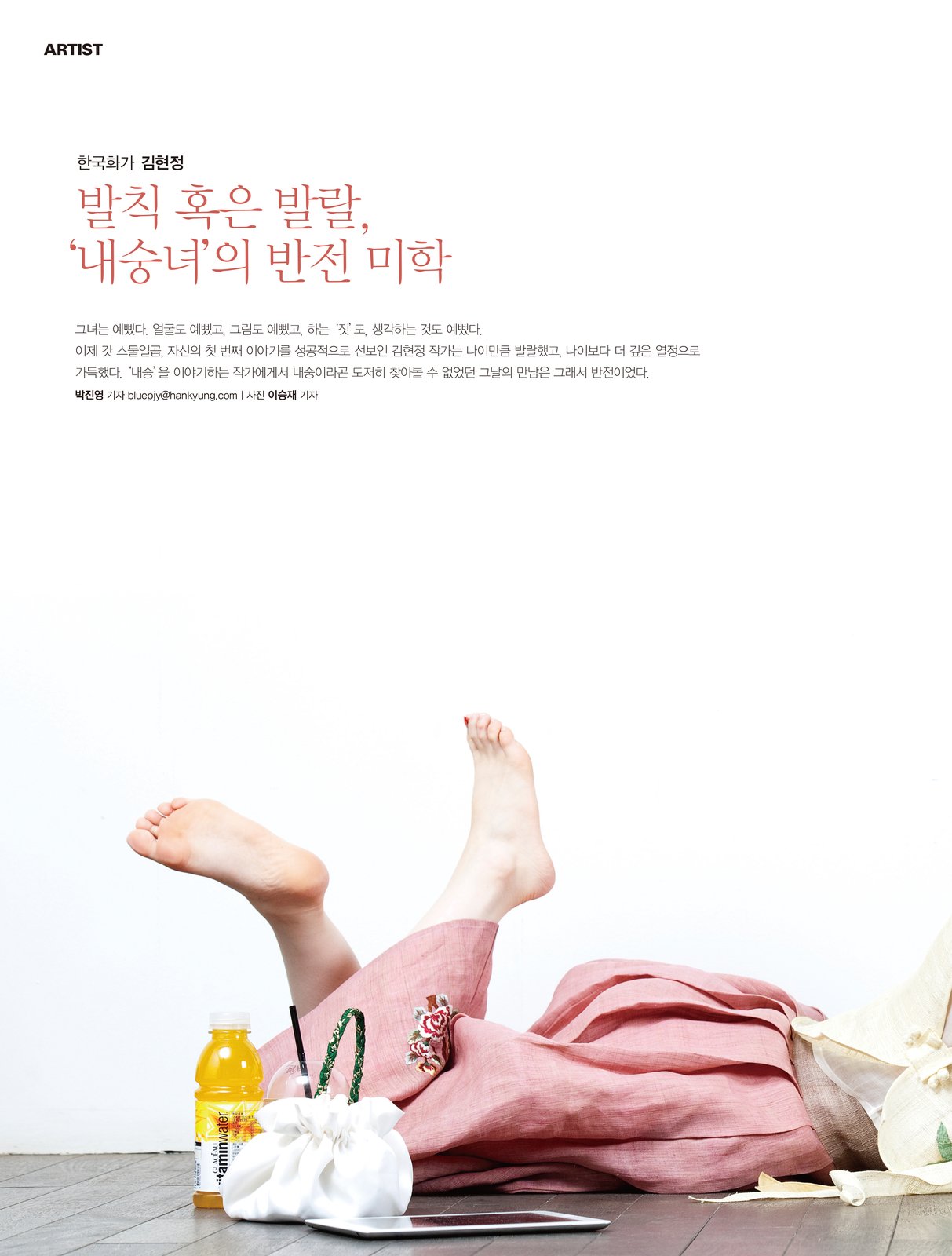
She was pretty. Her face was pretty, her paintings were pretty, and even what she did and what she thought were 'pretty.' Barely twenty-seven, having just successfully unveiled her first story to the world, artist Kim Hyun Jung was as playful as her age suggested, yet brimming with a passion deeper than her years. There was something of a reversal in meeting an artist who talks about 'naesoong' (coy pretense) yet showed not a trace of it herself that day.
Reporter Park Jin-young bluepjy@hankyung.com | Photography by reporter Lee Seung-jae
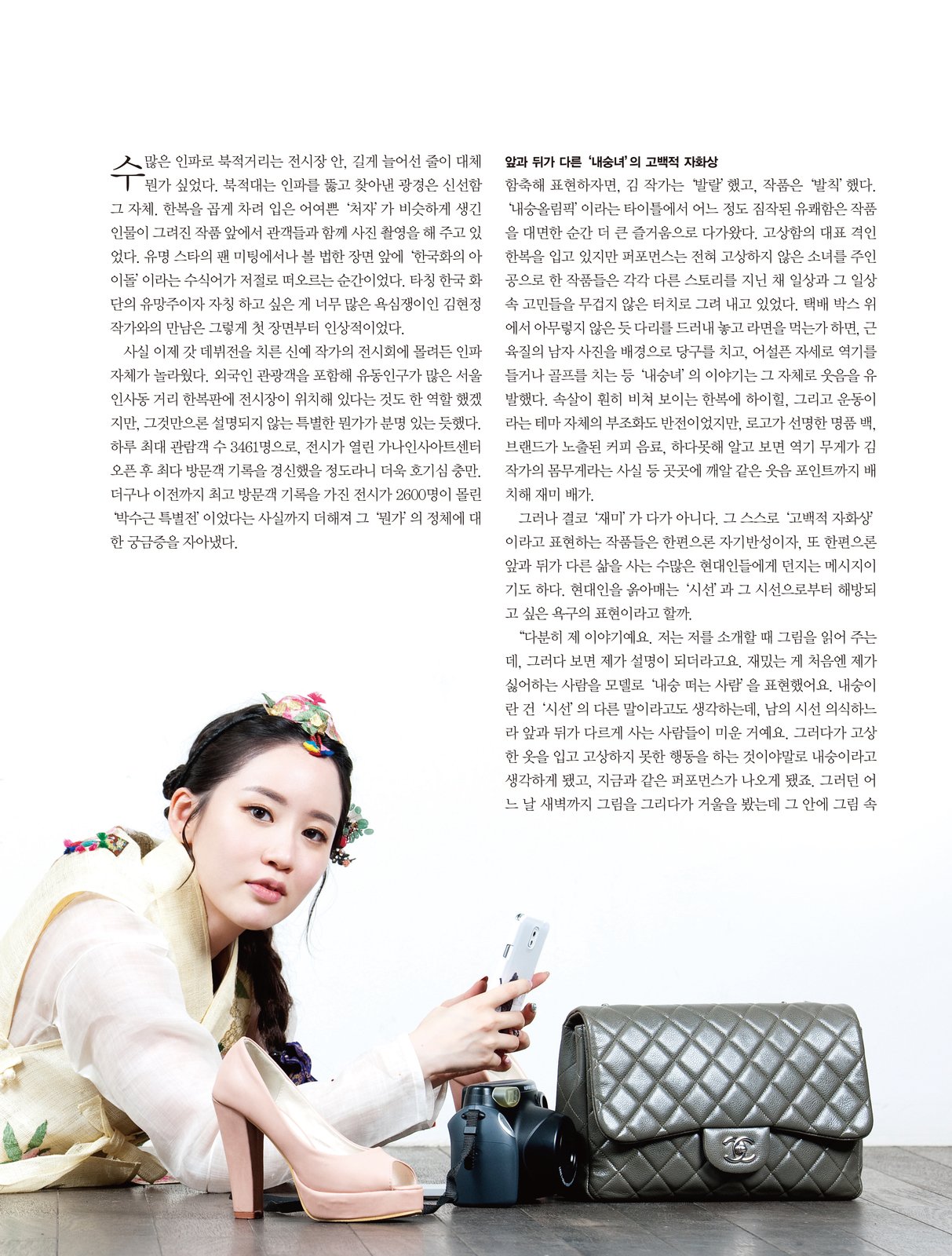
Inside an exhibition hall packed with crowds, I wondered what the long line could possibly be for. Pushing through the throng, what I found was something utterly fresh. A lovely 'young lady' dressed elegantly in hanbok was taking photos with visitors in front of a work depicting a similar-looking figure. Watching a scene that could have come from a fan meeting for a famous celebrity, the description 'idol of Korean painting' came to mind unbidden. The meeting with Kim Hyun Jung — called a rising star of the Korean painting world by others, and a self-described greedy person with too many things she wants to do — was striking from that very first scene.
In fact, the crowd itself gathered for the exhibition of a barely-debuted newcomer was surprising in its own right. The fact that the venue sat in the middle of Insadong, a Seoul street with heavy foot traffic including foreign tourists, surely played some role, but that alone didn't seem to explain it — there was clearly something special at work. Curiosity mounted further on learning that the show drew a peak single-day attendance of 3,461, breaking the record for most visitors since Gana Insa Art Center opened. What made it more intriguing still was that the previous record-holder, with 2,600 visitors, had been the special exhibition of the revered painter Park Soo-keun — leaving one all the more curious about the nature of this 'something.'
A Confessional Self-Portrait of the Two-Faced 'Naesoong Girl'
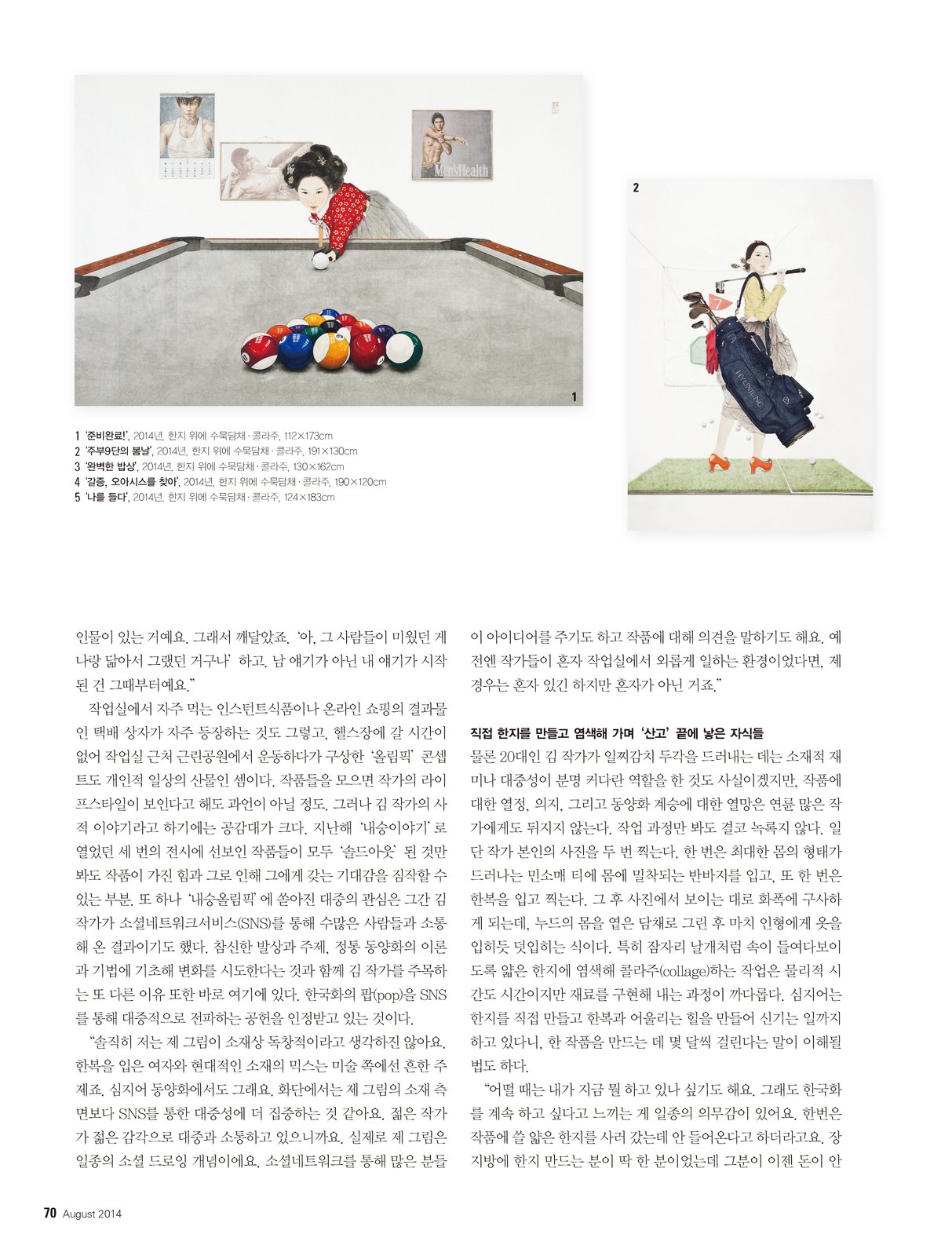
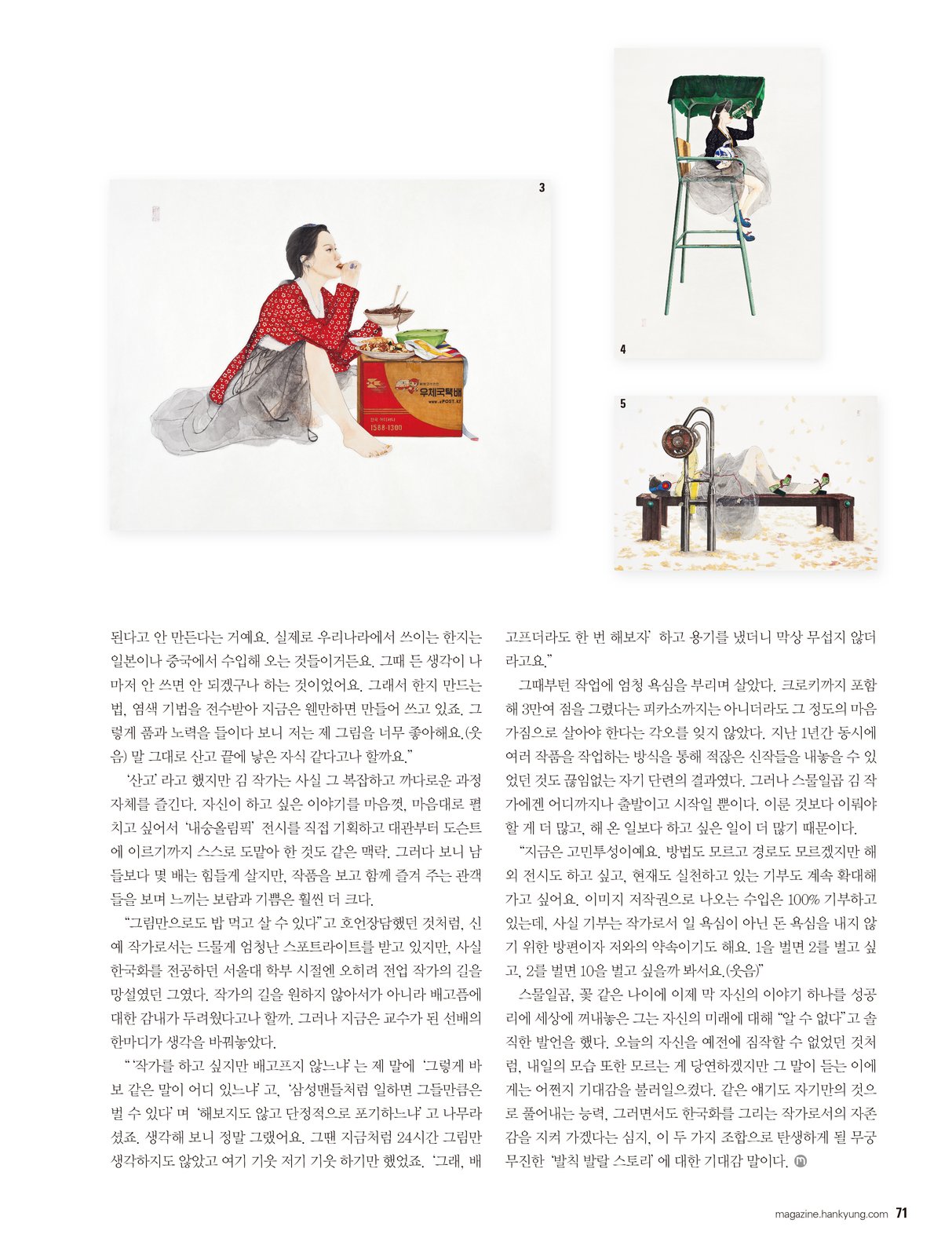
To put it simply, the artist herself was 'playful,' while her work was 'audacious.' The sense of wit hinted at by the title 'Naesoong Olympics' turned into even greater delight the moment one faced the works themselves. Featuring a girl dressed in hanbok — the epitome of elegance — yet engaged in behavior anything but elegant, each piece carried its own story, rendering everyday life and its worries with a light touch. The tales of the 'naesoong girl' were funny in themselves: baring her legs without a hint of self-consciousness while eating ramen atop a delivery box; playing billiards against a backdrop of a photo of a muscular man; awkwardly lifting a barbell or swinging a golf club. The incongruity itself — a hanbok so sheer the skin shows through, paired with high heels, set against the theme of exercise — was already a reversal, and the humor was doubled by little details planted throughout: a designer bag with its logo in plain sight, a coffee cup with its brand clearly visible, and even the fact, once you learn it, that the weight on the barbell equals the artist's own body weight.
But 'fun' is far from all there is to it. The works, which the artist herself describes as 'confessional self-portraits,' are on one hand an act of self-reflection, and on the other, a message aimed at the countless modern people who live one way in public and another in private. Call it an expression of the 'gaze' that binds modern people, and of the desire to be freed from it.
"It's very much my own story. When I introduce myself, I let the paintings speak, and in doing so, I end up explaining myself. What's interesting is that at first I used people I disliked as models to portray 'people putting on airs.' I think of 'naesoong' as another word for the 'gaze' — I resented people who, conscious of others' eyes, lived one way outwardly and another way inwardly. Then I came to think that wearing elegant clothes while behaving inelegantly was itself the essence of naesoong, and that's how the performances you see now came about. Then one dawn, after painting late into the night, I looked in the mirror and saw the very figure from my paintings staring back at me. That's when I realized: 'Ah, I resented those people because they resembled me.' That's when it stopped being about other people and started being about me."
The frequent appearance of instant food she often eats in her studio, or delivery boxes left over from online shopping, and even the 'Olympics' concept — conceived while exercising at a neighborhood park near her studio because she had no time to go to a gym — are all products of her own personal daily life. It's no exaggeration to say that gathering her works together reveals her lifestyle. And yet, what might seem like Kim's private story resonates broadly. The fact that every piece shown across the three exhibitions held under the theme 'Naesoong Story' the previous year sold out completely hints at the power of her work and the expectations placed on her. The outpouring of public interest in 'Naesoong Olympics' was also, in part, the result of her ongoing communication with a wide public through social media (SNS). Alongside her fresh ideas and themes and her attempts at innovation grounded in the theory and technique of traditional Korean painting, this is another reason she draws attention — she is recognized for her contribution to spreading 'pop' Korean painting to the public through social media.
"Honestly, I don't think my paintings are especially original in terms of subject matter. Mixing a woman in hanbok with contemporary objects is a fairly common theme in art — even within Korean painting. I think the art world tends to focus less on the subject matter of my paintings and more on the popularity I've built through SNS. It's because a young artist is communicating with the public in a young sensibility. In fact, my paintings operate on something like a concept of social drawing. Many people give me ideas or share opinions about my work through social media. Where artists once worked alone in their studios, in isolation, in my case, I'm alone, but not really alone."
Children Born Through Labor Pains — Making and Dyeing Her Own Hanji
Of course, the novelty of her subject matter and her popularity surely played a large role in the early recognition Kim, still in her twenties, has achieved. But her passion for her work, her determination, and her aspiration to carry Korean painting forward rival those of far more seasoned artists. Just her working process alone is no small undertaking. First, she photographs herself twice — once in a sleeveless top and fitted shorts that reveal her body's form as clearly as possible, and once in hanbok. She then renders the figure on canvas according to those photographs, first painting the nude body in light coloring, then layering clothing over it, much like dressing a doll. In particular, the process of dyeing thin hanji so sheer that it resembles dragonfly wings and collaging it onto the surface is painstaking not only in the time it demands but in the difficulty of preparing the material itself. She has even gone so far as to make her own hanji and craft shoes that match the hanbok, which makes it easier to understand why a single piece can take months to complete.
"Sometimes I wonder what exactly I'm doing. Still, I feel a kind of duty to keep going with Korean painting. Once, I went to buy the thin hanji I use for my work, only to be told it was no longer available. There had been just one person in Jangji-bang who made hanji, and he'd stopped because it no longer paid enough. In fact, most of the hanji used in Korea today is imported from Japan or China. That's when I thought, if even I stop using it, that would be a problem. So I learned the techniques for making hanji and dyeing it, and now I make most of what I use myself. Having put in that much effort and labor, I've grown to love my own paintings deeply. (Laughs) You could say they're like children born through labor pains, quite literally."
[Works featured: 1. 'Ready, Set!,' 2014, ink-wash coloring and collage on Korean paper, 112x173cm / 2. 'A Housewife's Spring,' 2014, ink-wash coloring and collage on Korean paper, 191x130cm / 3. 'The Perfect Meal,' 2014, ink-wash coloring and collage on Korean paper, 130x162cm / 4. 'Thirst, Searching for an Oasis,' 2014, ink-wash coloring and collage on Korean paper, 190x120cm / 5. 'Lifting Myself Up,' 2014, ink-wash coloring and collage on Korean paper, 124x183cm]
Though she calls it 'labor pains,' Kim actually enjoys that complex, painstaking process itself. Wanting to tell her own story exactly as she pleased, she personally planned the 'Naesoong Olympics' exhibition and took charge of everything from booking the venue to acting as docent — all in the same spirit. As a result, she lives a life many times harder than most, but the sense of reward and joy she feels watching audiences engage with and enjoy her work is far greater still.
Just as she once boldly declared, "I can make a living from painting alone," she has drawn an extraordinary spotlight rare for a debut artist. And yet, back when she was majoring in Korean painting as an undergraduate at Seoul National University, she had actually hesitated to commit to a career as a full-time artist — not because she didn't want to become one, but because she feared she couldn't endure going hungry for it. It was a single remark from a senior, now a professor, that changed her mind.
"When I said, 'I want to be an artist, but won't I go hungry,' she scolded me, saying, 'What a foolish thing to say — if you work as hard as the people at Samsung, you can earn just as much as they do. Are you giving up outright without even trying?' Thinking about it, she was right. Back then, I wasn't thinking about painting 24 hours a day the way I do now — I was just dabbling here and there. Once I gathered the courage to think, 'Alright, let's try it even if it means going hungry,' it turned out not to be so frightening after all."
From then on, she threw herself into her work with tremendous ambition. Without quite reaching the roughly 30,000 pieces — sketches included — that Picasso is said to have produced, she resolved never to forget the mindset it takes to work at that level. Her ability to produce a fair number of new works over the past year by working on several pieces simultaneously was the result of this constant self-discipline. But for the twenty-seven-year-old Kim, this is only the beginning — a starting point. There is far more still to achieve than what she has already accomplished, and far more she wants to do than what she has done so far.
"Right now I'm full of things to think about. I don't yet know the method or the path, but I want to hold exhibitions abroad, and I want to keep expanding the donations I'm already making. I donate 100% of the income I earn from image licensing — donating is, in a way, both a means of keeping my ambition as an artist about the work rather than about money, and a promise I've made to myself. Because if I earn 1, I'll want to earn 2; if I earn 2, I'll want to earn 10. (Laughs)"
At twenty-seven, an age in full bloom, having just successfully brought her first story out into the world, she spoke honestly about her future, saying simply, "I don't know." Just as she could never have predicted who she is today, it stands to reason she doesn't know what tomorrow holds either — yet somehow, that very statement stirred a sense of anticipation in the listener. Anticipation born from two qualities combined: her ability to spin even a familiar story into something uniquely her own, and the resolve to hold onto her self-respect as an artist working in Korean painting — the endless 'audacious and playful stories' that combination is bound to produce.