






Exhibition Guide | Kim Hyun Jung, the Idol of Korean Painting
Monthly Exhibition Guide's March 2015 'Artist to Watch' section introduced Kim Hyun Jung, known as 'the idol of Korean painting.' It covered her Naesoong series and the smash-hit attendance of her solo exhibition Naesoong Olympics, her selection for the Korean Art Critics Association's 2014 'Artist to Watch This Year' award, and the content of her master's thesis. Text by Editor-in-Chief Lee Moon-ja (Exhibition Guide).
View full text
"The Idol of Korean Painting"
Artist Kim Hyun Jung
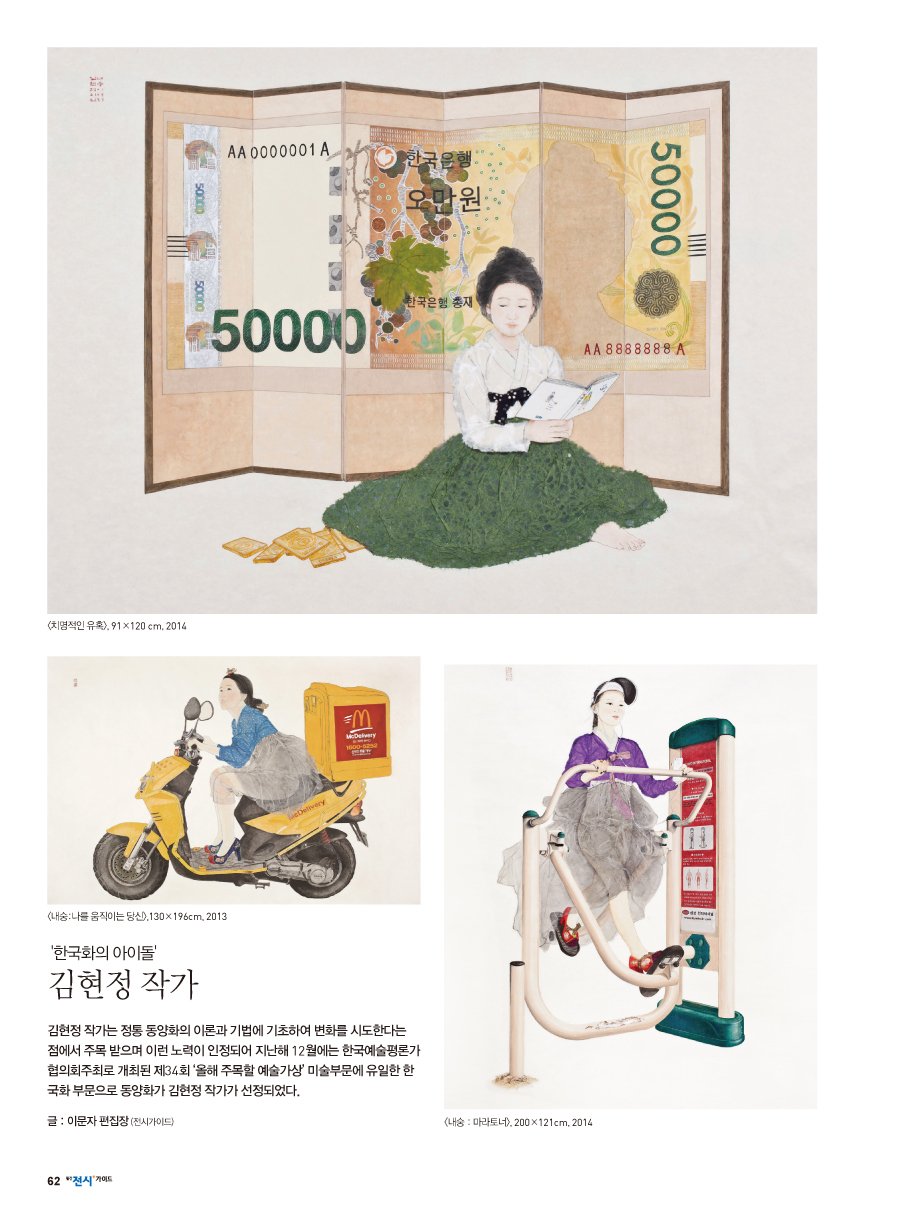
Kim Hyun Jung draws attention for attempting change while grounding her work in the theory and technique of orthodox Oriental painting — an effort that was recognized last December when she was selected, as the sole representative of Korean painting, for the Korean Art Critics Association's 34th "Artist to Watch This Year" award in the fine arts category.
Text: Lee Moon-ja, Editor-in-Chief (Exhibition Guide)
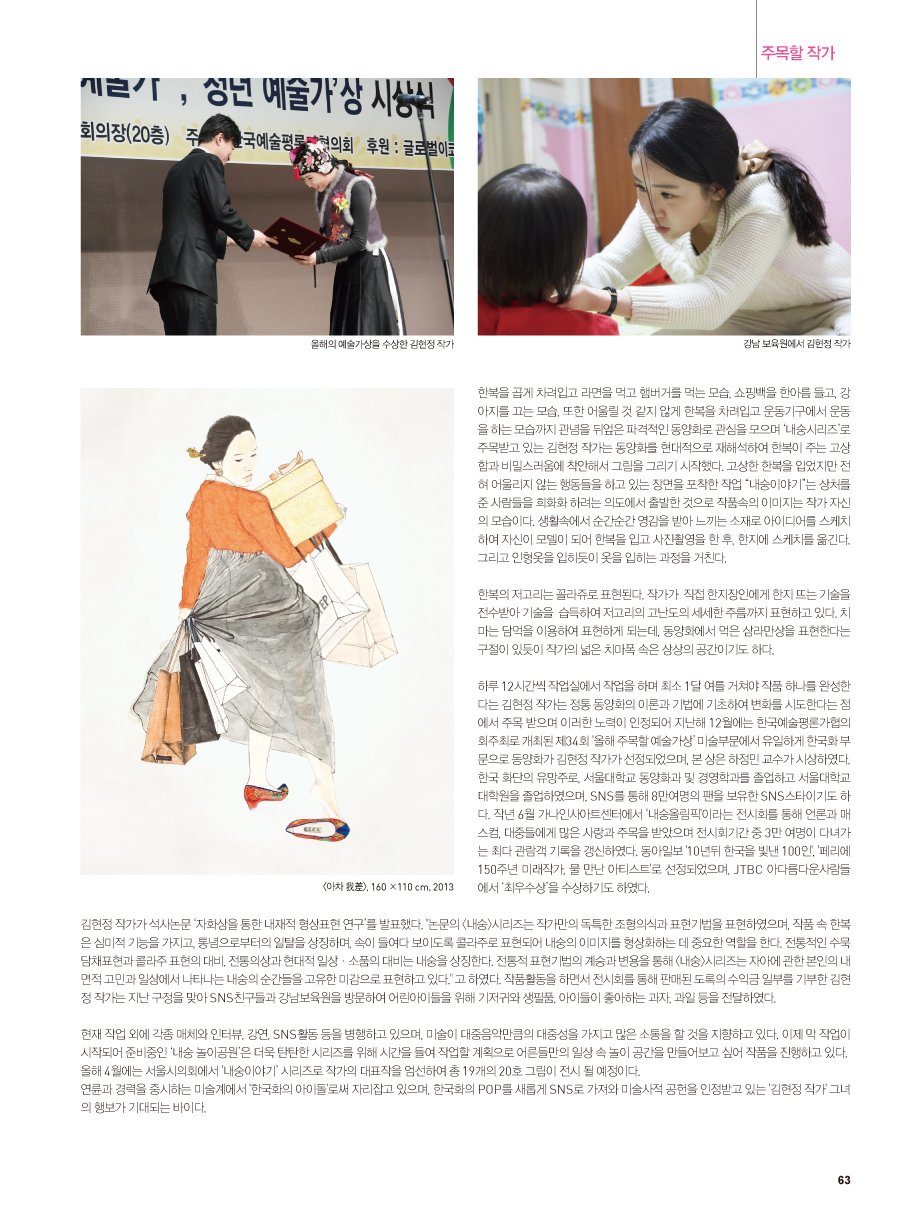
A woman dressed elegantly in hanbok eating ramen, eating a hamburger, carrying an armful of shopping bags while walking a dog, or, just as improbably, working out on exercise equipment while wearing hanbok — Kim Hyun Jung has drawn attention with provocative Oriental paintings that overturn convention, becoming known for her "Naesoong series." Reinterpreting Oriental painting in a contemporary way, she began painting based on the nobility and secrecy that hanbok evokes. Her work "Naesoong Story," which captures scenes of figures behaving in ways utterly mismatched with the refined hanbok they wear, began with the intent to satirize the people who had hurt her — and the figure in the paintings is the artist herself. Drawing inspiration from moment-to-moment sparks in daily life, she sketches her ideas, photographs herself in hanbok as the model, transfers the sketch onto hanji, and then, as if dressing a doll, goes through the process of "clothing" the figure.
The jeogori (top) of the hanbok is rendered through collage. The artist personally learned papermaking technique from a hanji master craftsman, mastering it well enough to render even the most intricate, high-difficulty pleats of the jeogori. The skirt, meanwhile, is rendered using diluted ink; just as there's a saying in Oriental painting that ink can express the entire universe, the wide folds of the artist's skirts are themselves a space of imagination.
Working roughly 12 hours a day in her studio and taking at least a month to complete a single piece, Kim Hyun Jung draws attention for attempting change while grounding her work in the theory and technique of orthodox Oriental painting — an effort recognized last December when she became the sole Korean-painting recipient of the Korean Art Critics Association's 34th "Artist to Watch This Year" award in the fine arts category, presented by Professor Ha Jeong-min. A rising star of the Korean art world, she graduated from Seoul National University with degrees in Oriental Painting and Business Administration and completed her graduate studies at Seoul National University, and she is also a social-media star with roughly 80,000 followers. Her exhibition "Naesoong Olympics," held at Gana Insa Art Center last June, drew tremendous attention and affection from the press, mass media, and the public alike, setting a new attendance record of roughly 30,000 visitors during the exhibition period. She has been selected for Dong-A Ilbo's "100 People Who Will Shine Korea in 10 Years" and Perrier's 150th Anniversary "Future Artist, An Artist in Her Element," and won the Grand Prize at JTBC's "Beautiful People."
Kim Hyun Jung also presented her master's thesis, "A Study on the Expression of Inner Form Through Self-Portraiture." "The Naesoong series discussed in the thesis expresses the artist's own distinctive formative consciousness and technique. The hanbok in the work carries an aesthetic function, symbolizes a departure from convention, and — rendered in collage to reveal what lies beneath — plays a crucial role in shaping the image of pretense. The contrast between traditional ink-and-color expression and collage, and between traditional dress and contemporary everyday props, symbolizes pretense. Through the inheritance and transformation of traditional expressive technique, the Naesoong series expresses, in her own distinctive sensibility, both her inner struggles over selfhood and the moments of pretense that appear in daily life," she said. Kim Hyun Jung, who has donated part of the proceeds from catalogues sold at her exhibitions, visited the Gangnam orphanage with her social-media friends around this past Lunar New Year to deliver diapers, daily necessities, and snacks and fruit the children enjoy.
Alongside her ongoing work, she is currently juggling interviews with various media, lectures, and social-media activity, and hopes that art can achieve as much popular reach and communication as popular music. Naesoong Amusement Park, now just getting underway, is planned to take more time to build into a fuller series — she hopes to create a space for everyday play meant only for adults. This coming April, a selection of her representative works from the "Naesoong Story" series — a total of 19 pieces in the 20-ho size — will be exhibited at the Seoul Metropolitan Council.
In an art world that tends to prize seniority and long careers, she has established herself as "the idol of Korean painting," bringing the pop sensibility of Korean painting into social media and earning recognition for her contribution to art history. Her next steps as "artist Kim Hyun Jung" are eagerly awaited.