






Univtomorrow | Artist Interview_The Rising Generation Who Paints Naesoong, Kim Hyun Jung
An interview with Kim Hyun Jung published in the "THE RISING GENERATION" cover story of Univtomorrow issue No. 700 (June 27, 2014), from her days as a graduate student in Oriental Painting at Seoul National University. It covers her self-portrait series on the theme of Naesoong, her solo exhibition '2014 Naesoong Olympics,' her distinctive working method of photographing herself and then cutting and pasting hanji (traditional Korean paper), and how she came to double-major in Oriental Painting and Business Administration. Written by student reporter Kim Ju-ri, photographed by Lee Seo-young, edited by Cho A-ra.
View full text
The Painter Who Paints Naesoong
Kim. Hyun. Jung.
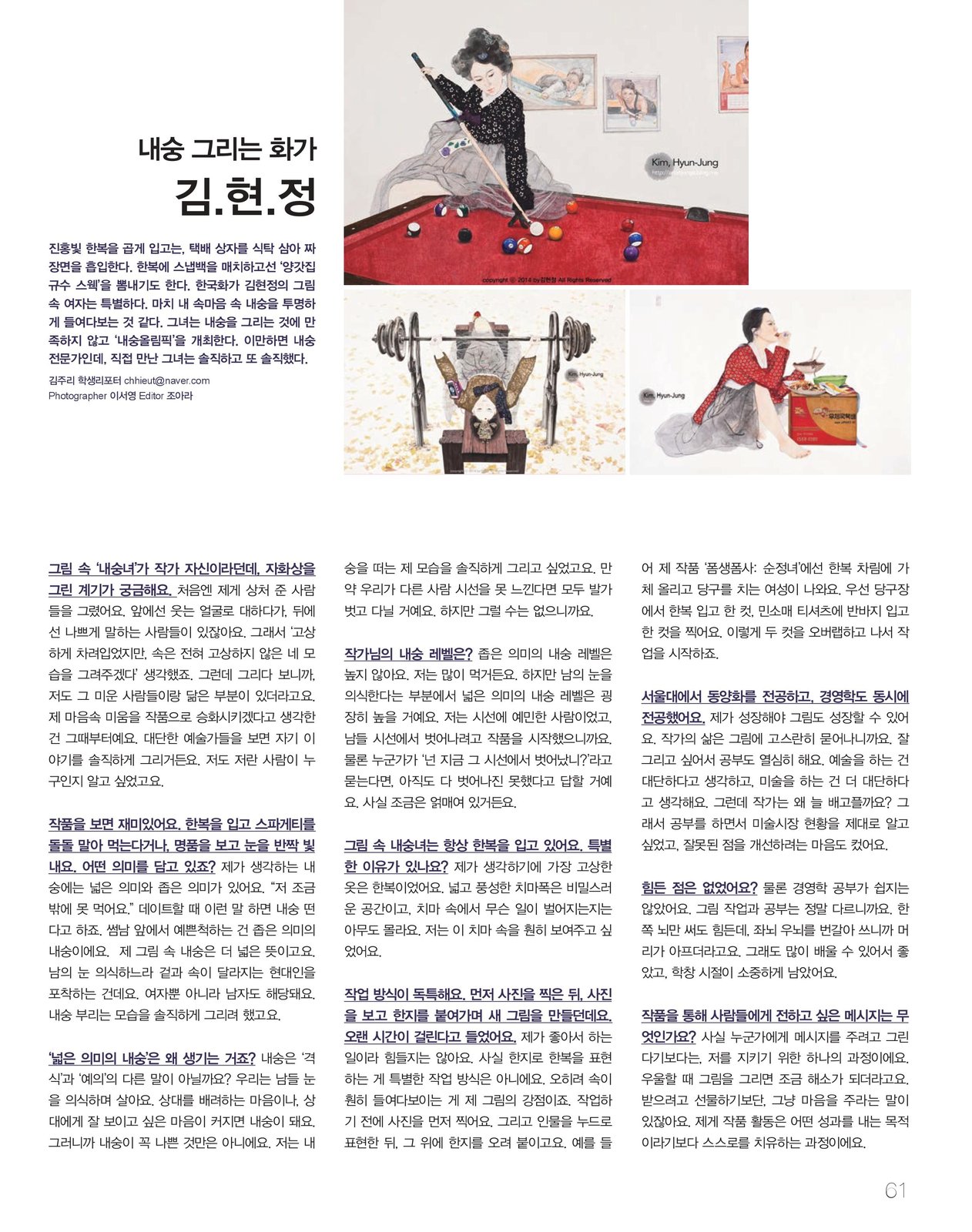
Dressed neatly in a crimson hanbok, she slurps down jjajangmyeon off a delivery box turned dining table. Pairing a hanbok with a snapback cap, she flaunts what could be called "noble-lady swag." The woman in Korean painter Kim Hyun Jung's pictures is unlike any other. It's as if she's showing us, in full transparency, the naesoong (feigned composure) hidden in our own hearts. Not content with simply painting naesoong, Kim goes on to host her own "Naesoong Olympics." You'd think she'd be quite the expert in feigning by now — yet meeting her in person, she was candid, and then some.
Student reporter Kim Ju-ri (chhieut@naver.com)
Photographer Lee Seo-young Editor Cho A-ra
I heard the "Naesoong girl" in your paintings is you yourself. What made you start painting self-portraits?
At first I painted the people who had hurt me — the kind who smile to your face and talk badly about you behind your back. So I thought, "I'll paint you exactly as you are: dressed elegantly, but not the least bit elegant underneath." But as I kept painting, I realized I shared something with those people I resented. That's when I decided to sublimate the resentment in my heart into my work. If you look at truly great artists, they paint their own stories honestly. I wanted to know who I really was, too.
Your work is fun to look at — a woman in hanbok slurping up spaghetti, or her eyes lighting up at the sight of luxury goods. What do these scenes mean?
For me, naesoong has a broad sense and a narrow sense. Saying "I can only eat a little" on a date — that's what people usually mean by naesoong, acting coy. Putting on a pretty face in front of a guy you like is naesoong in the narrow sense. The naesoong in my paintings means something broader: it's about capturing modern people whose outside and inside diverge because they're so conscious of others' eyes. It's not only women — men do it too. I wanted to honestly paint the act of feigning itself.
Why does this "broad sense of naesoong" arise in the first place? Isn't it just another word for "formality" and "manners"? We live conscious of other people's eyes. When consideration for others, or the wish to make a good impression, grows large enough, it becomes naesoong. So naesoong isn't necessarily a bad thing. I wanted to honestly paint myself in the act of feigning. If we felt no one's eyes on us at all, we'd probably all just walk around naked. But we can't do that.
What's your own naesoong level? My narrow-sense naesoong level isn't very high — I eat a lot. But in the sense of being conscious of others' eyes, my broad-sense naesoong level is probably very high. I've always been sensitive to how others see me, and that's exactly why I started making this work — to escape that gaze. Of course, if someone asked me, "Have you escaped that gaze now?" I'd have to say I still haven't fully escaped it. Honestly, I'm still a little bound by it.
The naesoong girl in your paintings is always wearing hanbok. Is there a particular reason? To me, hanbok seemed like the most elegant clothing there is. Its wide, billowing skirt is a secret space — no one knows what's happening underneath it. I wanted to show, in full view, what's under that skirt.
Your working method is unique — you take a photograph first, then build the new picture by cutting and pasting hanji over it. I hear it takes a long time. Since I do it because I love it, it doesn't feel hard. Actually, expressing hanbok with hanji isn't such an unusual technique in itself — the real strength of my paintings is that you can see straight through to what's underneath. Before I start working, I take a photograph first. Then I paint the figure nude, and cut and paste hanji over it. For example, in my piece "Live Due to Swag, Die Due to Swag: Naive Lady," a woman in hanbok with an elaborate updo is shown playing billiards. First I take a shot of her in hanbok at the billiard hall, then another shot in a sleeveless T-shirt and shorts. I overlap the two shots and begin the work from there.
You double-majored in Oriental Painting and Business Administration at Seoul National University. I have to grow as a person for my painting to grow, too — an artist's life shows through in their work, inevitably. I studied hard because I wanted to paint well. I think doing art is impressive, and doing fine art is even more so. But then why is it that artists are always broke? So I wanted to properly understand the state of the art market through my studies, and I had a strong urge to fix what was wrong with it.
Wasn't it difficult? Of course, studying business wasn't easy — painting and studying are really different activities. It's hard enough using just one side of your brain, but switching back and forth between left brain and right brain gave me headaches. Still, I got to learn a lot, and those school years remain precious to me.
What message do you want to convey to people through your work? Honestly, it's less that I'm painting to send anyone a message, and more that it's a process for protecting myself. When I'm feeling down, painting helps release some of that. There's a saying that you should give from the heart rather than give in order to receive. For me, making art isn't so much about achieving some result as it is a process of healing myself.