








Chunjae Education Woodeungsaeng Nonsul | September Issue: Communicating with the World through Korean Painting
An interview with Korean painter Kim Hyun Jung appeared in the September 2017 issue (pp. 26-31) of Woodeungsaeng Nonsul, a study comic magazine published by Chunjae Education. Under the title 'Communicating with the World through Korean Painting,' the piece introduced, in first-person narration, what led her to choose Oriental painting, the background behind the birth of her 'Naesoong' series, her solo exhibition at New York's Metropolitan Museum of Art, and her selection by Forbes. (Reporting by Kim Seung-hyun, photos by Song Young-shin and Kim Hyun Jung Art Center)
View full text
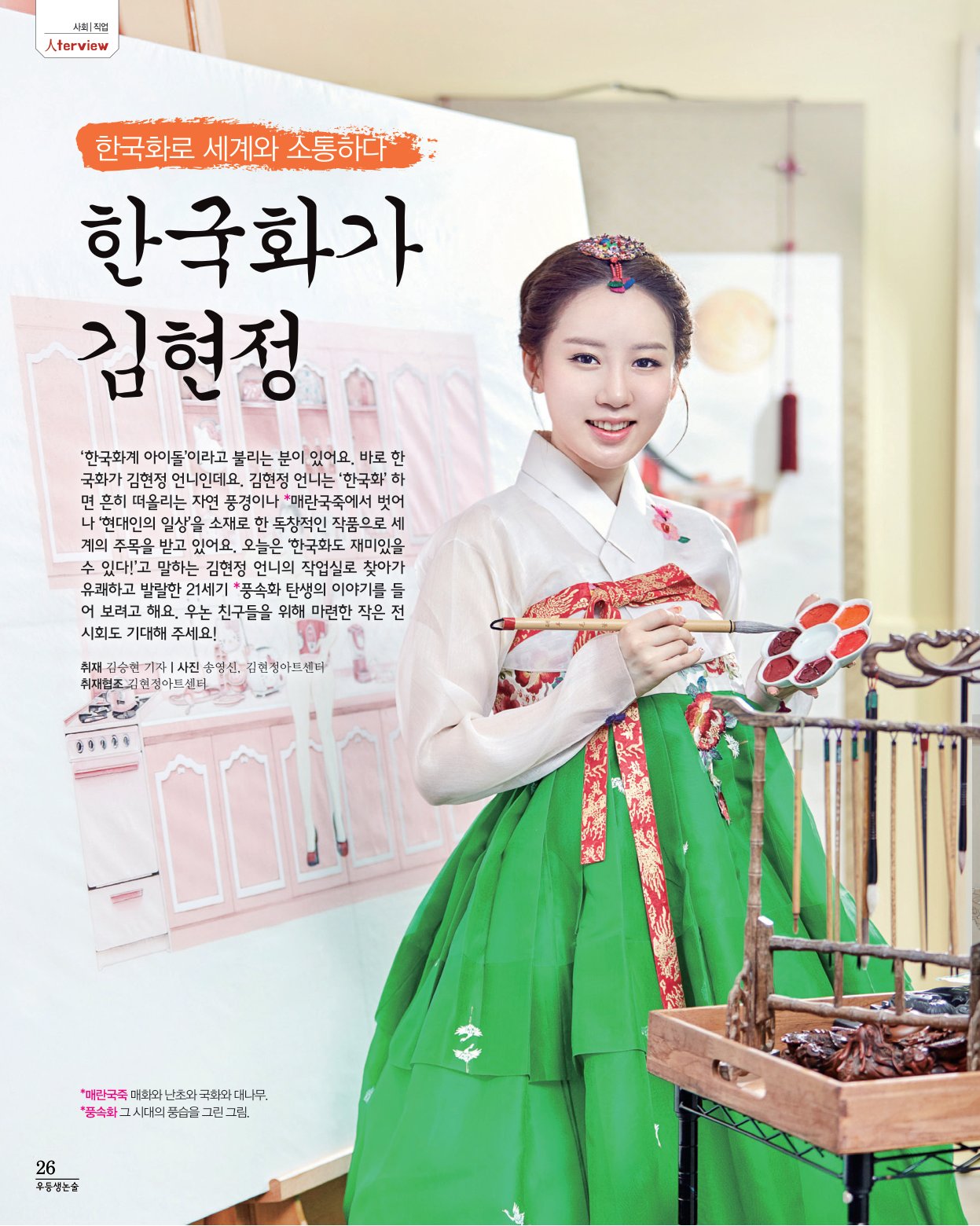
Korean Painter Kim Hyun Jung
Communicating with the World through Korean Painting
There's someone known as 'the idol of the Korean painting world.' That's Korean painter Kim Hyun Jung. While 'Korean painting' usually brings to mind natural landscapes or the *Four Gentlemen (plum blossom, orchid, chrysanthemum, bamboo), Sister Kim Hyun Jung is drawing worldwide attention with original works based on 'the daily life of contemporary people.' Today we're visiting the studio of Sister Kim Hyun Jung, who says 'Korean painting can be fun too,' to hear the story behind her cheerful, lively 21st-century *genre paintings. Look forward to a small exhibition prepared especially for our Woonon friends!
Reporting by Kim Seung-hyun | Photos by Song Young-shin, Kim Hyun Jung Art Center
Reporting cooperation: Kim Hyun Jung Art Center
*Four Gentlemen: plum blossom, orchid, chrysanthemum, and bamboo.
*Genre painting: painting that depicts the customs of its era.
Let's play while drawing!
Hello, Woonon friends! Welcome to the studio of Korean painter Kim Hyun Jung! I'm so happy to be able to tell you about myself and introduce my work.
What do you friends do for fun these days? When I was little, I used to play by coloring in coloring books or doodling. Before I knew it, whole stretches of time would pass while I was absorbed in it.
I started properly learning to paint at an art academy in third grade of elementary school. When I was little, I always copied my older sister. I saw her learning to paint and started following along. Having gone to the art academy since I was young, I painted 13 hours a day starting at age ten. You might think that sounds tough, right? Not really -- I really enjoyed the process of the things I was thinking taking shape and coming together on paper.
When I was little, my parents cared a lot about things like 'did you have a fun day' and 'did you do your best,' focusing more on the process than the result. Maybe it was the influence of that style of parenting -- even though I'd been learning to paint since I was little, I never lost interest along the way.
Was I good at drawing, you ask? In the word 'misul (art),' the character 'sul' means 'technique' in Chinese characters. With the mindset that technique improves with practice, I worked hard, and I ended up winning quite a few awards. Maybe that's why art was always my favorite subject, and naturally my dream was always to become a painter. Dreaming of being an artist, I naturally went on to an arts middle school.
Falling in Love with Oriental Painting
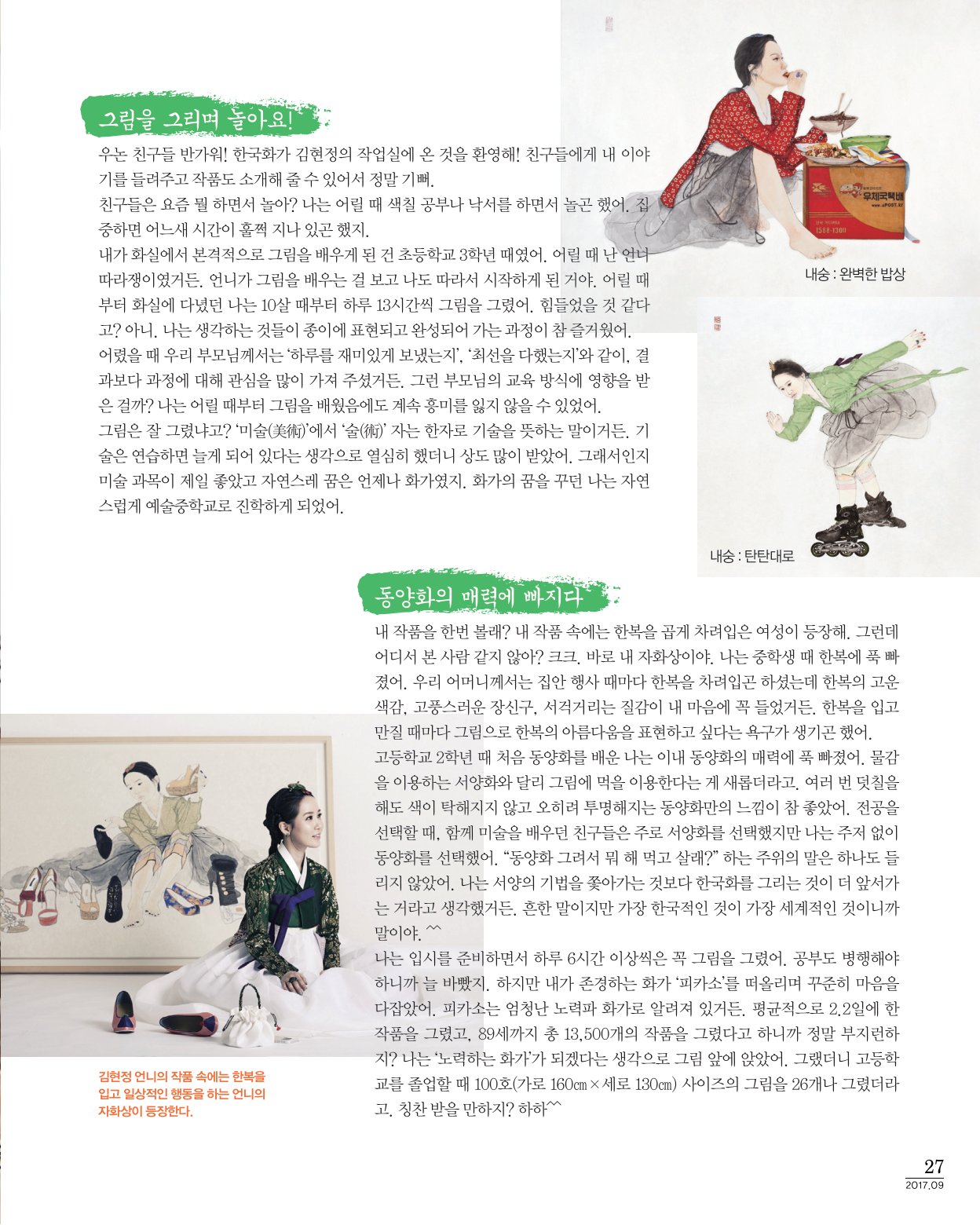
Want to take a look at my work? A woman dressed elegantly in hanbok appears in my paintings. But doesn't she look familiar? Haha. That's right -- it's my self-portrait. I fell completely in love with hanbok as a middle schooler. My mother used to dress in hanbok for family occasions, and I loved the lovely colors of hanbok, its old-fashioned accessories, and its rustling texture. Every time I wore and touched hanbok, I felt a desire to express its beauty through painting.
When I first learned Oriental painting in my second year of high school, I quickly fell completely in love with it. Unlike Western painting, which uses paint, it was new to me to use ink in painting. I loved the unique quality of Oriental painting, where the color doesn't get muddy even after many layers of paint -- instead it becomes more transparent. When it came time to choose a major, the friends I studied art with mostly chose Western painting, but I chose Oriental painting without hesitation. I didn't listen at all to the people around me who said, 'What are you going to do for a living painting Oriental art?' I thought that painting Korean painting was actually more forward-thinking than chasing after Western techniques. As the saying goes, the most Korean thing is the most global thing, right? ^^
While preparing for the entrance exam, I made sure to paint at least six hours a day. I also had to keep up with my studies, so I was always busy. But I kept steadying my resolve by thinking of Picasso, an artist I admire. Picasso is known as an incredibly hardworking painter -- he reportedly completed one work every 2.2 days on average and painted a total of 13,500 works by the age of 89. Isn't that amazing? With the mindset of becoming a 'hardworking painter,' I sat down in front of my canvas. By the time I graduated high school, I had painted 26 works sized 100-ho (160cm x 130cm). Worth some praise, right? Haha ^^
Let's play while drawing!
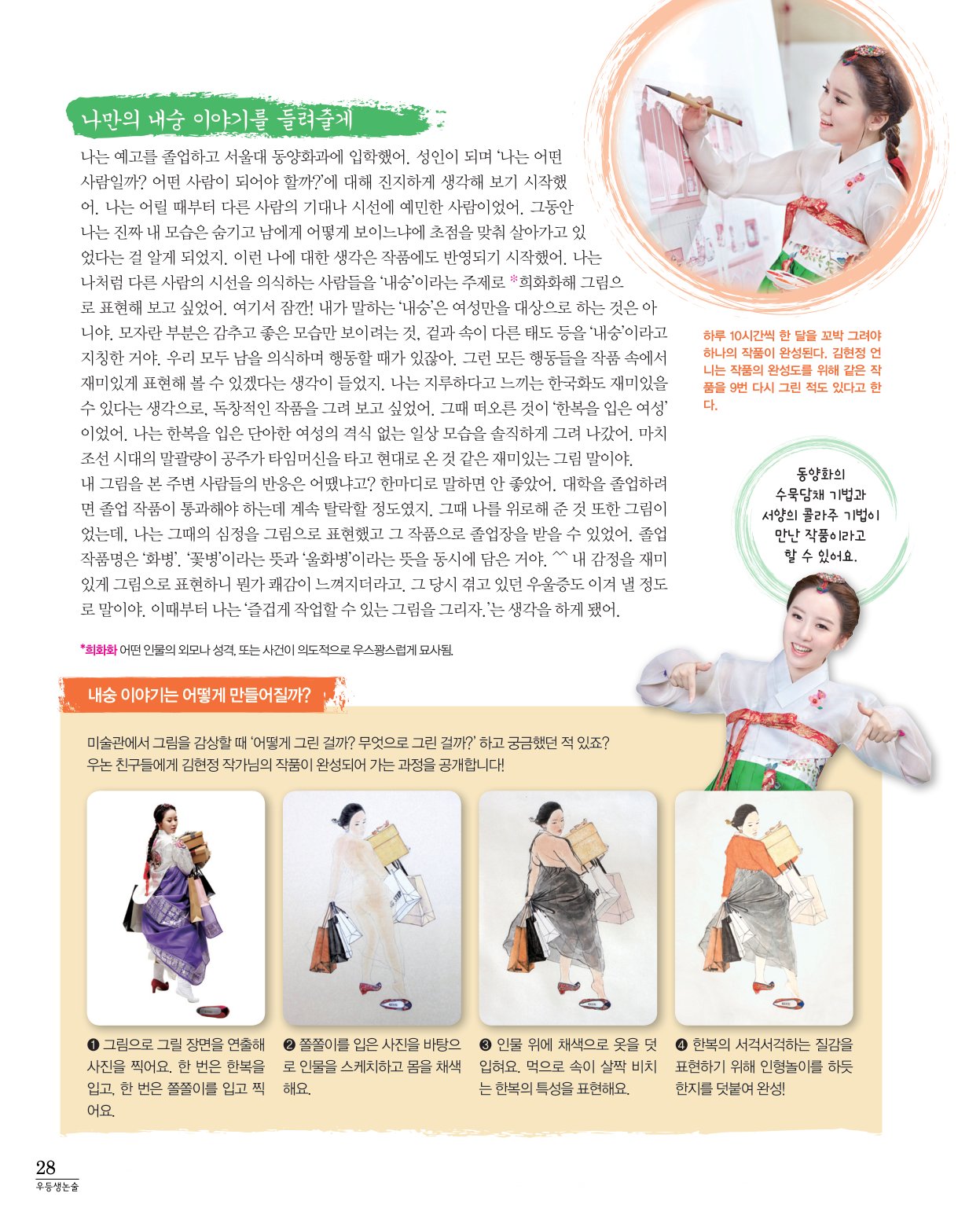
You could say it's a fusion of the Oriental ink-wash coloring technique and the Western collage technique. Have you ever wondered, while looking at a painting in a museum, 'how was this painted? What was it made with?' Let us reveal to our Woonon friends the process behind how artist Kim Hyun Jung's work comes to life!
1. I stage the scene I want to paint and take a photo. I take one photo wearing hanbok and one wearing a bodysuit.
2. Based on the photo of me in the bodysuit, I sketch the figure and paint the body.
3. I layer color over the figure to add the clothing. I use ink to express the slightly see-through quality of hanbok.
4. To express the rustling texture of hanbok, I finish by attaching hanji (traditional paper), as if playing with a paper doll!
How is the Naesoong Story made?
Sister Kim Hyun Jung held a solo exhibition by invitation of New York's Metropolitan Museum of Art.
Let me tell you my own Naesoong story
I graduated from an arts high school and entered Seoul National University's Department of Oriental Painting. As an adult, I began seriously thinking about 'what kind of person am I? What kind of person should I become?' I had been a person sensitive to other people's expectations and gaze since I was little. I came to realize that I had been living with my real self hidden away, focused instead on how I appeared to others. This way of thinking about myself began to be reflected in my work. I wanted to *caricature and express, through the theme of 'naesoong,' people like myself who are conscious of others' gaze. Wait, one thing -- the 'naesoong' I'm talking about isn't only about women. I use 'naesoong' to refer to hiding one's shortcomings and showing only one's good side, an attitude where the outside and inside differ. We all act with awareness of others sometimes, don't we? I thought I could playfully express all of those behaviors within my work. Feeling that Korean painting, which people often find boring, could actually be fun, I wanted to paint original works. What came to mind then was 'a woman wearing hanbok.' I honestly painted the informal, everyday moments of an elegant woman in hanbok. It's like a mischievous Joseon-dynasty princess who traveled through time to the present day -- that kind of playful picture.
You're wondering how the people around me reacted when they saw my paintings? To put it simply, not well. In order to graduate from college, your graduation piece has to pass, but mine kept getting rejected. What comforted me during that time was, again, painting -- I expressed how I felt at the time through a painting, and that very work is what let me receive my diploma. The title of my graduation piece was 'Hwabyeong,' which carries the double meaning of 'flower vase' and 'a bottled-up illness of anger.' ^^ Expressing my feelings playfully through painting gave me a strange sense of pleasure -- enough to help me overcome the depression I was going through at the time. That's when I started thinking, 'Let's paint things I can enjoy working on.'
*Caricature: to intentionally depict a person's appearance, personality, or an event in a comical way.
Art everyone can enjoy!
After graduating college, I threw myself fully into the path of an artist. Korean painting was going through a slump in the art market at the time. So when I made up my mind to walk the path of a Korean painter in earnest, I didn't even think about becoming famous or selling paintings. I just held a small wish to reach people's everyday lives through art.
How long do you think it takes to create one work of art? In my case, I have to paint 10 hours a day for a full month to finally complete one piece. I hated the idea of my hard-won paintings staying something only I ever saw. I wanted many people to see them, enjoy them, and talk about them. So I started actively communicating with others through social media. When I posted my work on social media, people liked my paintings. Seeing people enjoy them gave me the drive to keep creating new work, and I was able to get ideas from people too. I began sharing ideas and my working process with my social media friends, whose numbers grew to 120,000.
I thought that if people encountered my paintings through various media, they would come to my exhibitions, and that would lead to purchases of my work. Then people would no longer feel that art is difficult, and there would be fewer starving artists. From then on, I set myself the goal of lowering the barrier to art so that more people could enjoy it. Because art is meant to be enjoyed together.
<A small exhibition by Sister Kim Hyun Jung, Korean painter, continues below.>
Standing Tall in the World with Korean Painting
In 2013, I finally held my first solo exhibition. Work that broke away from stereotypes about Korean painting caused a stir. Reactions like 'this is fun!' and 'this is fresh!' followed one after another. After that, I kept holding solo exhibitions and took part in various exhibitions at home and abroad, working diligently on my art like no one else. My solo exhibition held in 2014 drew the largest audience since the art center opened, and all the works sold out within two days, creating quite a buzz. My exhibitions after that drew a cumulative total of 67,402 visitors, setting the all-time record for the most-visited exhibition in the country. Through this, I was also recognized for having popularized Korean painting among the general public.
My work drew great interest abroad, too. In 2016, I held a solo exhibition by invitation of New York's Metropolitan Museum of Art, and in 2017 I had the honor of being the first Korean artist selected for Forbes' '30 Under 30 Asia 2017' list. Thanks to this, I also gained the nickname 'the idol of Korean painting.' In such a short period of time, I've received so much undeserved love, and I'm nothing but grateful. ^^
As a painter, I felt that the way to give back to the world was to popularize art so that more people could enjoy paintings. There's often an image that 'art' is something luxurious and hard to access easily, right? So that more people could easily encounter and even own art, I started making affordable art products too -- like emoticons, framed prints, phone cases, and postcards. Isn't it nice for many people to be able to own and enjoy a painting that took so much effort to create? ^^
When I said I wanted to walk the path of a painter, many people around me worried. I heard suggestions like becoming a designer or getting a job at a company instead -- because of the stereotype that painters go hungry. I'm taking on various activities to become a role model, so that children can think of being an artist as a career worth pursuing. I dream of the day when 'painter' becomes one of the career dreams children hold. If any of our Woonon friends love drawing, why not give being a painter a try? Bye for now!
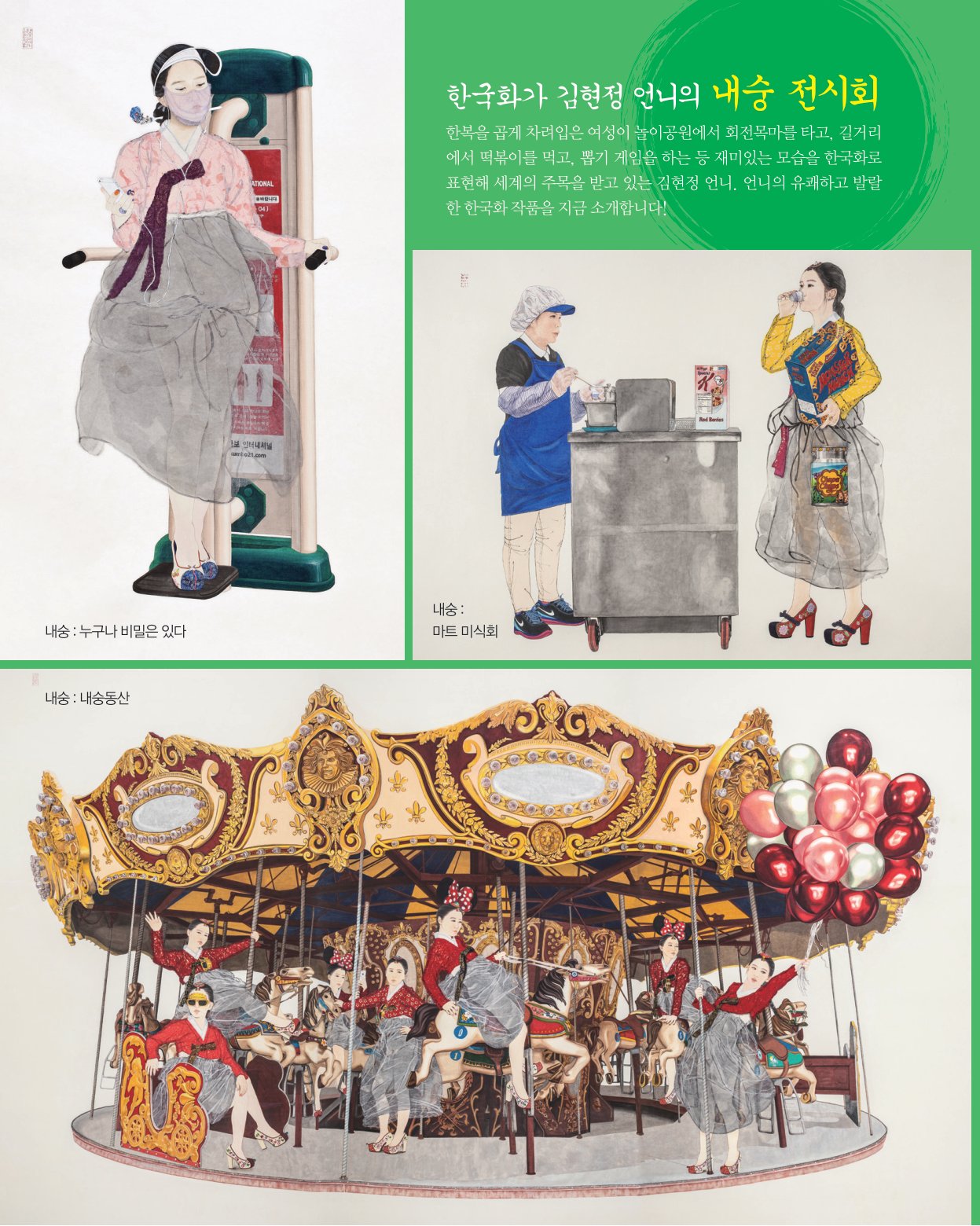
Korean Painter Kim Hyun Jung's Naesoong Exhibition
An elegant woman dressed in hanbok riding a carousel at an amusement park, eating tteokbokki on the street, playing a claw machine -- Sister Kim Hyun Jung, who has drawn worldwide attention for expressing these playful moments in Korean painting. Let us introduce you to her cheerful, lively Korean paintings now!
Want to see more of her work? Visit Sister Kim Hyun Jung's website! http://www.kimhyunjung.kr