






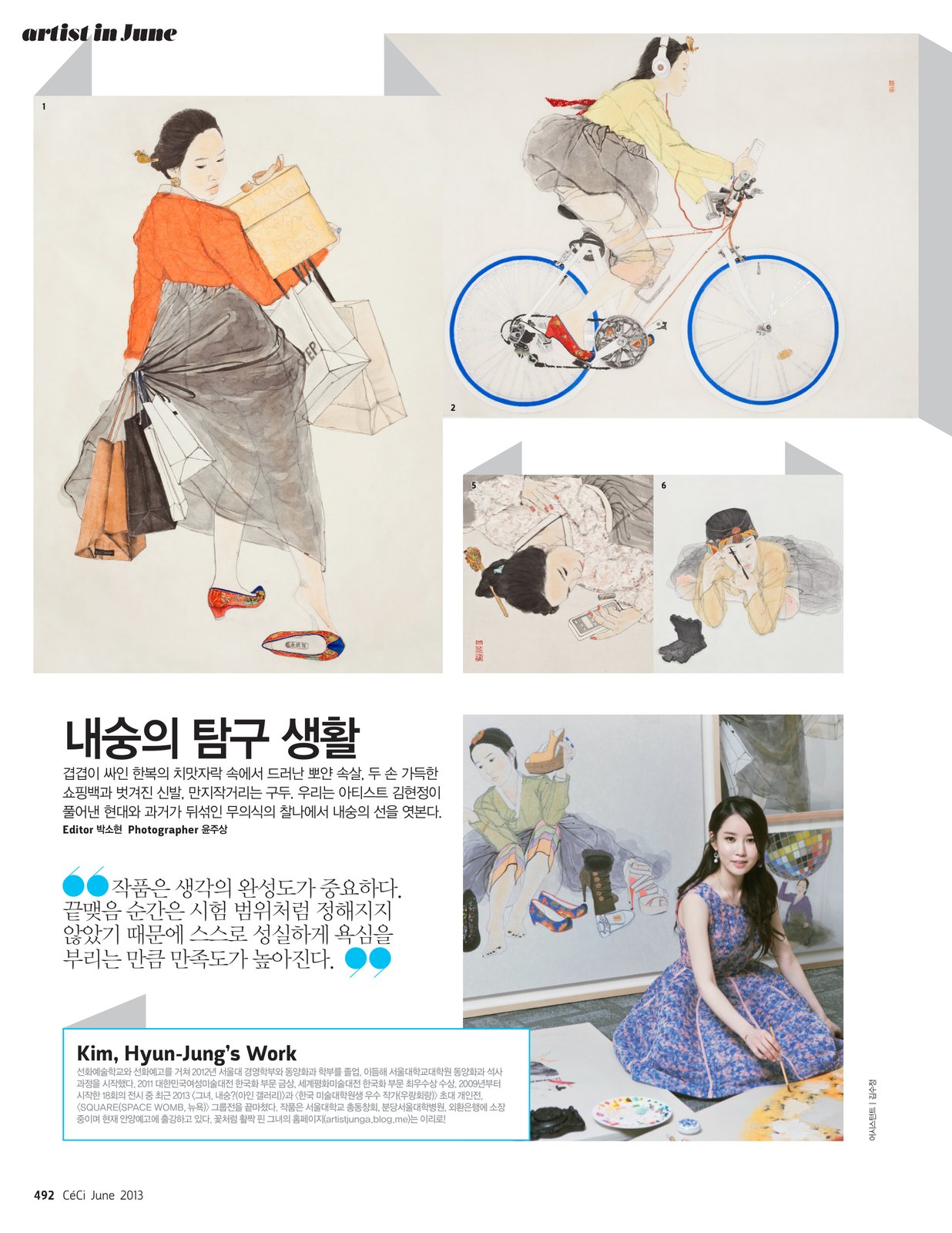

Ceci | vol.225 | A Study of Naesoong, Kim Hyun Jung’s Work
Fashion magazine Ceci ran an interview with Kim Hyun Jung titled "A Study of Naesoong" alongside images of nine works from her Naesoong series. Kim explained the background of her self-confessional self-portrait practice, which began from questioning the disconnect between people's outer and inner selves, her hanbok/nude/collage technique, her attachment to ink-wash painting, and her future goals. [Editor Park So-hyun, Photographer Yoon Ju-sang]
View full text
artist in June
A Study of Naesoong
Pale skin revealed within the layered folds of a hanbok skirt, hands full of shopping bags and a shoe slipping off, fingers fidgeting with a pair of heels. We catch a glimpse of the line of Naesoong in the instant of unconscious thought where the present and past mix, as unraveled by artist Kim Hyun Jung.
Editor Park So-hyun Photographer Yoon Ju-sang
"For a work, what matters is the completeness of the idea. Since the moment of finishing isn't fixed like the scope of an exam, the more sincerely and ambitiously I push myself, the greater my satisfaction."
Kim Hyun Jung's Work
After attending Sunhwa Arts School and Sunhwa Arts High School, she graduated in 2012 with degrees in Business Administration and Oriental Painting from Seoul National University. The following year she began her master's program in Oriental Painting at the same university's graduate school. She won the Gold Prize in the Korean Painting category at the 2011 Korea Women's Art Grand Exhibition and the Grand Prize in the Korean Painting category at the World Peace Grand Art Exhibition. Among 18 exhibitions since 2009, she has recently completed the invited solo exhibitions "She, Naesoong?" (Ain Gallery) and "Outstanding Korean Art Graduate Student Artist" (Woorim Gallery), and the group exhibition "SQUARE" (SPACE WOMB, New York). Her works are held in the collections of the Seoul National University Alumni Association, Bundang Seoul National University Hospital, and KEB Hana Bank, and she currently teaches at Anyang Arts High School. Visit her homepage (artistjunga.blog.me), in full bloom like a flower, right here!
[Photo: Assistant Kim Su-jeong]
[Work captions] 1 Oops (我差), 2013 2 Naesoong: Genitis, 2013 3 Naesoong: You Who Move Me, 2013 4 Naesoong: Trembling, 2013 5 Naesoong: Yearning (戀心), 2011 6 Naesoong: Emptiness (空), 2011 7 Naesoong: Moderation, 2013 8 Naesoong: You Who Move Me, 2013 9 Naesoong: Emptiness (空), 2013
I am ( an honest person who draws by sharing empathy, someone still searching for myself ) — Kim Hyun Jung.
The theme of Naesoong began from the question, after being hurt by seeing how people's outsides and insides differ, of whether their intentions were really all bad, or whether there wasn't some innocence in them to begin with. As the saying goes, "disliking someone is ultimately because you discover yourself in them" — it is also a reflection of a side of myself I had unconsciously tried to deny. Like disliking the so-called "doenjang-nyeo" (materialistic woman) stereotype, yet actually eating 1,000-won instant noodles while unable to take my eyes off takeout coffee and luxury bags. This process of coming to terms with it led to self-portrait work that honestly reveals the desires and realities of a woman in her twenties that anyone can relate to.
Self-portrait work is ( inner immersion, a means of objectifying myself ).
I was sensitive to others' gazes in order to appear positive to them. I asked myself what kind of person I am, what kind of person I should become, but it was difficult to name my true self. Naesoong may have been a defense mechanism that began from that very anxiety. To break the fallacy of being trapped in the conventional notion of what a likable person should be, I expressed it through the irony of mixed eras — hanbok, McDonald's, smart devices. Through self-confessional work, I search for my true self. That's why I have to be honest. The reason the work takes so long — drawing the figure nude before meticulously dressing it in hanbok — is for the same reason. It also reflects my wish to honestly bring out the story hidden within the wide folds of the skirt.
To me, ink-wash painting is ( both a goal and an obsession ).
When you first enter Oriental painting, you learn the ink-wash technique as a basic. While other artists gradually branch out into varied modes of expression, I stubbornly continue with ink-wash. It's because, moved unforgettably as a child by the works of Kim Hong-do and Shin Yun-bok, I want to reach that same level myself. Ink-wash is also a beautiful tradition. While Western oil painting becomes more complete and heavier the more layers you apply, ink-wash is a wonderful material that becomes more delicately transparent the more you layer it. I want to spread the charm of this fine material widely.
What I want to show off in my studio is ( Oriental painting materials ).
I learned the recipe for glue and paste from a master craftsman. For hanji, I use anpi, the thinnest paper among misarji sunji papers, for the sake of ink bleeding and detail. Being so thin, it can tear while I'm painting or crack while drying. It's a very delicate, fine-grained child of a material. In ink-wash painting, the transparency of the work is determined by the water. A spray bottle for fine water control is a permanent fixture on standby. The task of a fine brush, used to densely render each strand of hair and eyebrow at a thickness of 0.1mm, is a heavy one too.
An artist is ( a spokesperson who speaks on behalf of others' emotions ).
Whether screenwriter, novelist, composer, or painter, what these people have in common — regardless of medium — is that they give tangible form to phenomena or ideas. You have to pinpoint your own or others' emotions and draw them out in a way that feels cathartic, to elicit empathy. In the end, what's needed is communication. I've come to the conclusion that I should make work that seeks out the pent-up emotions buried under many people's desire for self-expression and the pressures of daily life.
The happiest moment as an artist is ( when the sense of time disappears ).
When I'm painting in the studio, before I know it, it's lunchtime the next day. I feel happy, believing it to be my true calling. I once received a letter saying that looking at my painting brought on so many thoughts that the reader alternated between laughing and crying. It made me feel, once again, glad I picked up a brush.
My future goal is ( to make the name Kim Hyun Jung recognized ).
My surname is Kim, and my given name is Hyun Jung. Among the countless Hyun Jungs that exist in search engines, I want to carve out territory with the keyword of ink-wash painting. Just as concertgoers applaud performers at a concert, I dream of an environment where painting, too, is broadly enjoyed by everyone, enriching our lives. For now, I need to beautifully carry through the project — currently under discussion — of decorating the presidential youth support center with the 'Naesoong' series, bring the upcoming exhibitions in Hong Kong, Germany, and Singapore to a fine close, and so, today too, I should start by painting fervently, without any naesoong (holding back) of my own.
CéCi, June 2013, pp.492-493