






Korean Medicine Times | “The Most Korean Content Is the Most Global”
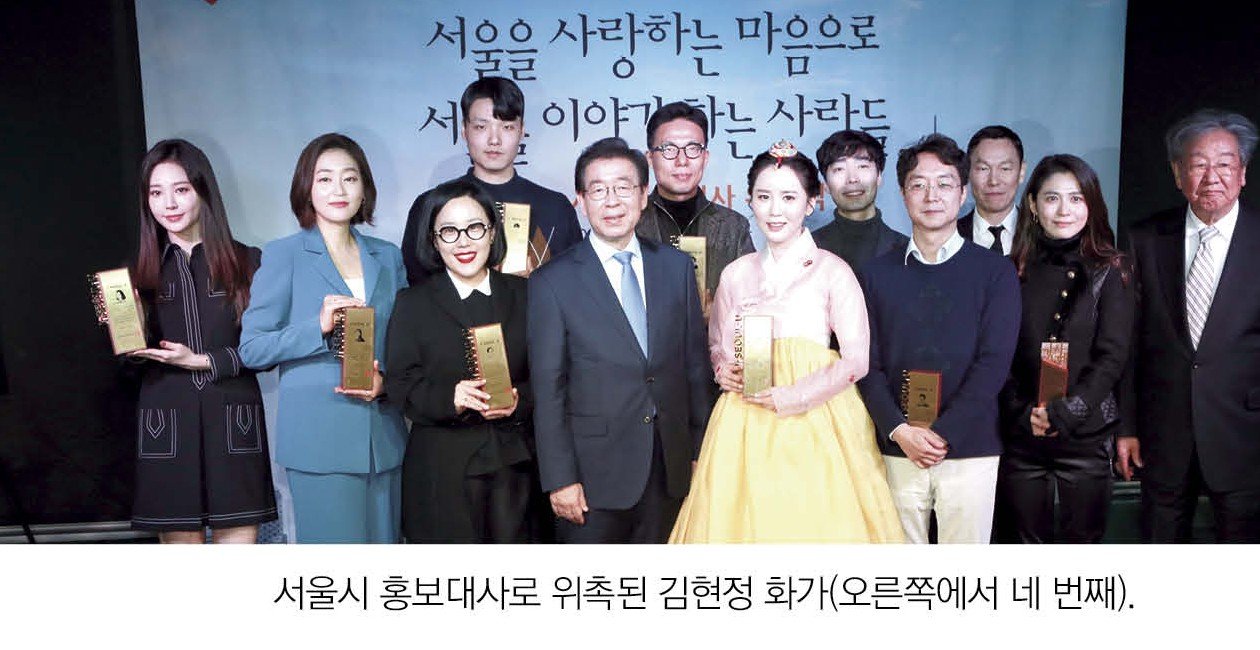
An interview with painter Kim Hyun Jung, conducted by the Korean Medicine Times on the occasion of her appointment as a Seoul publicity ambassador. She discussed what led her to major in Oriental painting and introduced signature works such as “Naesoong: You Move Me,” and said that traditional Korean medicine, as another uniquely Korean cultural heritage, has great potential for globalization, adding that under her belief that “the most Korean is the most global,” she hopes to become a cultural ambassador spreading Korean culture through Korean painting.
View full text
[Editor's note] In this feature, we spoke with painter Kim Hyun Jung, recently appointed a Seoul publicity ambassador in recognition of her active engagement with the public, about why she has worked to introduce Korean content to the public and to overseas audiences, and about how traditional Korean medicine might similarly connect with the public.
Oriental Painting, Korean Medicine… Korea's Own Traditional Culture Has Real Global Appeal
— You were recently appointed a Seoul publicity ambassador.
First, thank you. I was born and raised in Seoul, and have spent nearly 30 years here. It excites me to think my activities might help show how beautiful Seoul is and how rich its historical stories are, as a city that represents Korea.
— What drew your interest to Oriental painting?
Attending an arts high school, I naturally began exploring various painting styles with an eye toward my major, and gradually fell under the spell of ink-wash painting within Oriental painting.
As I began working with the materials of Korean painting, I settled firmly on Oriental painting as my major. In high school, I read a book by Oh Ju-seok called “A Special Lecture on the Beauty of Korea.” The book mainly examined the works of Kim Hong-do through the lens of “Korean beauty,” and I was deeply moved by the beautiful and remarkable tradition of Korean art. I wanted to follow the wit, delicate observation and lively brushwork Kim Hong-do showed in works like “Dancing Boy” and “Ssireum (Wrestling),” and that desire led me to keep pursuing Korean painting, insisting on its distinct techniques and materials.
— In 2016 you held the youngest-ever solo exhibition by a Korean artist at the Metropolitan Museum of Art.
One of my works, “Naesoong: You Move Me,” depicts a woman in hanbok, the “Naesoong girl,” riding a McDonald's delivery motorbike. A foreign visitor who saw this painting told me, “There's drive-through, but I never imagined McDelivery. That's really clever.” I explained that this wasn't my own idea but part of Korean culture, and enjoyed telling them enthusiastically about Korea's delivery culture. I had worried, vaguely, that hanbok isn't even that familiar to many Koreans, so would foreigners really understand it? But seeing how much interest foreigners showed in Korean genre painting and their eagerness to learn about Korean culture, I truly realized that the most Korean thing is the most global thing.
— What are your thoughts on traditional Korean medicine?
When I think of “hanuihak” (traditional Korean medicine), acupuncture comes to mind first. I still remember how painful and scary acupuncture felt as a child. I'm not sure why I was so afraid of it, but now that I'm an adult, when my body feels stiff or unwell, I actually go to a Korean medicine clinic for acupuncture, moxibustion and physical therapy. I also remember the drama “Huh Jun” from my childhood. It was such a popular show that I watched it faithfully, and I think it was a moment when Korean medicine became deeply embedded in popular culture. That drama got me thinking a lot about how art, too, could establish itself as popular culture.
From there, I came to think that one of the best ways for art to reach the public easily is to depict everyday life that people experience, with wit. I think Korean medicine, too, a distinctly Korean form of medical practice, could be well expressed through painting. So I'm planning to depict a scene of receiving treatment at a Korean medicine clinic next.
— Korean medicine is also a representative Korean cultural export.
As I understand it, Korean medicine takes each individual's constitution and temperament into account, selecting compatible herbal remedies to maximize treatment effect. Given the side effects of strong Western medications, I think the slower approach of herbal medicine and acupuncture is better suited to today's “slow” trend of practicing everyday wellness. And compared to the joke that a general hospital visit lasts only 90 seconds, doesn't a Korean medicine clinic spend considerably longer with each patient? At a Korean medicine clinic, the doctor listens seriously not only to physical discomforts but also asks what you usually eat, what exercise you do, what illnesses you've had before, and even quietly listens to emotional frustrations.
Everyone knows that invisible stress is at the root of many modern illnesses. It's not easy to bring up trivial stresses at a general hospital, but at a Korean medicine clinic, people end up talking about everything — work life, small issues at home, even relationships with people around them.
Thinking about why that is, I believe it's because there's a Korean medicine doctor who listens seriously, treating it all as part of the treatment. In the sense that it takes a holistic approach to a person's overall circumstances, I think Korean medicine is well-equipped to practice the concept of “communication.”
— Are there areas where more effort is needed for Korean medicine to become more global?
Korean medicine is a scientific medical practice no less than Western medicine, but I don't think that's how people generally perceive it. I hope academic research that can efficiently convey the various concepts Korean medicine deals with to foreigners will be pursued more actively, linked with scientific technology. Many world-famous Western medicines are extracted from precious plants, but Korean herbal medicine, largely based on plant leaves and roots, still hasn't fully shed the perception of being a supplementary remedy rooted in folk treatment.
In reality, what we think we know as Western medicine differs once you actually go abroad. In Europe, a single-doctor primary-care system means patients are closely monitored and cared for by the same physician over a long period. Prescriptions are also carefully managed to prevent unnecessary medication use, while exercise is recommended over surgery, and time-tested oral remedies are recommended over medication.
I actually think the Western medicine we think we know is closer to Korean medicine than we assume. If the concepts Korean medicine values could be defined with scientific figures and evidence, I think it would greatly help shift public perception. Just as Eastern practices like yoga and meditation have become even more popular abroad, I believe Korean medicine — and the Korean painting I practice — will one day become a global culture that people can comfortably share.
— What should be emphasized when introducing Korean culture abroad?
It's important to promote Korean culture with pride in the idea that “the most Korean is the most global.” Korean culture carries a 5,000-year history. I believe we need to properly understand our history and promote our culture with the spirit of “warming the old to know the new,” while also bringing the freshness and flexibility needed to harmonize tradition with the contemporary. The Naesoong Story series, depicting the “Naesoong girl” in hanbok, harmoniously expresses Western collage technique atop the tradition of Eastern ink-wash coloring, and has drawn praise for its freshness through its witty capture of everyday situations. I believe it's precisely this appeal of Korean painting, grounded in traditional materials and traditional technique, that has drawn attention to Naesoong Story overseas.
— What are your future plans?
This is ultimately tied to the business performance of Kim Hyun Jung Art Center, where I'm based. I want to become a “cultural ambassador” — a Korean painter who represents Korea internationally, widely spreading the charm and beauty of Korean painting to the public.
The power of Hallyu these days is truly remarkable. K-pop, K-drama, K-movies and more of Korea's culture are being introduced to the world and enjoyed by many. At first, I wondered, “Korea is known as a country of skilled hands, so why aren't there more Korean names among the world's famous artists?” That question made me realize I needed to understand the current state of Korea's art market, and I thought that if I, too, could contribute to broadening Hallyu, it would lead to good results.
In 2017, I was named to the U.S. business magazine Forbes' list of the 30 most influential people in Asia under 30. Through that opportunity, I plan to devote myself to various activities and to refining the completeness of my work, so that K-Art and Korean painting can become widely known around the world.