






Chosun Ilbo | [Kim Hyun Jung’s Picture Radio (8)] Collage, the Finishing Touch on Naesoong Work
In her column, Korean painter Kim Hyun Jung introduced the collage technique using hanji, the final stage in creating her 'Naesoong' series. She explained the background behind attaching thin hanji in the shape of clothing to capture the distinctive stiff texture of the hanbok jeogori (jacket), and detailed the specific process: boiling paste, choosing colors, dyeing, attaching, and tearing along the silhouette.
View full text
Gently lifting and tearing, then attaching and joining, carefully lifting once more to layer it all together.
Feeding in paste that carries a faintly fishy yet nutty scent, and adding color.
Through the crack of a slightly opened door, fine hanji sheets, swayed by a faint breeze, shyly tremble.
An act that lets me feel the thrill of the finishing touch by focusing on fingertips that sharpen every sense; work that sends me time-traveling with the intimacy of playing with paper dolls in childhood — not every stage of painting is always enjoyable, but collage is the one process I do consistently while humming along.
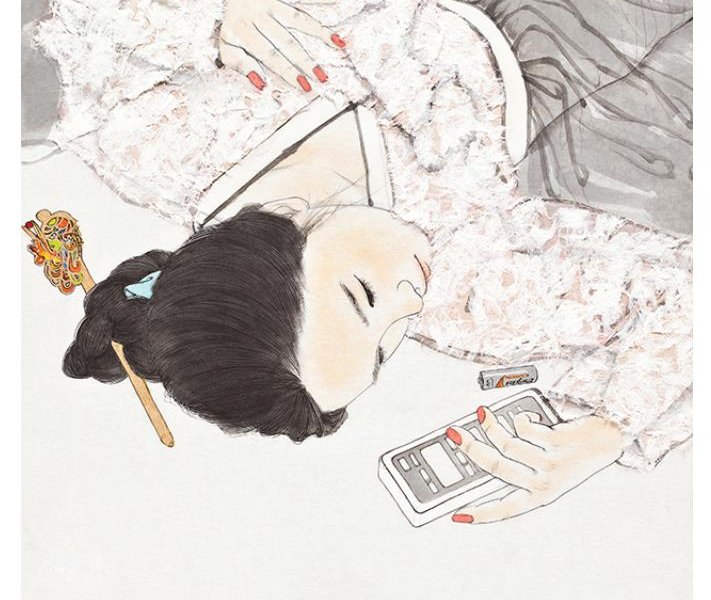
The final stage in making the <Naesoong> series is collage — attaching hanji to the jeogori (jacket) and skirt. In particular, this collage is characterized by using thin hanji to project the figure's silhouette.
Naesoong: Longing / Feign: Longing — Artist Kim Hyun Jung majored in Oriental Painting at Seoul National University and graduated from the same graduate school. She is currently drawing attention in the Korean art world for her fresh expression of the unique yet fascinating theme of "naesoong" together with hanbok. www.kimhyunjung.kr
The primary purpose of using collage in <Naesoong> was to borrow an expressive method suited to the hanbok jeogori. In other words, I wanted to realistically convey the crisp, taut feel of the jeogori, and after much deliberation, I arrived at hanji collage. Compared to the skirt of a hanbok, which has a flowing, starched feel, the jeogori fits closer to the body, giving it a somewhat stiffer feel — especially at the shoulder line — and hanji collage proved very effective at revealing that texture of hanbok.
Meanwhile, using collage to reveal the figure's silhouette reinforces the impression of "dressing" the figure in hanbok. While the skirt portion is rendered in ink-and-light-color so the silhouette shows through, the jeogori especially is expressed by attaching thin hanji in the shape of the garment, highlighting the meaning of dressing the figure in translucent hanbok.
For the most part, it's hard to find Korean painting techniques compiled into books. So the work is generally passed down through a master-disciple relationship. Having received instruction from several teachers, I want to organize what I've absorbed and digested in my own way.
A scene of collage in progress.
First is the process of boiling the paste.
Boiling five-year-aged starch powder, following the traditional method passed down to me, is a pleasure even for the nose. I mix and boil water and starch powder in a ratio of 1:2.75, stirring constantly. The studio fills with a carbonara-like aroma. And you have to stir the paddle vigorously enough to work up a sweat all over. Afterward, it's strained gently through a bamboo sieve. Throughout this whole process, since contact with metal reduces adhesiveness, you must use wooden tools as much as possible.
Second is the process of deciding the jeogori's color.
This stage feels almost like shopping. To match the color to what this figure suits and to what the work is trying to say, I use color swatches to decide the jeogori's color.
Third is the process of dyeing the hanji.
For the jeogori portion, I obtain dye in the previously chosen color and dye the paper. The skirt portion is occasionally rendered in collage too, but I always render it in ink.
Since thin hanji is hard to come by, I have paper made to order at a hanji workshop and then dye it in the desired clothing color myself. Dyeing can be done either by directly dyeing the raw mulberry-bark fiber before the hanji is made, or by applying color multiple times to already-made hanji.
Fourth, matching the pleats, I attach the paper using the paste made earlier.
Finally, I tear it by hand along the silhouette.
Though this technique began as a way to create translucency, it requires this many steps, and there's always the anxiety that the intended silhouette could be ruined if done wrong — so I work in constant tension and concentration.
In a way, I think we do countless "collages" in everyday life too. Sometimes we want to tear away someone's hurtful words; sometimes we want to carefully gather good feelings and paste them neatly into our lives. Emotions that would tear if handled too roughly can, if arranged well alongside various memories in a collage, be held onto more firmly and for longer.