








Samcheonri | Summer Issue — The Audacious Creativity of Korean Painter Kim Hyun Jung
An essay on Korean painter Kim Hyun Jung contributed by art critic Park Young-taek (Professor, Kyonggi University) to the summer 2016 issue of the Samcheonri in-house magazine. Criticizing today's Korean painting as often a 'taxidermied tradition,' the piece highlights how Kim's 'Naesoong Stories' series honestly depicts the desires and everyday life of contemporary young women through a hanbok-clad figure. A profile and mini-interview with the artist are included at the end.
View full text
Young artists' Korean-painting work is operating on a very different level from before. Through their work, Korean painting is being boldly dismantled compared to before. Among them, one artist stands out unmistakably: Kim Hyun Jung. In January of this year she held an invitational solo exhibition at the Metropolitan Museum of Art in New York, and was invited as the youngest artist to 'Stop, and Look,' an exhibition shedding light on the history of Korean painting at the National Museum of Modern and Contemporary Art. Let's meet the work of young Korean painter Kim Hyun Jung, who is drawing enormous public interest with the theme 'Naesoong Stories.'
PROLOGUE
Oriental Painting Containing 'Society,' and Contemporary Art of the 'Individual'
What is commonly called Oriental painting refers to a series of paintings that pictorialize the distinctive thought developed in Northeast Asia — paintings from a handful of Confucian-cultural-sphere countries including China, Korea, and Japan. Landscape painting, the Four Gentlemen (plum, orchid, chrysanthemum, bamboo), and various other paintings all fall into this category. They are, without exception, a kind of religious painting in which Confucianism, Laozi and Zhuangzi, and Buddhist thought are intermingled. Put simply, what we commonly call traditional Oriental painting can be said to be the imagization of the way people of that time understood objects and the world, based on the cosmology, worldview, and religious view they held. In traditional society, an image (art) was, in this way, a symbolic expression of the values people of a specific period believed in.
Since the modern era, art has become limited to the individual's creative work, and afterward artists came to paint a variety of pictures according to each one's own beliefs, interests, and set of convictions about art. We call this contemporary art. So today's artists' paintings are, ultimately, a personal declaration of an individual's thoughts about art and of the various problems arising from their own life. Accordingly, today's Oriental painting is no longer the same as the landscape painting, Four Gentlemen, or folk paintings of before. The interests, beliefs, and hopes of people of the past cannot be the same as the values of contemporary people, can they? That much time has passed, the era has changed, and the framework through which people see and understand the world has changed a great deal as well.
Today's Korean Painting, a 'Taxidermied Tradition'
Coming into the 1980s, the term 'Korean painting' began to be commonly used instead of 'Oriental painting' (currently every art college uses 'Department of Korean Painting' rather than 'Department of Oriental Painting'), and the work of young artists in recent years has also changed a great deal from before. Rather than paintings internalizing traditional thought and values, they are actively used as tools that faithfully reflect one's own desires in life, the reflection of one's era, and one's inner self. In fact, painting is the work of giving form to one's own honest eye and sense in viewing objects and the world. It is also a departure from existing conventional painting and shared values and worldview, and a revelation of one's own eye, sense, and outlook on life. Passing through the mid-1980s, the Korean art world began developing interesting work on a level different from before. Even now, many majoring in Korean painting still paint 'Korean painting/Oriental painting.'
What, then, is Korean painting today? Traditional Oriental painting effectively disappeared after the collapse of Joseon, which had been sustained by Confucian ideology. The absence of the literati class of scholar-officials who had been devoted to that ideology turned landscape painting and the Four Gentlemen — which had belonged to their ideological painting — into signifiers without signified meaning. Even today, a considerable number of Korean-painting works are cases where those empty signifiers are simply repeated. And this is claimed and upheld as tradition.
For most artists, I think Korean painting is mortgaged to reproducing a specific subject through traditional materials, or to a fixed perspective and awareness of Korean painting and its conventional discourse. Accordingly, those paintings habitually follow what is already assumed to be 'Korean painting,' claiming through this to be doing 'Korean painting' work — revealing the strange situation where legitimacy is granted only within the confines of borrowing the alibi of being a 'Korean-painting artist.' They 'sketch from life' formulaic natural scenery and understand it as an extension of traditional landscape painting, or regard the meticulous, decorative rendering of flowers, birds, or figures as coloring painting. Or they borrow subjects belonging to traditional categories, twist them slightly, and want to regard it as a fairly meaningful reinterpretation of tradition. And they attempt this collectively, uniformly. Most of these paintings remain a kind of decorative painting, illustration. Even so, the meaning used to package them still leans on tradition. In any case, I think the biggest problem in contemporary Korean painting arises from borrowing a limited subject matter, rigid notions, and worn-out, clichéd meaning for what 'Korean painting/Oriental painting' is. At the same time, it arises from mistaking a 'taxidermied tradition' for tradition.
SHE
Kim Hyun Jung, Who Attempts Distinctive Work
Kim Hyun Jung is an artist evaluated as doing quite 'provocative' and distinctive work in the Korean-painting field these days. Both the content of her work and the 'system' by which she creates and runs her exhibitions differ greatly from the conventional. People say she is an artist who works with the kind of fresh sensibility and playful imagination that only a young generation can possess, with something different from the established generation in many respects. She appears to work with an approach in which attempting her own distinctive work and breaking from existing habitual work coexist with a calculated, strategic aspect as a professional, achievement-driven artist.
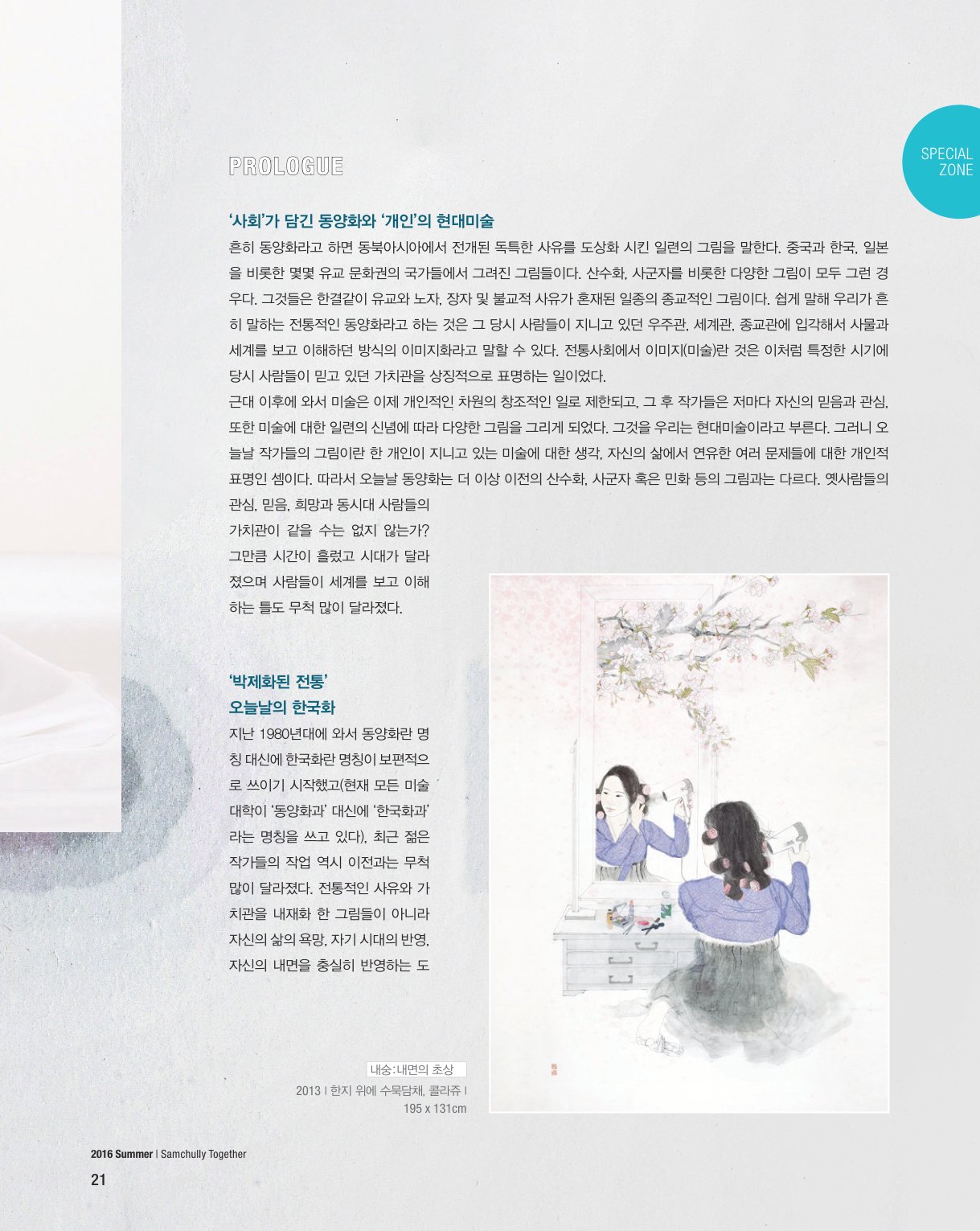
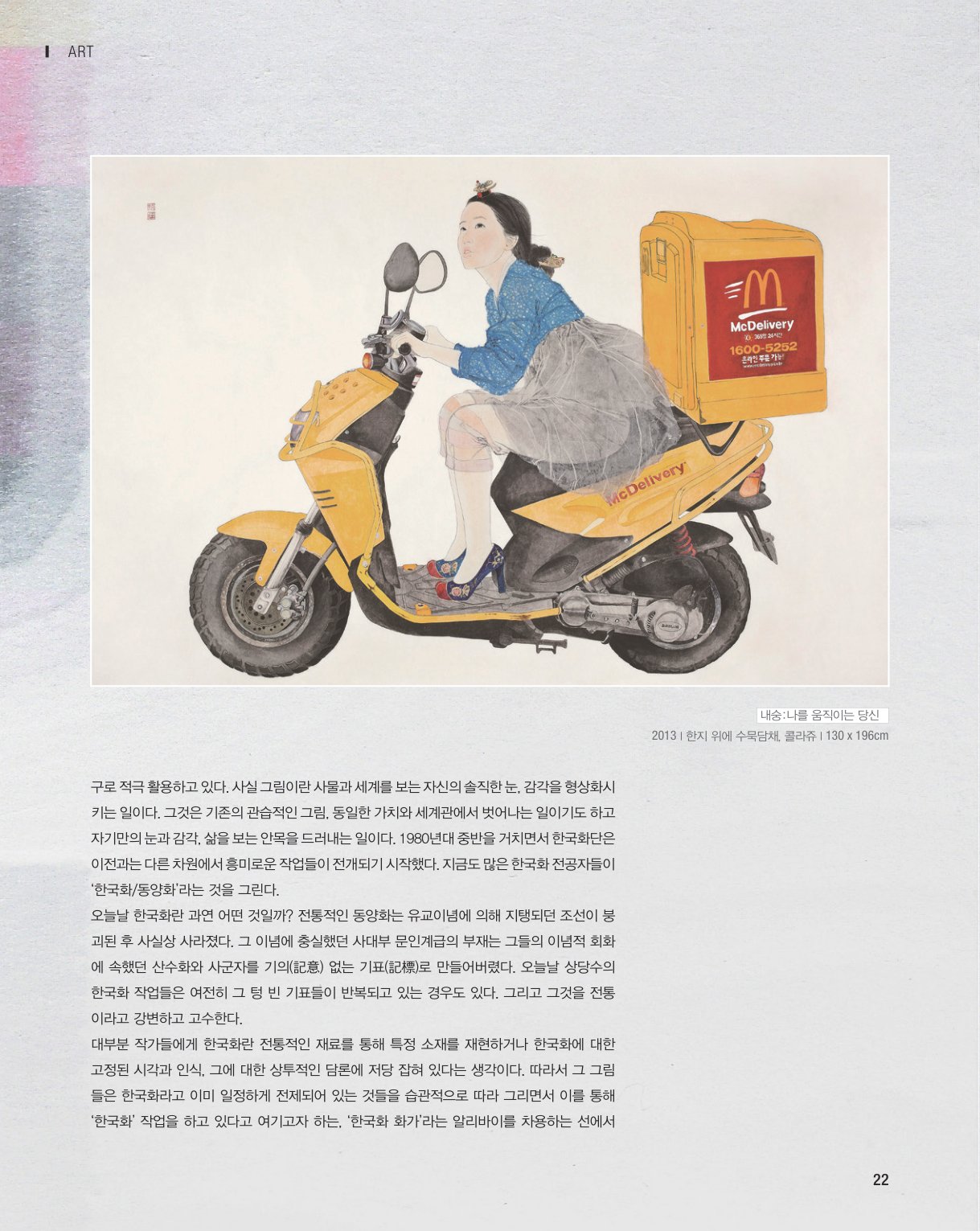
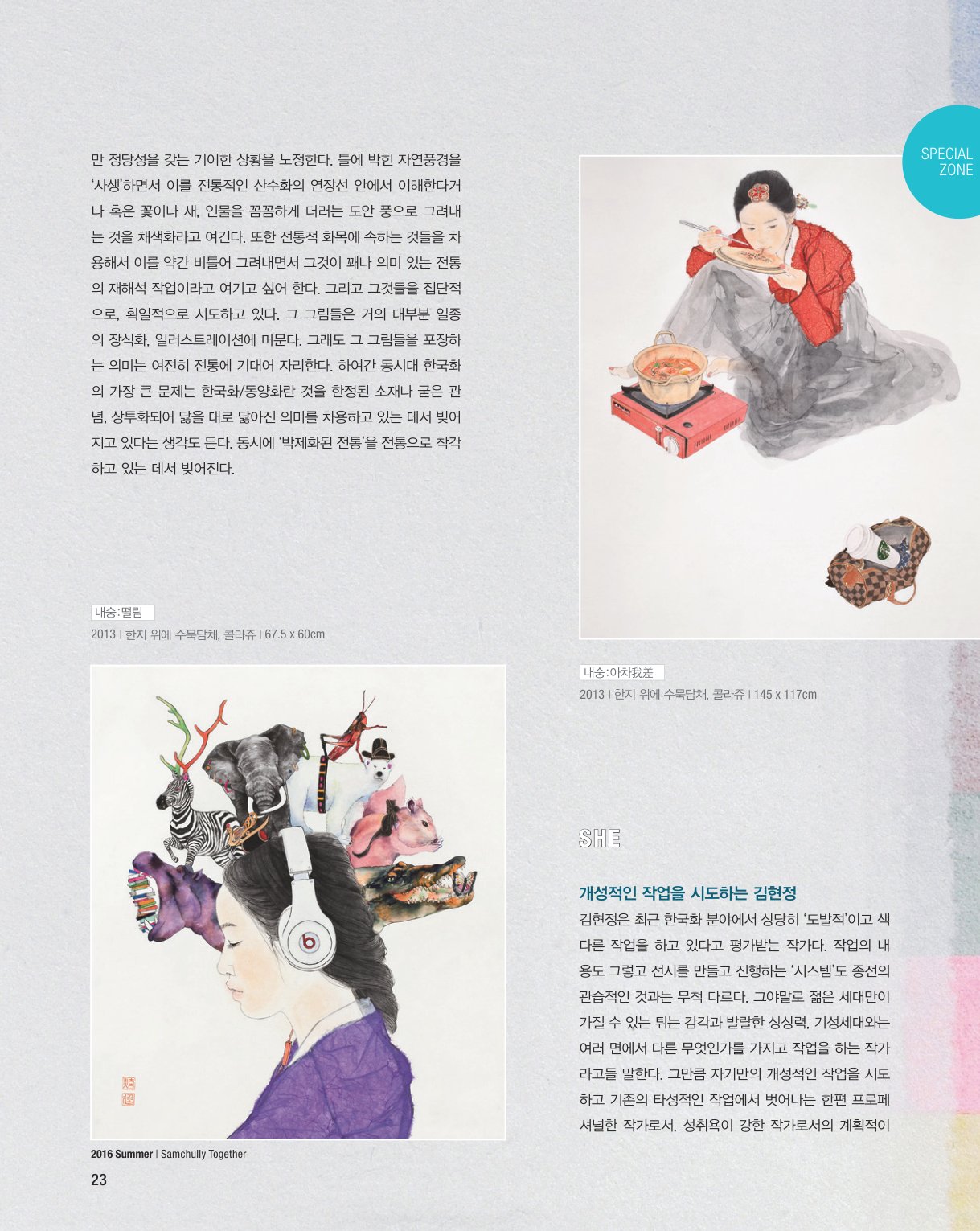
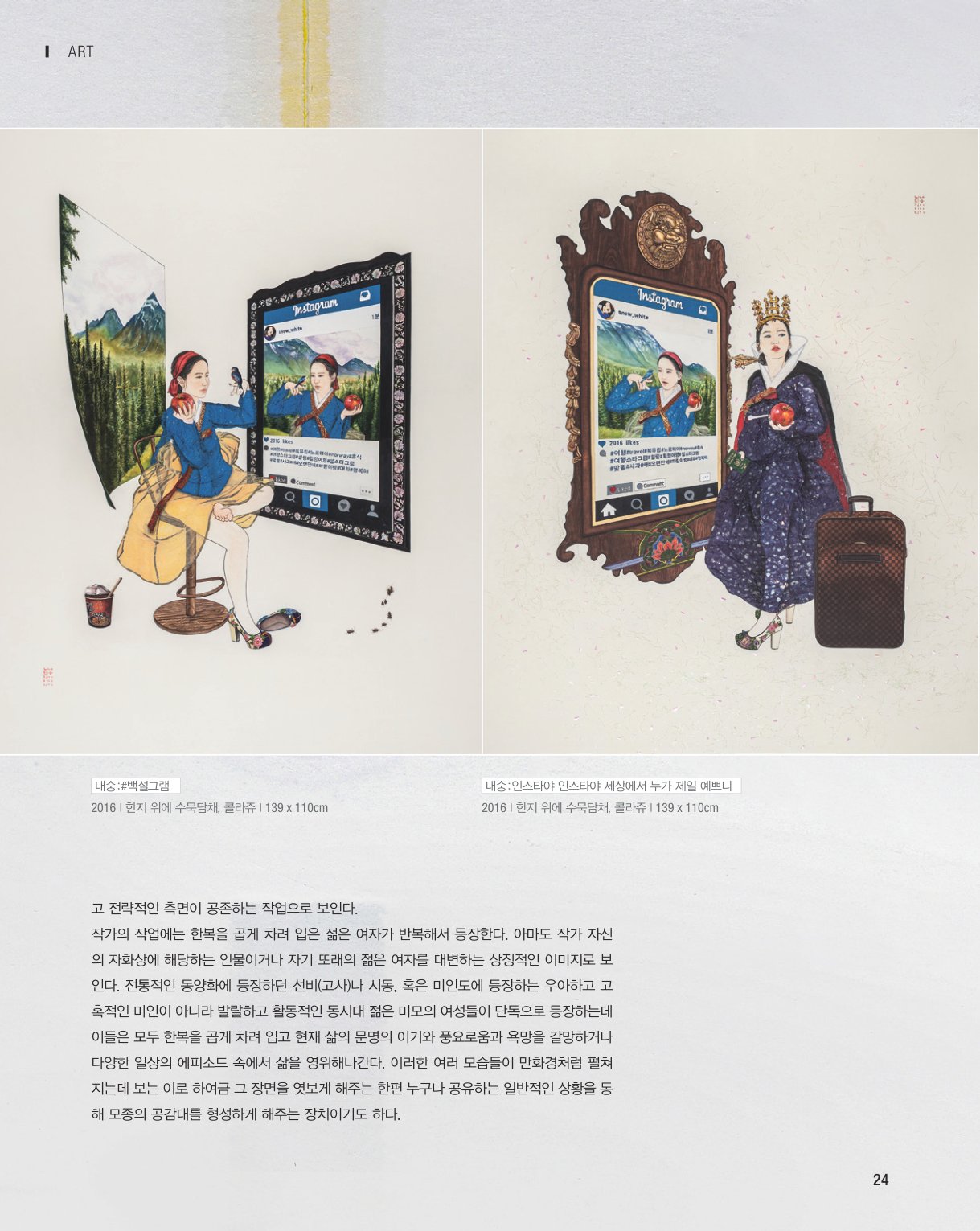
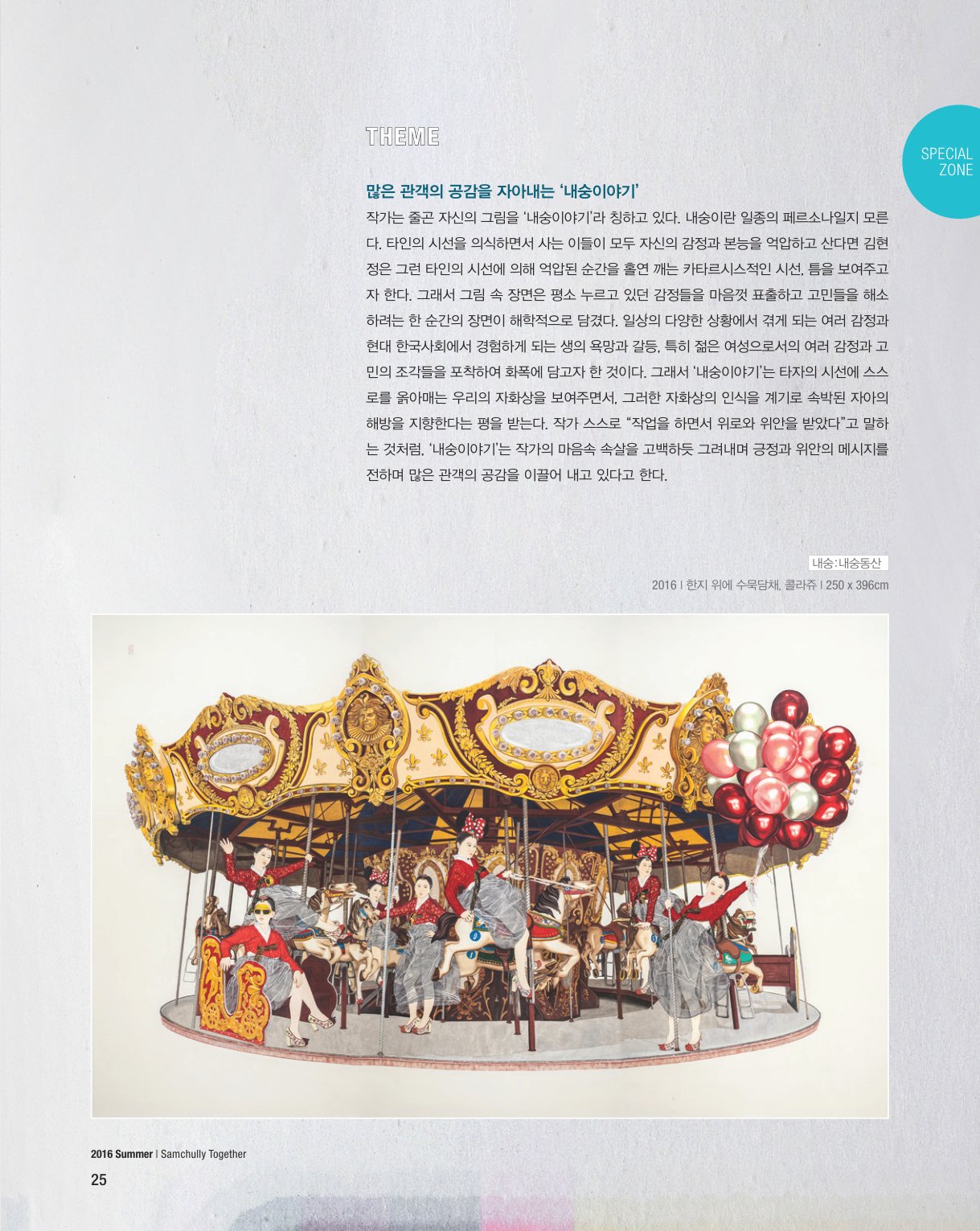
In the artist's work, a young woman dressed elegantly in hanbok appears repeatedly. She seems to be either a figure corresponding to the artist's own self-portrait, or a symbolic image representing a young woman of her own age. Rather than the scholar-recluse or attendant figures found in traditional Oriental painting, or the elegant, alluring beauty of a bijindo (beautiful-woman painting), a lively, active, beautiful young woman of the present era appears alone, always dressed elegantly in hanbok, yearning for the conveniences and abundance of present-day civilization and desire, or living her life amid various everyday episodes. These various scenes unfold like a kaleidoscope, functioning both as a device that lets the viewer peek in on the scene and, through generally shared situations, forms a certain empathy.
THEME
'Naesoong Stories,' Evoking Empathy in Many Viewers
The artist consistently calls her paintings 'Naesoong Stories.' Naesoong may be a kind of persona. If all people who live conscious of others' gaze suppress their own emotions and instincts, Kim Hyun Jung wants to reveal a cathartic gaze, a crack, that suddenly breaks the moment suppressed by that outside gaze. So the scenes within the paintings humorously capture a single moment where feelings normally held down are freely expressed, and worries are meant to be released. She sought to capture on canvas the various emotions experienced in daily situations, the desires and conflicts of life experienced in contemporary Korean society, and especially the fragments of emotion and worry of being a young woman. So 'Naesoong Stories' is said to show our self-portrait, binding ourselves to the gaze of others, while through the recognition of that self-portrait, aiming for the liberation of a confined self. As the artist herself says, "I received comfort and consolation through this work" — 'Naesoong Stories' paints, as if confessing the artist's inner self, delivering a message of affirmation and comfort, and is said to draw great empathy from many viewers.
SPECIAL
The Courage to Connect Honest Self-Awareness to Painting
The young woman Kim Hyun Jung paints has the pretty, adorable, lively and cute look of an idol star. But the moment she appears clad in an alluring hanbok, a curious temporal gap arises. It is the contrast of elegant, refined hanbok with mundane, slightly absurd behavior — the contrast of traditional dress and contemporary props. Traditional attire meets contemporary custom, so to speak. As various circumstances of young women's lives today connect, an unexpected dissonance, like a crack, arises. The painting, rendered in meticulous coloring technique, carries content that feels somewhat heterogeneous relative to its own form.
And this content is thought to evoke great empathy among contemporaries. Rather than an antiquated or traditional Korean painting that seems to have little to do with present-day contemporary life, it accompanies a curious catharsis, coming from the fact that the problems of our lives in this very moment are expressed somewhat directly, honestly, boldly, and explicitly.
It points out our vague prejudices, while above all showing the self-awareness of a young person being honest with themselves, and the courage to naturally connect that to painting.
Subjects Captured from Everyday Life, Containing the True Face of Our Lives
Kim Hyun Jung captures her subjects from "the familiar processes we always experience in our daily lives," which are naturally observed from the artist's own everyday life. And the content drawn out by that observational power delivers a certain sincerity to those who view the paintings. It is precisely there, one may argue, that the true face of our lives resides.
In this way, Kim Hyun Jung's Korean painting draws attention for being an honest reflection of her own era and life, and for expressing her own life desires, psychological conflicts, or inner story quite honestly and unreservedly — and for stating that story honestly.
Kim Hyun Jung Profile
Born 1988. She passed through Sunhwa Arts Middle and High School, and through Seoul National University's Department of Oriental Painting, earning her master's degree in Oriental Painting from the same graduate school. In an art world that values seniority and career length, she is recognized for her contribution to art history as the 'idol of Korean painting,' bringing the pop of Korean painting freshly into SNS and popularizing it. Alongside active creative activity, she is also at the forefront of popularizing Korean painting through active communication via SNS and blog.
http://www.kimhyunjung.kr
MINI INTERVIEW
KIM, HYUN-JUNG
Where do you find subject matter for your work? Please share your own creative know-how for Samcheonri staff.
# I actively make use of SNS and find subject matter within everyday life. Since my 'Naesoong' series is my self-portrait, you could say the scenes of my actual life show through a great deal in the paintings. And there's something I care about just as much as my creative work — 'communication with viewers through SNS.' I personally run Facebook and a blog, supplementing what was difficult without an exhibition — the difficulty of communication between artist and viewer. Artists' creative work has traditionally been one-directional, but I try to communicate bidirectionally, through messengers and SNS, working to reach viewers in a friendlier way. In fact, meeting viewers online and conversing with them, I encounter many unexpected ideas I hadn't thought of. It has become, in a sense, a part of my work process. I hope Samcheonri staff, too, discover creativity in your own daily lives.