







Osulloc | Our Self-Portraits Reflected in the Canvas
Osulloc's tea magazine interviewed Korean painter Kim Hyun Jung about how her signature 'Naesung Story' series came about, her process of using portrait photography, and her long fascination with ink wash painting. Written by Lee Anna, photographed by Kim Kyung-soo.
View full text
Tea lovers
Our Self-Portraits
Reflected in the Canvas
Like Narcissus,
who fell in love
with his own beauty
reflected in the water,
oriental painter Kim Hyun Jung
captures her own reflection
in a mirror on canvas,
and through it
speaks of all of us
living in the present.
Written by Lee Anna — Photographed by Kim Kyung-soo
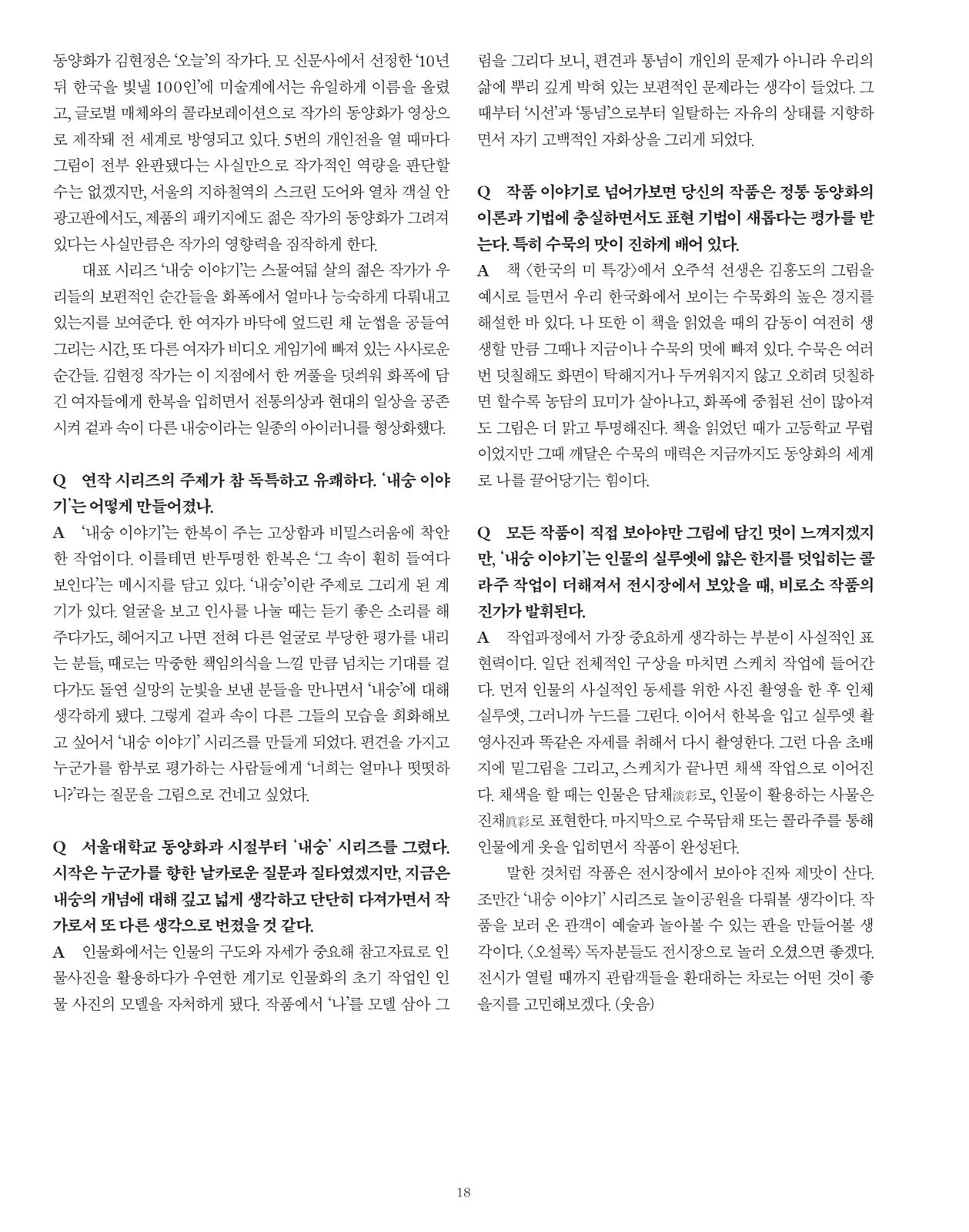
Oriental painter Kim Hyun Jung is an artist of 'today.' She is the only figure from the art world named to a major newspaper's list of '100 People Who Will Shine Korea in 10 Years,' and through a collaboration with a global media outlet, her oriental paintings have been made into video content broadcast around the world. The fact that every painting sold out at each of her five solo exhibitions can't alone measure an artist's ability, but the fact that a young artist's oriental paintings appear on subway screen doors and train-car advertisements in Seoul, and even on product packaging, hints at the scope of her influence.
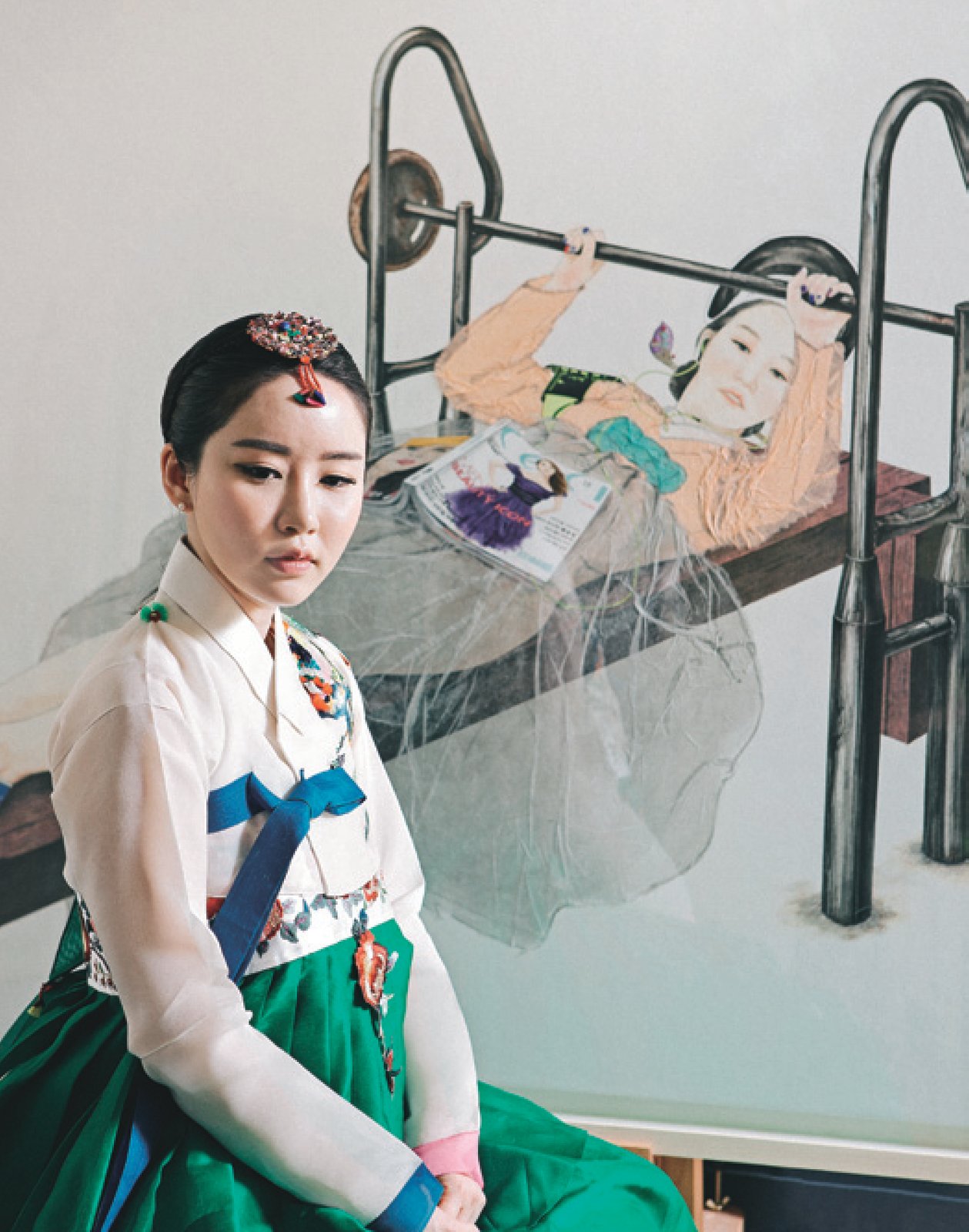
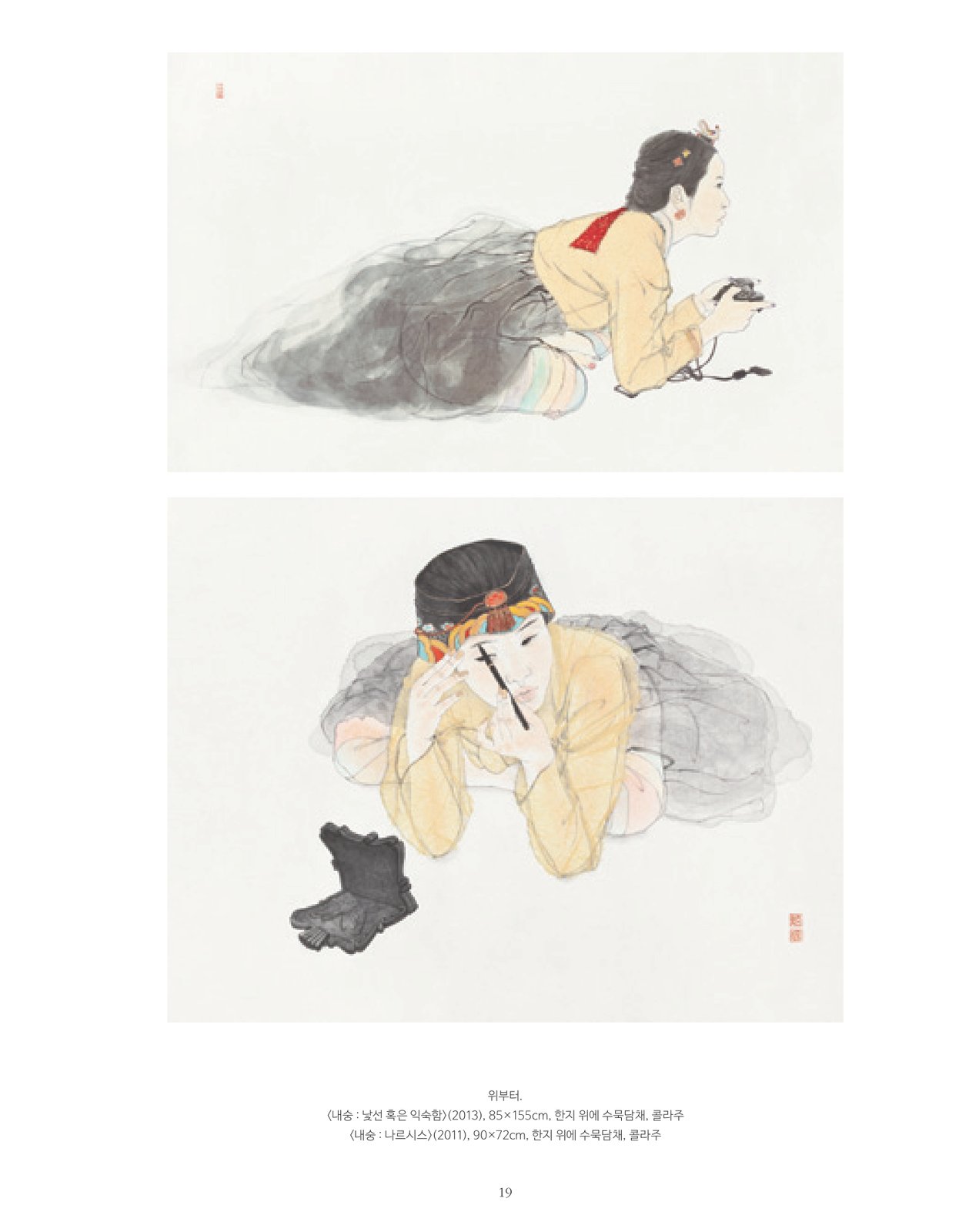
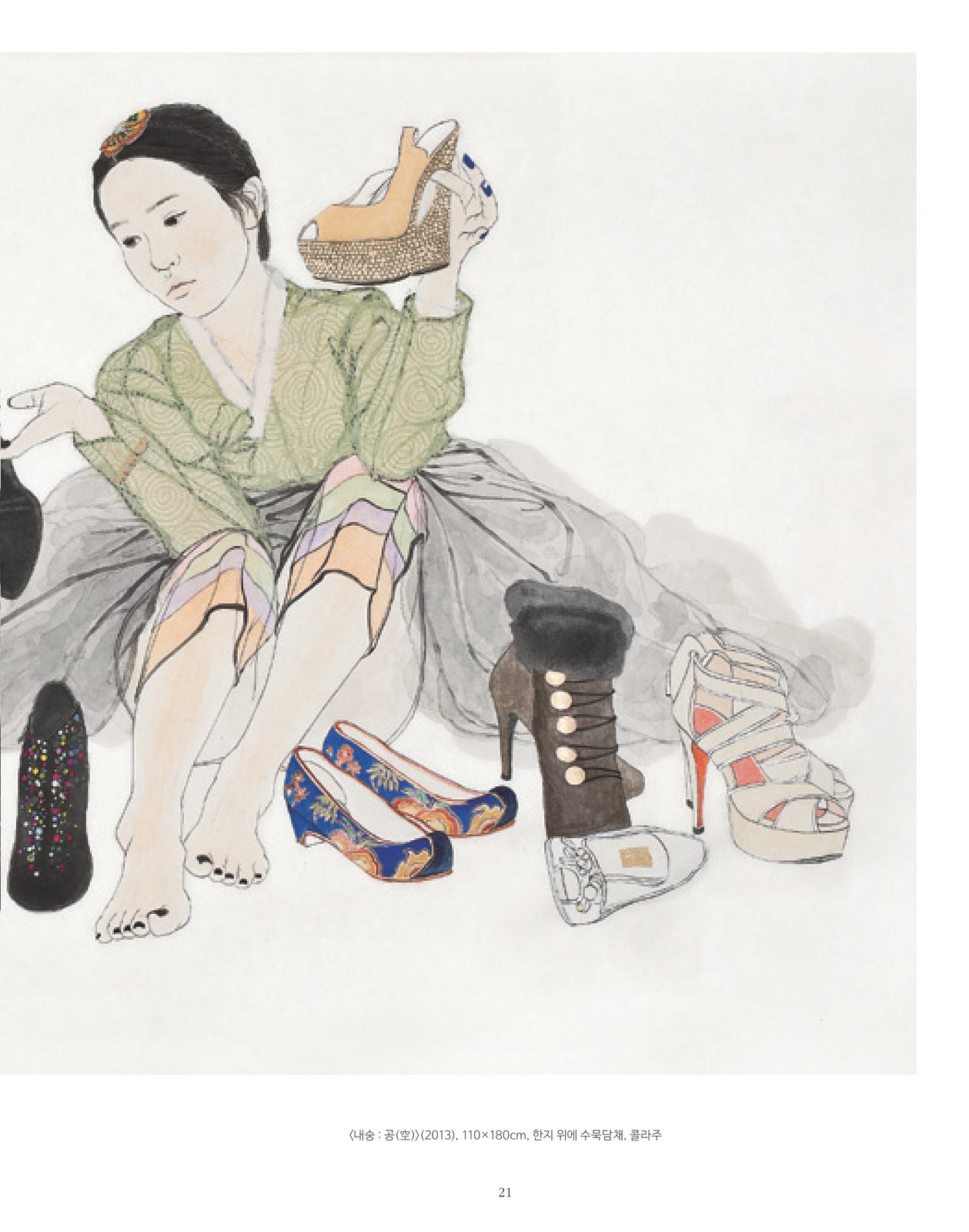
Her signature series 'Naesung Story' shows just how skillfully this twenty-eight-year-old artist handles our shared, universal moments on canvas. A woman lying on the floor, carefully drawing on her eyebrows; another absorbed in a handheld video game — private, everyday instants. Kim Hyun Jung adds one more layer here, dressing the women on her canvas in hanbok, letting traditional dress and modern daily life coexist to give form to a kind of irony: 'naesoong,' the gap between how a person appears and what they hide inside.
Q The theme of this series is remarkably unique and playful. How did 'Naesung Story' come about?
A 'Naesung Story' grew out of the elegance and secrecy that hanbok conveys. For instance, a semi-transparent hanbok carries the message that 'you can see right through her.' There was a specific moment that led me to the theme of 'naesoong.' I thought about it after meeting people who said pleasant things to my face but judged me unfairly the moment I was gone, and people who placed such heavy expectations on me that I felt a crushing sense of responsibility, only to suddenly show disappointment in their eyes. I wanted to paint the way these people looked one way outside and another way inside, and so I began the 'Naesung Story' series. To people who carelessly judge others out of prejudice, I wanted to pose a question through painting: 'how upright are you, really?'
Q You've been painting the 'Naesung' series since your time in the Oriental Painting department at Seoul National University. What began as a sharp question and rebuke aimed at others seems to have grown, over time, into something you've thought through more deeply and broadly as an artist, branching into new ideas.
A In figure painting, the composition and pose of the subject matter a great deal, so I used photographs of people as reference — and through that process I ended up modeling for my own early figure studies almost by accident. As I kept using 'myself' as the model in my work, I began to feel that prejudice and convention weren't an individual's problem but a universal one, deeply rooted in all our lives. From then on, aiming for a state of freedom that breaks away from 'gaze' and 'convention,' I began painting confessional self-portraits.
Q Turning to the work itself — your paintings are praised for staying faithful to the theory and technique of authentic oriental painting while still feeling fresh in their expression. The flavor of ink wash is especially pronounced.
A In his book Lectures on Korean Beauty, the scholar Oh Ju-seok used Kim Hong-do's paintings as an example to explain the high level of mastery ink wash reaches in Korean painting. The impression that book left on me is still vivid, and I'm as captivated by the flavor of ink wash now as I was then. No matter how many times you layer ink wash, the surface never turns muddy or heavy — the more layers you add, the more the subtle charm of light and dark comes alive, and the more overlapping lines fill the canvas, the clearer and more transparent the painting becomes. I read that book back in high school, but the appeal of ink wash I discovered then is still the force pulling me into the world of oriental painting today.
Q Every work truly needs to be seen in person to feel its charm, but 'Naesung Story' in particular — with its collage of thin hanji layered over the silhouette of the figure — only reveals its true worth when seen at the exhibition.
A The part of the process I consider most important is realistic expression. Once I've finished the overall conception, I move into sketching. First I take photographs to capture a realistic sense of the figure's movement, and draw the nude body silhouette from that. Then I photograph the same pose again, this time wearing hanbok, matching the earlier silhouette shot exactly. After that I draw the underdrawing on backing paper, and once the sketch is done I move into coloring. When coloring, I render the figure in light, translucent tones (damchae) and the objects she interacts with in bold, opaque color (jinchae). Finally, the work is completed by dressing the figure through ink-wash coloring or collage.
As I said, the work truly comes alive when seen at the exhibition. I'm thinking of taking on an amusement park next in the 'Naesung Story' series. I'd like to build a stage where visitors who come to see the work can actually play within the art. I hope Osulloc's readers will come visit the exhibition too. Until then, I'll be thinking about what kind of tea would make the best welcome for visitors. (Laughs)
From top.
'Naesung: Unfamiliar or Familiar' (2013), 85×155cm, ink and light color on hanji, collage
'Naesung: Narcissus' (2011), 90×72cm, ink and light color on hanji, collage
'Naesung: Emptiness (空)' (2013), 110×180cm, ink and light color on hanji, collage