








Cheonji Ilbo | [Interview] The ‘Idol of Korean Painting’ Kim Hyun Jung… Painting ‘Naesoong,’ Doing Anything While Wearing Hanbok
Cheonji Ilbo interviewed Korean painter Kim Hyun Jung about the starting point of her 'Naesoong Story' series, the shift toward self-portraiture, and the meaning of hanbok as her subject matter. Kim explained that work born out of a reaction against others' gazes evolved into confessional self-reflection.
View full text
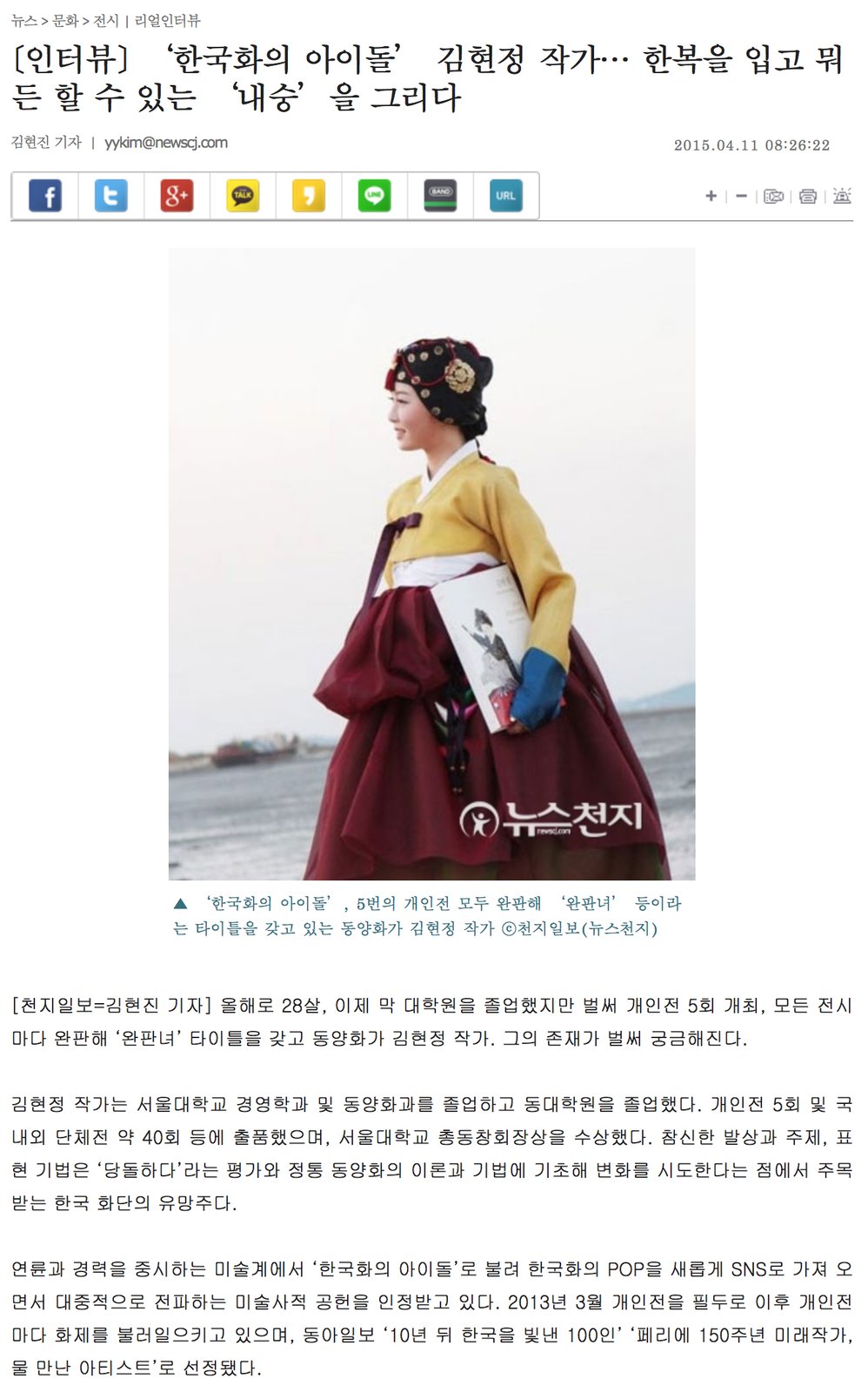
[Cheonji Ilbo = Reporter Kim Hyun-jin] This year, at just 28 years old, having only just graduated from graduate school, Oriental painter Kim Hyun Jung has already held five solo exhibitions, every one of which has sold out completely, earning her the nickname "the sold-out artist." One can't help but grow curious about her.
Kim Hyun Jung graduated from Seoul National University with degrees in Business Administration and Oriental Painting, then completed the same graduate school's program. She has held five solo exhibitions and exhibited in roughly 40 group exhibitions at home and abroad, and received the Seoul National University Alumni Association President's Award. She is a rising star of the Korean painting world, noted for her fresh ideas, themes, and techniques described as "bold," while attempting change grounded in the theory and technique of traditional Oriental painting.
In an art world that prizes seniority and experience, she's been dubbed the "idol of Korean painting," credited with the art-historical contribution of bringing Korean-painting pop culture newly to social media and spreading it to the public. Since her solo debut in March 2013, each subsequent exhibition has generated buzz, and she has been named to Dong-A Ilbo's "100 People Who Will Shine Korea in 10 Years" and selected as one of Perrier's 150th Anniversary "Future Artists, Artists Who Have Found Their Element."
She has also received the Grand Prize at JTBC's Beautiful People. Through her solo exhibition 'Naesoong Olympics' at Insa Art Center, she has drawn the greatest attention from both media and art lovers. Every exhibited painting selling out generated buzz each time, and she has won much public affection via social media. She was named "Notable Artist of the Year" in the fine arts category and awarded a trophy and certificate.
Kim Hyun Jung met with audiences through an "Artist Talk" program at her June 2014 solo exhibition <Naesoong Olympics> at Insa Art Center, Insadong, Seoul. A total of 3,733 visitors attended the second Artist Talk session, setting an all-time attendance record for Gana Insa Art Center. Over the ten-day exhibition period, about 24,000 visitors in total came, again setting Gana Insa Art Center's highest attendance record.
Kim Hyun Jung is a young Oriental painter in her twenties who has become a topic of conversation for painting women in hanbok under the theme of naesoong. Despite her brief career, she has gained enough popular appeal to be called the "idol of Korean painting." Let's find out more about her.
Q. Your work's starting point is "naesoong." Please tell us about that.
As a college student just past twenty, I was often hurt — whether shallowly or deeply — in relationships with others. What I found especially hard to bear was people's tendency to judge who I was based on a single facet of me, or the way their gazes evaluated me. This was, of course, not a worry unique to me alone.
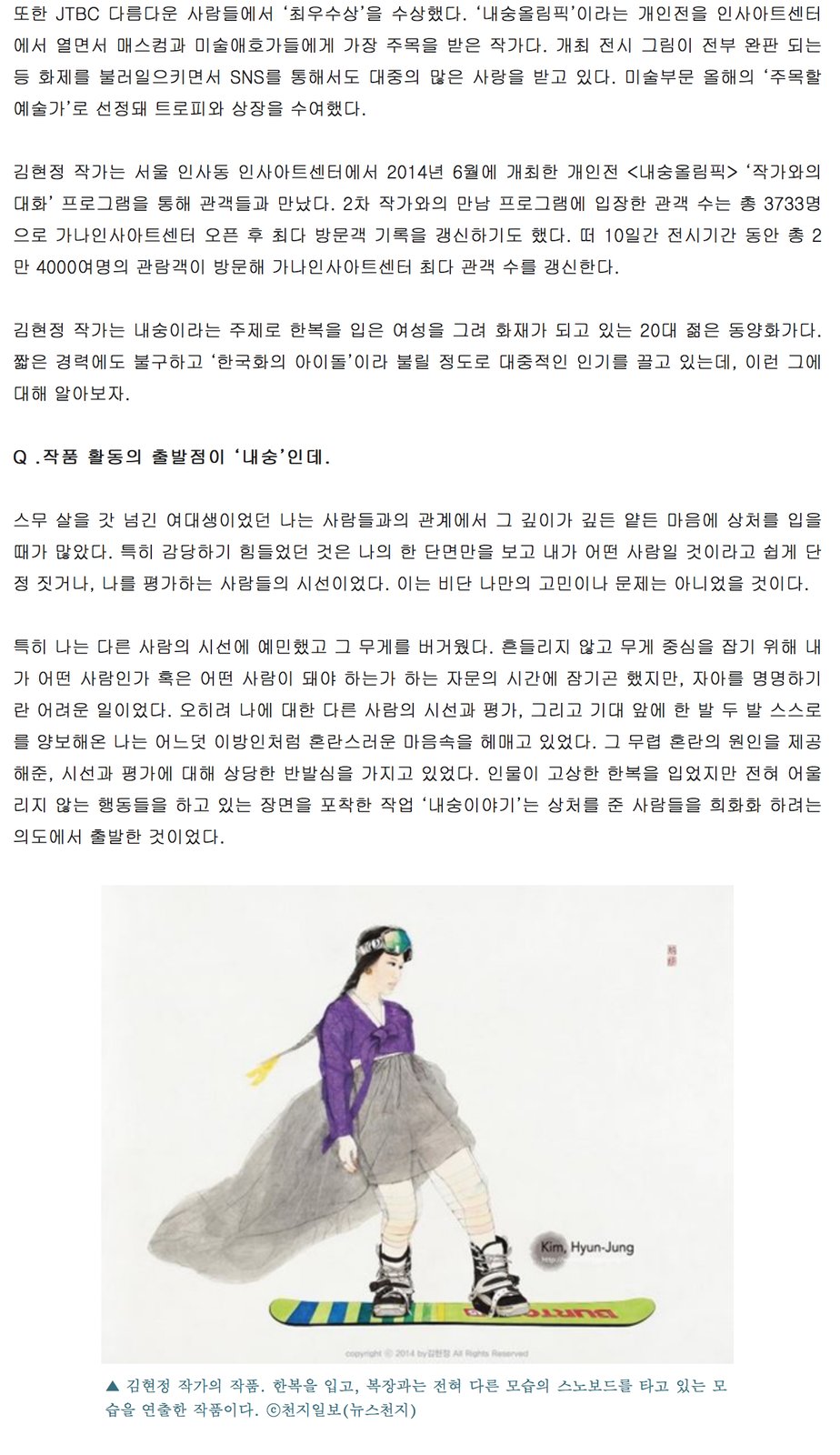
I was particularly sensitive to others' gazes, and their weight felt burdensome. To find my footing without wavering, I often sank into hours of self-questioning — who am I, or who should I be — but naming one's self proved difficult. Rather, having gradually ceded ground, step by step, to others' gazes, evaluations, and expectations of me, I found myself before long wandering, confused, like a stranger in my own mind. It was around then that I felt considerable resistance toward the gazes and judgments that had caused that confusion. The work 'Naesoong Story,' capturing scenes of figures dressed in elegant hanbok doing utterly mismatched things, began with the intent of caricaturing the people who had hurt me.
Q. Why did you shift to self-portraiture?
The reason I came to tell stories through figures, to express something in my work, is that the two mentors who most influenced me both work with the figure. In figure painting, composition and the dynamism of the pose matter, so I used photographs of people as reference material for realistic expression. Becoming my own model for closer observation was a natural choice.
In the early stage of this work, I was overlaying other people's personalities onto the figure on the canvas, so the woman in the painting was another person wearing my mask. Then one dawn, in my studio, half in a daze, I looked in the mirror. In the mirror, a woman was looking back at me — the same woman as the one captured on canvas, in appearance and inner heart alike. It was a small experience, but it became an important turning point for me. The woman in my work, "unable to boldly reveal her true self, showing an awkward front while conscious of others' gazes," turned out to be none other than myself. The woman on the canvas, whom I had thought was someone else, resembled me not only in appearance but in essence.
Having discovered "myself" thus objectified, my gaze — not knowing where to turn as I sought my true self — turned inward, entering a new phase of immersion. Though I cannot firmly declare what kind of person I am, perhaps if I honestly and boldly lay bare my current state of being bound by others' gazes, I will gradually grow bolder before those gazes.
In the end, I am seeking my true self through confessional work. Most of the subject matter in my paintings reflects my everyday behavior or habits; revealing myself through painting is, at once, an artistic act and an honest confession of reflection on life.
Q. Your work shows a witty perspective on the duality of women. How do you yourself view this "naesoong"?
The dictionary meaning of "naesoong" is "appearing gentle on the outside but cunning within." As is somewhat evident from this very question, "naesoong" is commonly associated with "women" in most people's natural association. But the "naesoong" used in my work is, from its very definition, gender-neutral. Although naesoong is understood in our society as more fitting for women, I don't believe it is women's exclusive property.
Rather, I think naesoong is a common "inconsistency" that arises from the universal human desire to be recognized by others — ordinary people hiding their shortcomings and wanting to show their good side. This appears almost instinctively. Ultimately, I also think of it as a phenomenon whereby, following social convention, individuals cede part of their identity. When I first conceived 'Naesoong Story,' it began from a desire to caricature people who put on a show of naesoong, but as the work has progressed, "naesoong" has now become a subject of psychological and philosophical analysis for me.
In conclusion, the "naesoong" used currently in 'Naesoong Story' is naesoong in a broad sense: every attitude of presenting an outward appearance different from one's true feelings, in order to satisfy others' gazes or conventional evaluation.
Q. Why did you choose hanbok as the figures' clothing?
One motif I've been developing in my work is delivering a shock to the conventions (通念) we unconsciously accept as given. The ways we receive information and evaluate or judge based on it offer stability, but sometimes bury an individual's unique personality. Of course, conventional views and evaluations sometimes cause errors, so an appropriately critical perspective toward them is necessary.
In my work, the figure wears hanbok, Korea's traditional dress, while using props symbolizing contemporaneity, creating a strange contrast. Juxtaposing images that don't overlap in their era like this is intended to deliver a shock to the convention that "at times like this, you should do this" or "a person like this should be like that." A figure in hanbok, earbuds in, riding a bicycle, or with feet up on a desk, operating a tablet, is not an image that fits conventional etiquette or conventional expectations. The figure wearing hanbok also functions symbolically — representing concealment or complexity related to naesoong, while adding aesthetic quality to the work.
But more important than that is the unexpectedness created by the contrast between the dynamism of the hanbok-clad figure and the era-specific props within the work. By having traditional dress and modern daily life coexist on the canvas, and by embodying the naesoong of a woman whose outside and inside differ — a kind of absurdity or irony — I present a departure from the ordinary.
The shock toward convention that I show through my work will not be sharpened to an uncomfortable degree. In the work titled <我差/Ops>, the title uses the Chinese characters for "I (我)" and "lacking (差)," meaning one's own shortcomings. The moment coffee spills over a luxury bag is an "oops" moment, and so is the moment of drinking coffee that costs several times more than the roughly 1,000-won ramyeon you're eating — hence the name.
But since my artistic activity ultimately aims, through confessional work, toward freedom from conventional gazes and evaluations, the unexpectedness I intend is not blunted.
Q. What kind of artist do you want to become?
I want to be an artist who scratches the itch people can't reach. Perhaps the artists remembered as great are those who refreshingly scratched what ordinary people wanted to say but couldn't. Looking at it that way, the direction I should head as an artist becomes clear: to be someone who can, at the right moment, unclog the frustrations ordinary people feel. In that sense, rather than sinking into my own world or being swayed only by my own thoughts, I try to be an artist sensitively attentive to and interacting with the affairs of the world. I think this is probably where the buzzwords of communication and empathy in today's film, entertainment, art, lectures, and publishing all originate.
I also dream of being an artist whose witty work can make people laugh. I too have been healing from a depression that began from that early hurt, through my work. If even a single person can smile while looking at my work, that alone would make me happier than anything.
Meanwhile, Kim Hyun Jung is holding the exhibition Naesoong Olympics at the Seoul Metropolitan Council from the 6th through the 11th of this month.