









Ahopsi Online | Idol of Korean Painting, Artist Kim Hyun Jung: “The Path Others Tell You Not to Take Isn’t Necessarily the Wrong One”
Featured in the youth self-help book 'At Twenty, I Decided to Live Like Myself,' this interview traces how the self-portrait style 'Naesoong' series emerged out of Kim Hyun Jung's treatment for depression, the meaning behind her semi-transparent hanbok technique, the origin of her nickname 'the idol of Korean painting,' and why she considers diligence the most important virtue for an artist. The piece closes with advice for twenty-year-old readers.
View full text
KIM HYUN JUNG — The Idol of Korean Painting
The path others tell you not to take isn't necessarily the wrong one
Named to Forbes' 2017 "30 Under 30 Asia" list of influential young people, Kim Hyun Jung is one of the most closely watched figures in Korea's contemporary art scene today. Her work, which reinterprets the various faces of modern Korean life through satire and humor, draws attention every time it is exhibited under the name "Naesoong" or "21st-Century New Genre Painting." Having amassed tens of thousands of fans on social media and earned the nickname "the idol of Korean painting," we take a look at the story of her life.
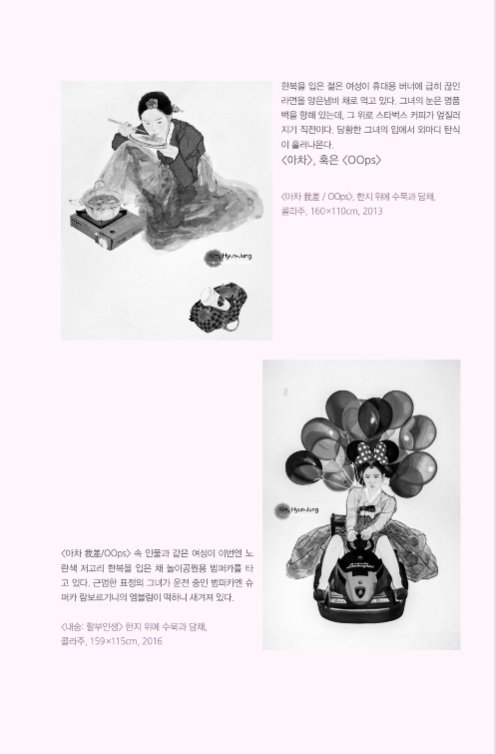
A young woman in hanbok hastily eats ramyeon straight out of the pot, boiled on a portable burner. Her eyes are fixed on a luxury handbag, just as a cup of Starbucks coffee is about to spill over it. A startled exclamation escapes her lips.
Acha (Oops)
Acha 我差 / OOps, ink and light color with collage on hanji, 160×110cm, 2013
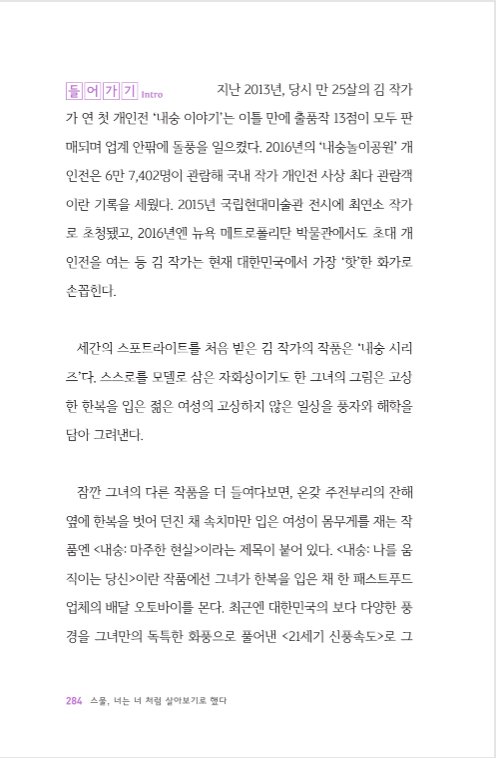
The same woman from Acha 我差/OOps now rides a bumper car at an amusement park, this time in a yellow jeogori hanbok. Her expression is solemn as she drives a bumper car emblazoned with the emblem of a Lamborghini supercar.
Naesoong: An Installment-Plan Life, ink and light color with collage on hanji, 159×115cm, 2016
Intro
In 2013, when the artist was just 25, all 13 works in her first solo exhibition, "Naesoong Story," sold out within two days, creating a stir across the industry. Her 2016 solo exhibition "Naesoong Amusement Park" drew 67,402 visitors, setting a record for the most-attended solo exhibition by a Korean artist. She was invited to exhibit at the National Museum of Modern and Contemporary Art in 2015 as its youngest-ever participating artist, and in 2016 held an invitational solo exhibition at the Metropolitan Museum of Art in New York — today she is counted among the "hottest" painters in Korea.
The work that first put Kim in the spotlight was the "Naesoong" series. A self-portrait of sorts, in which she herself is the model, her paintings depict the less-than-elegant daily lives of young women dressed in refined hanbok, rendered with satire and humor.
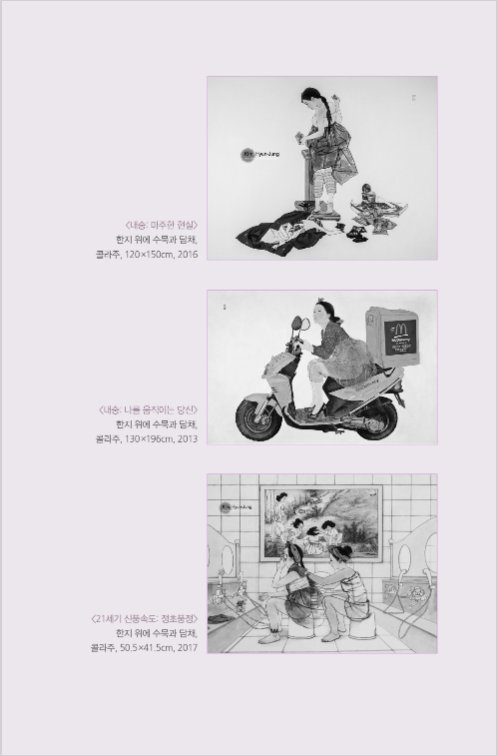
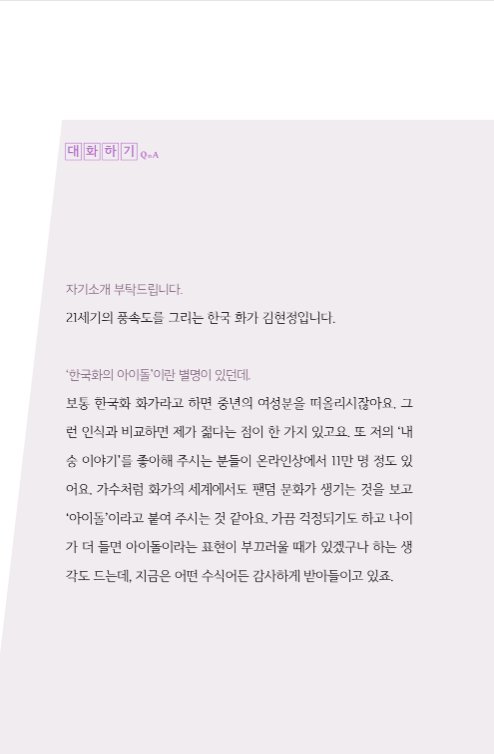
Looking briefly at a few more of her works: a piece showing a woman who has shed her hanbok down to her underskirt, weighing herself amid the debris of various snacks, is titled Naesoong: Facing Reality. In Naesoong: The One Who Moves Me, she rides a fast-food delivery scooter while wearing hanbok. More recently, she has expanded into painting a wider range of Korean scenes in her own distinctive style under the title 21st-Century New Genre Painting.
Naesoong: Facing Reality, ink and light color with collage on hanji, 120×150cm, 2016
Naesoong: The One Who Moves Me, ink and light color with collage on hanji, 130×196cm, 2013
21st-Century New Genre Painting: New Year's Scene, ink and light color with collage on hanji, 50.5×41.5cm, 2017
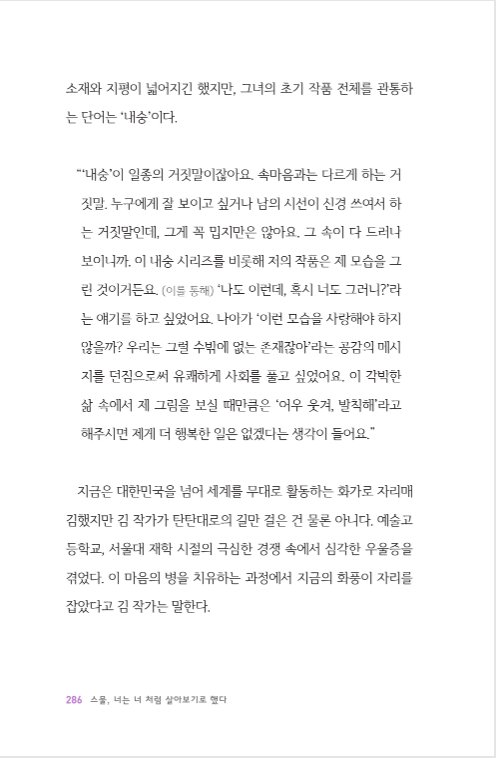
Though her subject matter and horizons have broadened, the word that runs through the whole of her early work is "Naesoong."
"'Naesoong' is a kind of lie — a lie you tell that differs from your true feelings. It's the lie you tell because you want to look good to someone, or because you're conscious of others' eyes, but I don't find it entirely unlikable, because it reveals everything underneath. This Naesoong series, and my work in general, is a painting of myself. Through it I wanted to say, 'I'm like this — are you too, perhaps?' And further, to send a message of empathy: 'Shouldn't we love this side of ourselves? We can't help but be this way.' In this harsh life, if people can look at my paintings and just say, 'Ha, that's funny, that's cheeky,' there's nothing that would make me happier."
Though she has now established herself as an artist active not just in Korea but on the world stage, Kim's path has not been an easy, straight one. During her years at an arts middle and high school and at Seoul National University, amid fierce competition, she suffered from serious depression. She says the style she works in today took shape through the process of healing from that illness.
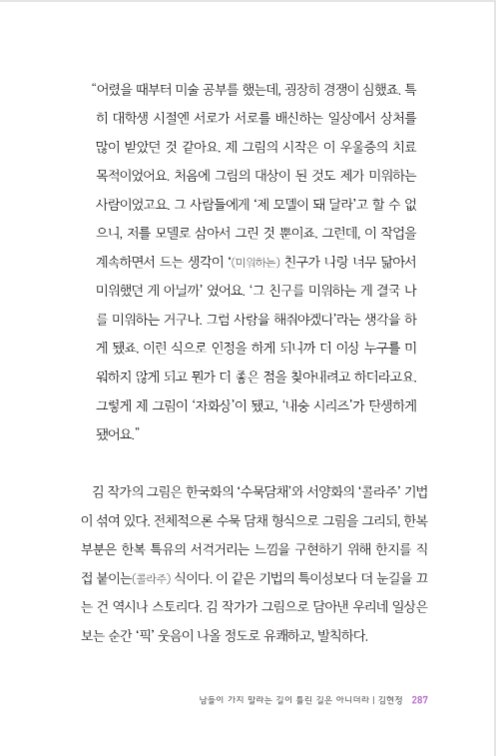
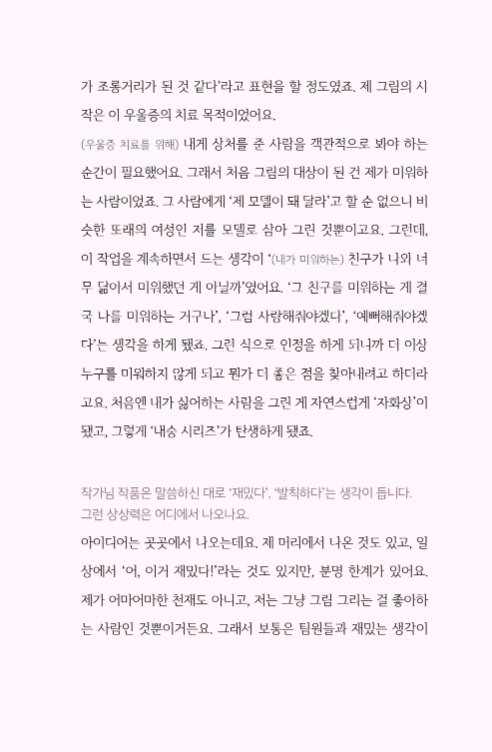
"I studied art from a young age, and the competition was intense. Especially during my university years, I think I was hurt a great deal by the everyday betrayals people committed against one another. My paintings began as a form of treatment for that depression. At first, the subjects of my paintings were people I resented. Since I couldn't ask them to 'be my model,' I simply used myself as the model instead. But as I kept doing this work, I began to think: 'Maybe I resented that friend because she was too much like me.' 'Resenting her was, in the end, resenting myself. So I should love her instead.' Once I came to accept things this way, I stopped resenting anyone and started trying to find something better in people instead. That's how my paintings became 'self-portraits,' and how the 'Naesoong series' was born."
Kim's paintings blend the "ink-wash and light coloring" technique of Korean painting with the Western technique of "collage." The overall painting is done in ink-wash style, but for the hanbok sections, she directly pastes hanji (traditional mulberry paper) to recreate the crisp, rustling texture particular to hanbok. What draws even more attention than the distinctiveness of this technique is the storytelling. The everyday scenes she captures in paint are witty and cheeky enough to make you burst into laughter the moment you see them.
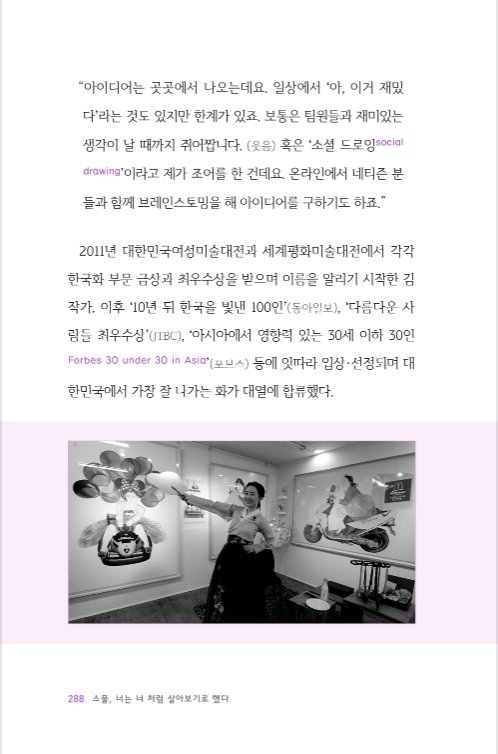
"Ideas come from all over. Some come from everyday life — 'oh, this is funny' — but there's a limit to that. Usually we squeeze our brains together with the team members until something funny comes to mind. (Laughs) Or there's what I coined 'social drawing' — brainstorming ideas together with netizens online."
Kim, who first made a name for herself by winning the gold prize in Korean painting at the 2011 Korea Women's Art Competition and the grand prize at the World Peace Art Competition, went on to be selected for "100 People Who Will Shine Korea in 10 Years" (Dong-A Ilbo), the "Grand Prize for People Who Made a Difference" (JTBC), and Forbes' "30 Under 30 Asia," joining the ranks of Korea's most successful painters.
"I've received a great many awards, and I'm grateful every time. But I don't think an award changes your life. I take it, at most, as praise confirming that 'the path others tell you not to take isn't the wrong one after all.' I don't think there's any reason to feel smug beyond that."
It isn't easy to establish a presence in your field in your twenties. For Kim, who has accomplished this uncommon feat, the virtue she holds most important is "diligence." Indeed, she still works seven days a week, embodying the word diligence with her whole body. In a field of art where talk often centers on genius inspiration or talent, her emphasis on the importance of diligence is worth taking to heart.
"I think of painting as a kind of rest, in a way. And I'm also a factory — if the factory stops running, there's no revenue, so I have a structure that can't afford to stop. I'm not a genius, so I don't think I can afford to be lazy. Honestly, the time given to us to refine ourselves is longer than we think. If you live each day diligently, that time accumulates, and you end up growing sturdier than you imagined."
QnA
Please introduce yourself.
I'm Kim Hyun Jung, a Korean painter who paints the genre scenes of the 21st century.
You have a nickname, "the idol of Korean painting."
When people hear "Korean painting artist," they usually picture a middle-aged woman, and compared to that image, I'm young — that's one part of it. Also, there are about 110,000 people online who love my "Naesoong Story." I think, just as fandom culture exists around singers, a similar culture has formed around painters, and that's why people call me an "idol." I sometimes worry that as I get older the term "idol" might feel embarrassing, but for now I'm grateful for whatever they call me.
Let's talk about your work. You use the word "Naesoong" as your subject.
Given the motivation and theme behind starting this work, I actually think the word "gaze" fits better than "Naesoong." As someone who dreamed of becoming a painter, I felt I needed to know who I was in order to paint, so I once did some soul-searching — "who exactly is Kim Hyun Jung?" But I found I didn't know. Because I was always someone who worried about how I appeared to others, rather than someone who could define for myself, in my own voice, "I am this kind of person." I was someone who, rather than "I chose this because I like it," thought "would choosing this make me look good to others?" — someone conscious of others' "gaze." So I felt the word "gaze" was more fitting when defining myself or my work. But if I titled the series "Gaze Story" or "Gaze Series," it would feel heavy, and that seemed to go against the purpose of my painting and exhibiting. So I thought using the word "Naesoong," which shares a similar context to "gaze," might have more wit. Now, beyond the word Naesoong itself, I introduce my work as "21st-Century New Genre Painting" — capturing the lives we live today.
Is there a message you want to send to society through your work?
"Naesoong" is a kind of lie — a lie you tell that differs from your true feelings. It's the lie you tell because you want to look good to someone, or because you're conscious of others' eyes, but I don't find it entirely unlikable, because it reveals everything underneath. That's also why I paint the inside of the hanbok visible through the fabric. This Naesoong series, and my work in general, is a painting of myself. Through it I wanted to say, "I'm like this — are you too, perhaps?" And further, to send a message of empathy: "Shouldn't we love this side of ourselves? We can't help but be this way." In this harsh life, if people can look at my paintings and just say, "Ha, that's funny, that's cheeky," there's nothing that would make me happier.
I read an article that said the "Naesoong series" originated from your depression.
I studied art from a young age, and I attended a very competitive middle and high school. Art college was also fiercely competitive. Especially during my university years, I think I was hurt a great deal by the everyday betrayals people committed against one another. The whole world seemed depressing. I had to take medication every day just to sleep. Once, when my doctor asked "how do you feel," I described it as, "I'm walking barefoot alone down a road strewn with broken glass, and everyone is just watching," "no one is helping me," "I feel like I've become a laughingstock." My paintings began as a form of treatment for that depression.
(To treat the depression) I needed a moment to look objectively at the people who had hurt me. So the first subjects of my paintings were people I resented. Since I couldn't ask them to "be my model," I simply used myself — a woman of similar age — as the model instead. But as I kept doing this work, I began to think: "Maybe I resented that friend because she was too much like me." "Resenting her was, in the end, resenting myself," "so I should love her," "I should cherish her" — that's the thought I arrived at. Once I came to accept things this way, I stopped resenting anyone and started trying to find something better in people instead. What began as a painting of someone I disliked naturally became a "self-portrait," and that's how the "Naesoong series" was born.
As you said, your work feels "fun" and "cheeky." Where does that imagination come from?
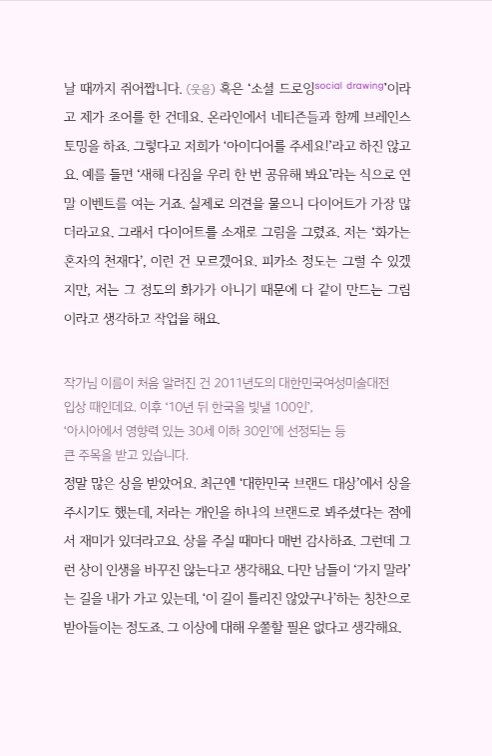
Ideas come from all over. Some come from my own head, some from everyday life — "oh, this is funny!" — but there's definitely a limit. I'm not some enormous genius; I'm just someone who likes to paint. So usually we squeeze our brains together with the team members until something funny comes to mind. (Laughs) Or there's what I coined "social drawing" — brainstorming together with netizens online. We don't outright ask "give us ideas!" though. For example, we might run a year-end event like "let's share our New Year's resolutions together." When we actually asked, dieting came up the most, so I painted around the theme of dieting. I don't really believe in the idea of "the painter as a lone genius" — maybe someone like Picasso could be, but I'm not that caliber of painter, so I think of my work as something made together with everyone.
Your name first became known when you won at the 2011 Korea Women's Art Competition, and since then you've drawn major attention, being selected for "100 People Who Will Shine Korea in 10 Years" and "30 Under 30 Asia."
I've received a great many awards. Most recently I was given the "Korea Brand Award," which was interesting in that it viewed me, as an individual, as a kind of brand. I'm grateful every time I receive an award. But I don't think an award changes your life. I take it, at most, as praise confirming that "the path others tell you not to take isn't the wrong one after all." I don't think there's any reason to feel smug beyond that.
If awards haven't changed your life, then what has shaped it?
I think it's been people. Being a painter isn't a career you can easily recommend to someone. I even tell my nieces and nephews, "painting is, well, maybe as a hobby?" (Laughs) There isn't a bright future for women painters, either — Kim Hong-do, Shin Yun-bok, Picasso, Van Gogh, Gauguin... they're all men. And I started doing Korean painting back when it was considered "a bit old-fashioned to be painting hanbok." Even now at art fairs, you can count the Korean painting pieces on one hand — it's mostly oil painting, installation, sculpture and other forms. I feel like I've done a full set of everything people told me not to do, and I think the reason I'm Kim Hyun Jung today is the people who supported and cheered me on, and walked alongside me, every step of the way.
Genius inspiration or talent is often cited as the most important quality for an artist. But you've said you consider "diligence" the most important virtue, and that you actually commute like an office worker.
Yes. I work seven days a week.
You don't take a single day off?
You could think of painting itself as a kind of rest. And I'm also a factory — if the factory stops running, there's no revenue, so I have a structure that can't afford to stop. I'm not a genius, so I don't think I can afford to be lazy. Honestly, I think the time given to us to refine ourselves is longer than we imagine. If you live each day diligently, that time accumulates, and you end up growing sturdier than you thought possible.
What kind of painter do you want to become?
I hold onto the proposition that "art should breathe together with society." To create a society that breathes together, I want to paint pictures that breathe on their own. I want to lower the threshold of art, so people can feel "art really is easy and fun." I live my life trying to do everything I can to realize that dream.
But honestly, setting aside such a grand dream, I think it's enough just to live happily with the people around me. If today was lived diligently and joyfully, that's enough. If I paid my staff's salaries on time and covered the rent, that's enough. I don't think I'm at an age yet where I can pontificate on life — I'm just trying, moment to moment, to do my best and become someone I'm not ashamed of.
Any advice you'd give to people at twenty?
I don't think I'm in a position to say such things. But I do think I have one real strength: I love talking, so I keep asking people questions. I have my own rule about it, though — I ask people who are even one year older than me. Elementary schoolers discussing how to get into middle school with each other won't get anywhere; it just turns into complaining. But if you ask a middle schooler, you can get real advice: "here's how it's done." Talking a lot with peers your own age is good too, but I think you can gain something different by talking with seniors, adults, and teachers.
Watch the video
Scan the QR code to watch this interview on video.