

Daily Economic | Korean Painter Kim Hyun Jung’s Portrait of Korea: Naesoong — Youth Is Not About Age, But Direction
An essay by artist Kim Hyun Jung introducing her painting 'Naesoong: Where Is Your Rainbow?' Through the image of the hanbok-clad 'Naesoong girl' astride a large Harley-Davidson motorcycle, it explores the middle-aged generation's belated pursuit of dreams deferred in youth, and poses a question about the direction of life that crosses generational lines. The article closes with a brief biography of the artist.
전체 본문 보기
Artist's Statement: Personal views only, for reference.
At the intersection on my way to work, I often come across those massive motorcycles. Helmets, leather jackets, the deep, heavy roar of the exhaust — these elements always make us instinctively picture a young man. But when your eyes actually land on the rider, the person sitting on the bike is, more often than not, someone in their fifties or sixties.
Why would someone, no longer young, go chasing after a form of transportation that looks clumsy, dangerous, even out of step with the times? Perhaps it's because, when they were young, they had neither the time nor the money to truly hold their dream in their hands — and only now, at this point in life, have they finally gained the ability to pick back up a longing that reality kept postponing, again and again. Statistics show that the primary consumer group for large, deep-exhaust motorcycles — Harley-Davidsons especially — is people around fifty years old. As if those once-shelved dreams were, at last, in the garages of people in their fifties and sixties, starting up again — late, but in earnest.
We're used to treating “dreams” as the exclusive property of youth, and rarely does anyone seriously ask someone in their fifties or sixties, nearing retirement: What do you still want to do? What wishes do you still hope to fulfill? But today, as “the hundred-year life” gradually becomes a reality, people approaching sixty are often pushed back into the same question by the unfolding of the second half of their lives: What exactly am I going to live on for the next forty years? And which direction should I head in?
It was from this question that I painted ‘Naesoong: Where Is Your Rainbow?’ I wanted to place a dignified, hanbok-clad ‘Naesoong woman’ at the very center of the world, letting her — beneath a gentle, restrained exterior — become a ‘grown-up child’ who relishes the roar of an engine and longs for speed and freedom.
At the center of the composition, a woman in a red jacket sits astride a huge motorcycle. That vivid red, evoking a traditional wedding bride, nearly overtakes the entire picture, burning like a flame, fierce and unrestrained. Beneath her is the motorcycle's black body, gleaming with a cold metallic sheen — heavy, solid, carrying a sense of power that cannot be ignored. The gray of her semi-transparent skirt and the beige of her handbag unfold slowly around her, pushing the clash between static traditional dress and a mechanical civilization full of speed to its sharpest point. The world of hanbok — once belonging to quiet, restraint, propriety, and order — now stands firmly atop a roaring engine, as if trembling, as if waking up.
The large expanse of white background in the picture is not simply “empty” space. The moment the viewer's gaze shifts slightly toward the motorcycle's rearview mirror, they'll discover a glittering night scene flickering within it. The blank space characteristic of Oriental painting does not stop at the surface of the paper, but extends outward toward the city's night view through this small mirror. The buildings, headlights, and streets compressed into that narrow rectangle hint at the restless, bustling modern city beyond the frame. And so the seemingly silent white paper is gradually filled in by the viewer's imagination; the noise, lights, and speed of the modern city quietly flow into the picture through this small “window within the mirror.”
The woman's expression, as the title suggests, carries a sense of “Naesoong” — hidden depths beneath a demure surface. She turns her head slightly, as if casually glancing back, her gaze holding shyness, curiosity, and provocation all at once, along with a faint tension as if afraid of being seen through. And yet the motorcycle she rides carries, of all things, a license plate reading “SHY GIRL.” She calls herself a “shy girl” while, without a moment's hesitation, straddling a loud, dominant, hugely masculine-coded machine. It is precisely this contrast that gives the work its power. With a touch of humor and a touch of irony, it gently pierces a familiar Korean posture: outwardly demure and restrained, while inwardly always harboring a bold longing to cross the line.
Here, the Harley-Davidson is not merely a vehicle. It is a brand regarded worldwide as a “Lovemark,” an almost emotional presence in many people's hearts. For quite a few middle-aged people, it is both a symbol of youth and a romantic vision left unfulfilled for far too long. In their younger years, tuition, rent, their children's education costs, household expenses piled on layer after layer, and the things that existed “only for oneself” were always the first to be given up, postponed, quietly put away. Desires long suppressed by identity, responsibility, and reality raise their heads again, roaring back to life, as retirement draws near. I wanted to compare this belated calling to a “rainbow.” A rainbow always appears briefly after the rain, bright, yet impossible to truly grasp; it shows itself for a moment, then quietly vanishes. As children, almost everyone chased after a rainbow, believing that if they ran fast enough, they could reach the place where it hung. But once we grow up, we often bury that rainbow beneath the clouds of reality, pretending we no longer need it. Then, at some turning point in life, it suddenly reappears, like a soft call sent from somewhere far away, reminding you: you, too, once had a direction you wanted to run toward.
Korean society, whether addressing the young or the middle-aged, seems to make contradictory demands of both. On one hand, it tells teenagers and twenty-somethings, “You must have a dream.” On the other, it keeps urging, “You must face reality.” Employment, résumés, buying a home, a stable job, sensible choices, a respectable path — once a person starts calculating all this, the so-called “rainbow” gradually retreats, until it ends up as light as a doodle folded into the corner of a résumé, barely worth mentioning. In an era where even talking about dreams feels like a luxury, we learned to grow up too soon, and lost our willfulness too soon as well.
Meanwhile, our parents' generation has also, almost without noticing, arrived at the edge of retirement. Only as they near the point of handing back their business cards, leaving their positions, ending some long-performed social role, do they finally get the chance to ask themselves again: Beyond the company, beyond the title, beyond an identity like “someone's parent,” who am I, really? What did I once love? What did I truly long for? What did I leave behind for far too long? Facing these belated questions of self-inquiry, I tried to superimpose a hanbok-clad “SHY GIRL” astride a heavy motorcycle onto the figure of a middle-aged person looking back at their own life.
The title ‘Naesoong: Where Is Your Rainbow?’ is itself a direct question posed to the viewer. A teenager standing before this painting might first be drawn to the enormous motorcycle rather than to the woman's expression, and feel a very direct flutter inside: I want to ride one too, I want to try racing off like that too. A viewer in their fifties or sixties, meanwhile, might not notice the English on the license plate first, but instead feel a tremor both unfamiliar and familiar in her slightly awkward, half-turned glance backward. That might be the mischief hidden deep down from many years ago, an impulse long since worn smooth by life, the sense of speed the body once truly remembered as youth raced down a straight highway. So this painting is not meant to divide the generations, but to try to place the anxieties of different generations within the same frame. Young people uncertain about the future, and middle-aged people equally uncertain about the rest of their lives, are ultimately brought back to the same question: What, exactly, am I moving toward right now? And what, in the end, am I running for?
What I want to say through this work is this: the trouble of having a dream has never belonged only to teenagers and twenty-somethings. Living in an age of hundred-year lives, at thirty, fifty, even seventy, we still have the right to keep asking ourselves: Where do I really want to go? And to those who have already reached middle age, I especially want to say, gently: your rainbow may not have come too late; it may be only now that it is finally revealing its true colors. Just as a rainbow can only rise after the rain has stopped, there are some roads in life that only become clear after you've weathered the storm. Even if that rainbow looks, in others' eyes, like nothing more than a childish toy; even if that roar of the engine looks, to bystanders, like nothing more than belated willfulness — as long as it can still make your heart pound hard again, as long as it can still, in some fleeting moment, let you clearly feel “I still want to keep moving forward,” then the road you are racing down right now is your rainbow.
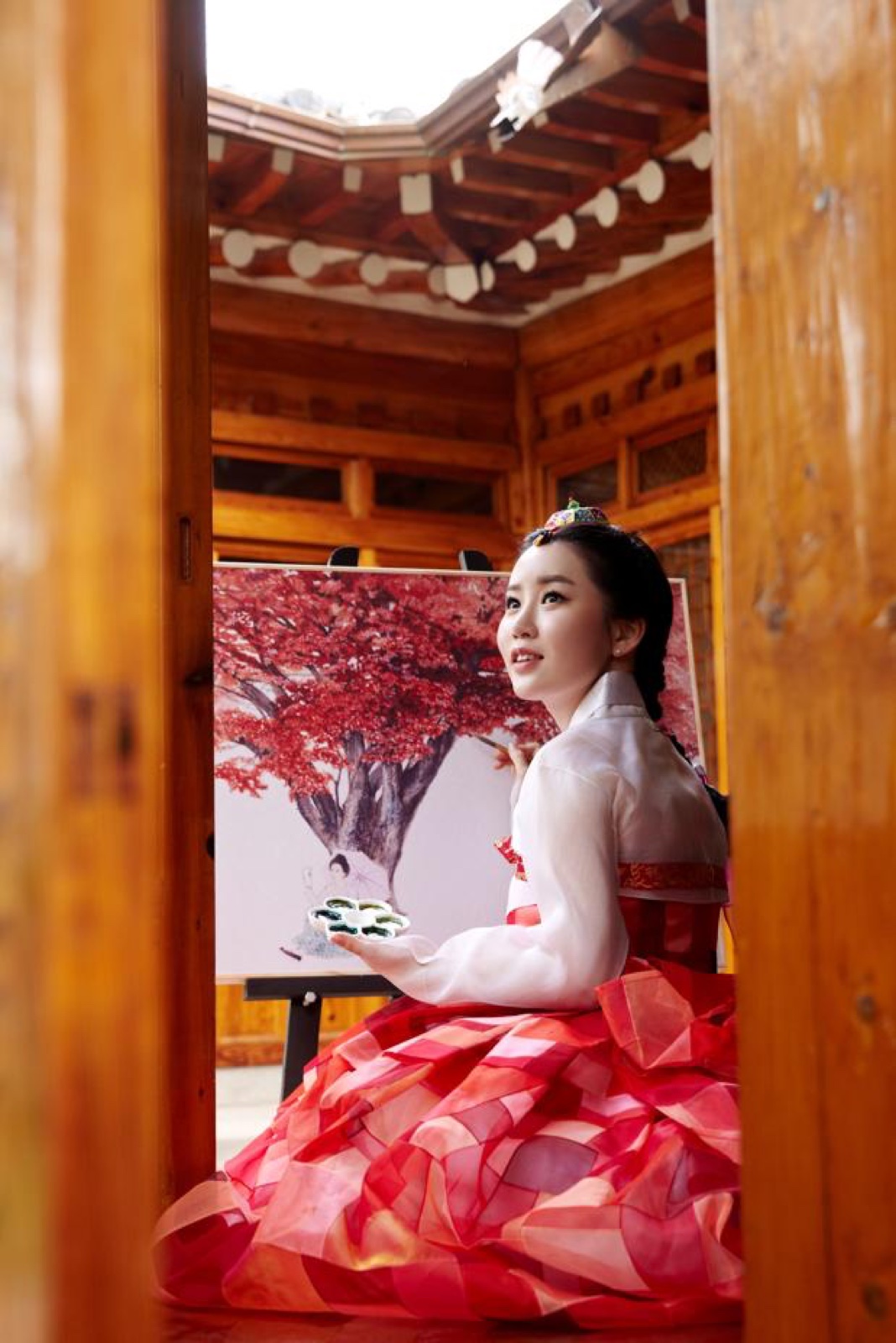
Korean painter Kim Hyun Jung (Source: Kim Hyun Jung Art Center)
Korean painter Kim Hyun Jung graduated from Sun Hwa Arts Middle and High School and studied Oriental Painting at Seoul National University, completing her doctoral coursework at the same university's graduate school. She is widely known for her Naesoong series, which depicts the everyday customs of 21st-century Korea, skillfully capturing the texture and emotional layers of contemporary Korean life with a brush that blends humor and satire, and continuing to respond to social realities and the mood of the times through the lens of ‘Portraits of Korea.’ She has appeared as the “Bun Noona (Topknot Sister)” on the EBS program “Haeyo Hwahaeyo,” and serves as a publicity ambassador for the City of Seoul and for Bridge of Hope. In recent years, she has also engaged with roughly 300,000 followers across social media, and continues to expand the boundaries and reach of Korean painting in a contemporary context through an ongoing series of exhibitions at home and abroad.