







N Content_Moneytoday | The World Is Captivated by the Fun and Playfulness of a Hanbok-Clad Woman’s Cheeky Daily Life
Artist Kim Hyun Jung is introduced as a Korean painter who has drawn international attention with her "Naesoong Story" series depicting the cheeky daily life of women in hanbok. The article covers why she combines hanbok and traditional ink-and-wash technique with contemporary subject matter, the "21st-Century Genre Painting" series, her corporate collaboration work, and her thoughts on image copyright issues. Photography by Song Eun-ji and Kim Hyun Jung Art Center.
View full text
A woman boldly hiking up her hanbok skirt to ride a bumper car; a girl with braided hair, dressed in fine hanbok, smiling brightly with both hands full of shopping bags…. The cheeky, unrestrained women in these paintings hint at the artist's own daily life. We met painter Kim Hyun Jung, who expresses the elegance and refinement one associates with hanbok and Korean painting through cheeky, unconventional ideas.
"Naesoong Story": Adding Contemporary Women's Wit to Tradition
In January 2016, Kim held an invitational solo exhibition at New York's Metropolitan Museum of Art, and was invited as the youngest artist featured in an exhibition at the National Museum of Modern and Contemporary Art Korea illuminating the history of Korean painting. In 2017, she became the first Korean art figure selected for American business magazine Forbes' "30 Under 30 Asia 2017." Asked about her glittering résumé, Kim humbly answered, "It's because I'm someone optimized for college entrance-exam art."
"The 'sul (術)' in misul (art) means 'skill/technique.' Just as you hone a skill, I think painting also needs to be done consistently over a long time. Even the great Picasso is said to have made some 30,000 works…. Because I know I'm someone who lacks talent, I've painted that much more, that much longer, and thanks to that I think I'm gradually getting good results."
Kim said she has interests typical of her peers, like luxury goods and shopping, but that she has worked relentlessly behind the scenes just as much.
"In college, I double-majored in Oriental painting and business administration, and I didn't neglect either one. Thanks to that, I was able to graduate 2nd in the entire College of Fine Arts."
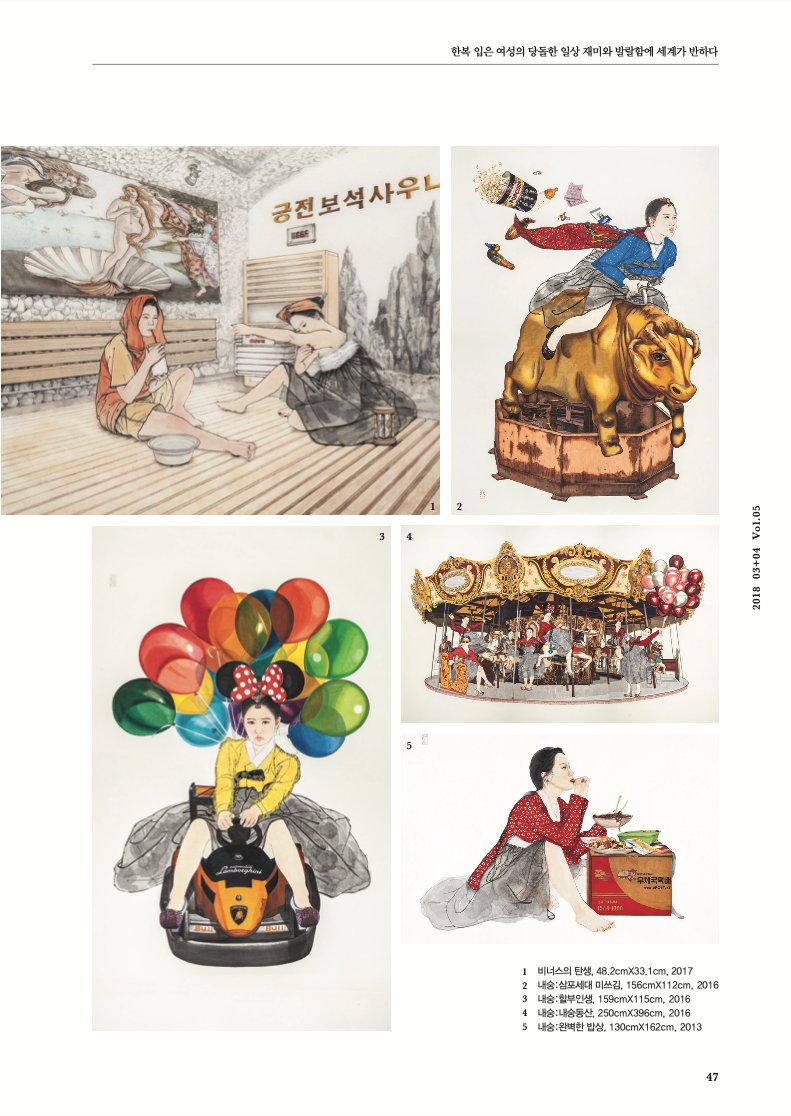
She kept building her skills by painting consistently even after graduation. Then, an exhibition she held under the theme "Naesoong" drew massive crowds and caused a stir. "Naesoong Story," which shatters the prejudice that women in hanbok are demure and refined, is both Kim's self-portrait and a representation of the contemporary woman.
According to Kim, hanbok is "an effective outfit for expressing the meaning that one can wear an elegant garment while still engaging in common, everyday behavior." Through the contrast between formal attire and convention-breaking (?) behavior, the theme of "Naesoong" can be conveyed more intuitively. In particular, Kim gave special meaning to the wide skirt of the hanbok. "The skirt is so wide, isn't it? It holds so many stories within it, and I wanted to express it as a secretive space, like a universe."
In her works, Naesoong refers to "any attitude of revealing an outward appearance that differs from one's true inner feelings, in order to satisfy others' gaze or evaluation." To express this Naesoong, she first draws the figure nude, then constructs the jeogori (upper garment) using the Western collage technique with hanji (traditional Korean paper). Thanks to this, the rustling texture of hanbok comes vividly to life. For the skirt, she uses the ink-wash technique, adjusting the density of the ink to express the body faintly showing through. Through this, she draws out the viewer's insight into Naesoong — the sense that "you can see right through her." In particular, the luxury shoes or bags in her works are the "crystallization of gaze," whose value is maximized by others' attention, while simultaneously being ironic objects that coexist with a not-so-favorable gaze toward the instinctive attachment of young women to such items. In other words, they are objects symbolizing the irony of "gaze" and "convention." Kim said, "Pretty shoes, bags, and coffee are contemporary materials that contrast with the traditional garment of hanbok, while also being objects that, together with hanbok, strongly stir my desire for expression."
What led her to depict the cheeky daily life of contemporary people within Korean painting, a genre that seems to prize tradition?
"I felt that expressing 'myself' was a painter's calling, so I thought a lot about what kind of person I was. I concluded that I was someone who cared a great deal about other people's gaze."
She said that no matter what object she chose, she would first think, "Would this look good to others?" rather than whether she liked it herself. Kim said other people's gaze was her mirror, and because of that, she had no center of her own. "I thought about calling this the 'Gaze Story,' but that felt too heavy, so I decided to start light and witty instead — that's how 'Naesoong' came about."
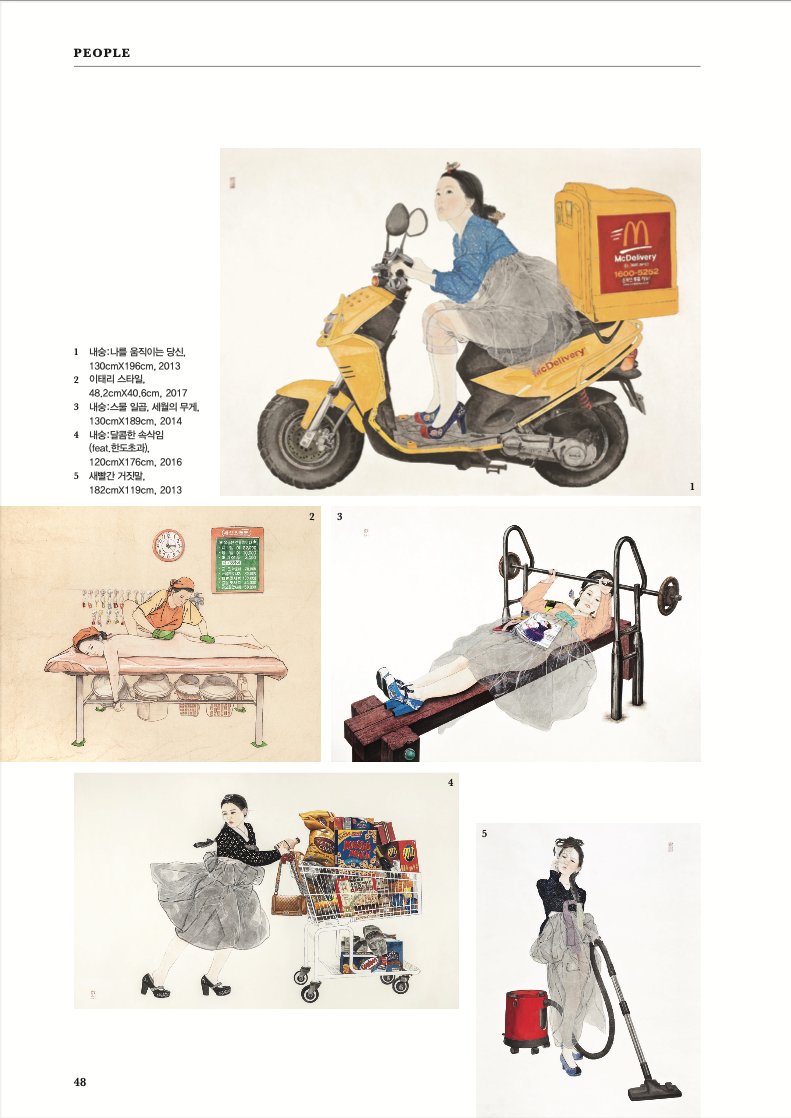
Following Naesoong Story, Kim has been painting the "21st-Century Genre Painting" series. Works like "The Birth of Venus" and "Italian Style" depict not hanbok but the everyday lives of contemporary people — yet what makes them different is that they capture aspects of Korean daily life rarely seen abroad. So what does "Korea" mean to Kim?
"For example, I remember when foreign visitors cheered at my work 'You Who Move Me' during my solo exhibition in New York, seeing a woman in hanbok riding a McDelivery scooter. They asked, 'How did you come up with the idea of McDonald's delivery?' That's when I realized McDelivery only exists in Korea. Tradition and old things are good, but I realized that Korea's unique aspects of culture — McDelivery, jjimjilbang, exfoliating scrubs (ttae-mili) — could just as easily become subject matter."
"Korea" Recreated as 21st-Century Genre Painting
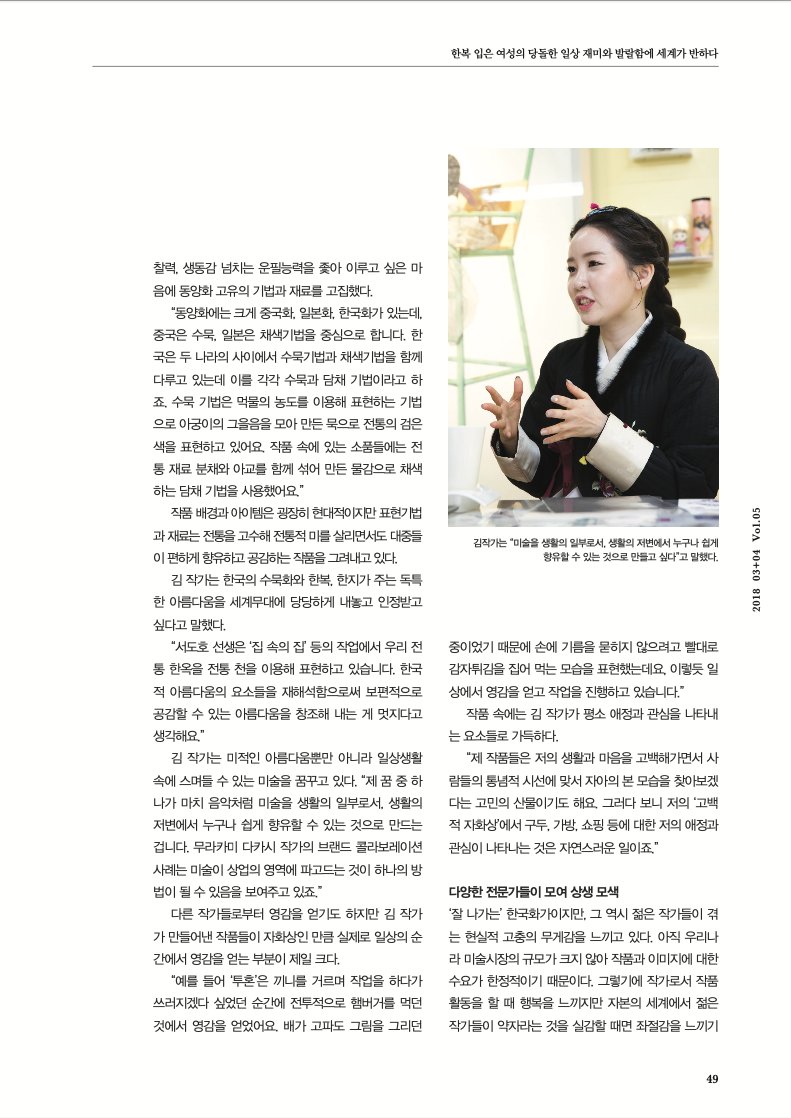
After her first year of arts high school, Kim was drawn to the charm of ink-wash painting and chose to major in Oriental painting. She was especially moved by the book "Special Lectures on Korean Beauty," which interpreted and shed light on the works of Kim Hong-do from the perspective of "Korean beauty." Wanting to follow Kim Hong-do's wit, keen observation, and lively brushwork as shown in works like "Dancing Boy" and "Wrestling" to achieve "something of her own," she insisted on using Oriental painting's own techniques and materials.
"Within Oriental painting there are broadly Chinese painting, Japanese painting, and Korean painting. China centers on ink-wash technique, Japan on color technique. Korea handles both ink-wash and color techniques together, which are respectively called ink-wash and light-color techniques. The ink-wash technique uses the density of ink for expression, using traditional black ink made from soot collected from a traditional furnace. For the props in my work, I use a light-color technique, painting with paint mixed from traditional materials — mineral pigment and glue."
While the backgrounds and items in her works are thoroughly contemporary, her techniques and materials stick to tradition, preserving traditional beauty while producing works the public can comfortably enjoy and relate to.
Kim said she wants to confidently bring the unique beauty of Korean ink-wash painting, hanbok, and hanji onto the world stage and have it recognized.
"Artist Suh Do-ho, in works such as 'Home within Home,' expresses our traditional hanok houses using traditional fabric. I think it's wonderful how he reinterprets elements of Korean beauty to create beauty that resonates universally."
Kim dreams of art that permeates everyday life, beyond just aesthetic beauty. "One of my dreams is to make art, like music, something that anyone can easily enjoy as part of everyday life. Takashi Murakami's brand collaboration cases show that having art penetrate the commercial realm can be one way to do that."
While she also draws inspiration from other artists, since her own works are self-portraits, the biggest source of inspiration comes from everyday moments in her real life.
"For example, 'Fighting Spirit' was inspired by a moment when I was skipping meals while working and felt like I might collapse, so I frantically ate a hamburger. Even though I was hungry, I was in the middle of painting, so to avoid getting oil on my hands, I ate the fries using a straw — that's the scene I expressed. This is how I draw inspiration from daily life and carry out my work."
Her works are filled with elements that reflect her personal affections and interests.
"My works are also the result of confessing my life and heart, while confronting conventional societal gaze in search of my authentic self. So it's natural that my affection and interest in things like shoes, bags, and shopping shows up in my 'confessional self-portraits.'"
Various Experts Gathering to Seek Mutual Growth
Though a "successful" Korean painter, she is well aware of the real hardships young artists face, since Korea's art market isn't yet large enough for demand for artwork and images to be plentiful. While she feels happiness doing creative work as an artist, she also feels frustration realizing that young artists are in a vulnerable position in the world of capital. Even so, the driving force that lets her keep working is the support and encouragement of family and friends, and the interest of those who love her art and work.
"My parents never hold back their support for me, and out of gratitude for that, even when I want to rest because I'm exhausted, I end up pushing myself instead. The interest of people who leave comments on my blog and elsewhere also gives me confidence and courage. I want to take this chance to say that so much interest and support truly becomes a great source of strength for an artist."
Kim said that for creators to grow together, exchange among artists with diverse specialties is necessary. She currently runs a creative center called "H&A Center," Kim Hyun Jung Creative Center. At the center, researchers with various specialties in film, textile art, and cultural arts put their heads together. It was thanks to working with them that Kim was able to hold various exhibitions and carry out brand collaborations.
"As KakaoTalk emoticons and corporate collaboration projects increased, I had to research many elements beyond just painting. Fortunately, thanks to experts from each field putting their heads together, we've been creating fun products. Would you call it collective intelligence? I realized my own effort alone wasn't enough, and I try to do as much as possible together with others."
As she produces various products beyond just her artworks, Kim naturally thinks about image copyright issues. "Music copyright is relatively well protected, but I think image copyright still needs a lot more protection." While there are many organizations and facilities protecting copyright, working artists still feel it falls short in practice, she says. Kim said, "When running contests or artist-support programs, a transparent system is needed where everyone can see and check content selection and data," calling for improvement of related systems.
"The Daily Life of the Modern Woman" Through Collaboration Examples
"Let's Run/Let's Run" (2015)
A collaboration with the Korea Racing Authority's Let's Run Park racecourse. Motivated by the traditional "running horse painting" genre, it captures the moment when a horse's four legs lift off the ground while galloping at full speed. Rather than the noblemen or aristocrats who usually appear in traditional horse-riding paintings, the work presents a fresh impression through the figure of a young woman.
"Coca-Cola: Golden Sprint Short Track" (2018)
In honor of the PyeongChang Winter Olympics, Coca-Cola and artist Kim Hyun Jung put the nation's hopes into this work. The image of a woman gliding across smooth ice alongside short-track speed skaters delivers a thrill that transcends winning or losing.
"Bausch + Lomb: Bausch + Lomb x Narcissus" (2017)
Rather than sitting demurely in hanbok, the woman in this piece is depicted sprawled out casually while putting in contact lenses. Through the protagonist's pretty expression and pose, we glimpse a slightly freer, everyday side of women's lives.