






D.I. Magazine | Telling Today’s Korea Through 21st-Century Genre Painting
A cover interview from the July 2016 issue (Vol.199) of design magazine D.I., in which Korean painter Kim Hyun Jung discusses the working philosophy behind her 'Naesoong Stories' series, her solo exhibition <Naesoong Amusement Park>, and her solo exhibition <21st-Century Genre Painting Stories> at the Korean Cultural Center in Berlin, Germany. It covers her free-spirited self-portraiture departing from gaze and convention, an expressive method combining traditional Korean painting technique with collage, and the potential for globalizing Korean painting through overseas exhibitions.
View full text
"The idol of the Korean-painting world, opening a new horizon for Korean painting." This is the epithet that follows artist Kim Hyun Jung.
Her 'Naesoong Stories' series, capturing her eating instant ramyeon or grilling pork belly at a barbecue restaurant while wearing an elegant, refined hanbok, carries her confession — a yearning for a state of freedom, departing from gaze and convention. The reason her work is loved by so many viewers isn't simply because it's witty and fun.
Text. Reporter Lee Yun-jung, lyj@websmedia.co.kr
Please introduce yourself to D.I. Magazine's readers.
Hello, I'm Kim Hyun Jung, a Korean painter who paints a 21st-century genre painting under the theme 'Naesoong Stories.' I dream of art that communicates, and aside from time spent on lectures, interviews, and exhibition activities, I work every day.
You've steadily worked under the theme of 'Naesoong Stories.' What is this work about?
My work captures the figure within the painting living everyday life without minding others' gaze and without keeping up formalities. She eats tteokbokki in a relaxed posture while wearing refined hanbok, or grills and eats pork belly alone — ordinary, honest scenes. This is work that expresses the many faces a person has, and at the same time it's a confessional self-portrait aiming for a state of freedom that departs from gaze and convention.
Is there a reason you paint self-portraits?
I wanted to express my honest self in daily life through painting. Since adolescence I was a student sensitive to other people's gaze, and that gaze even became the standard for my life at one point. I wanted to find the self that had grown faint from being so conscious of that gaze, and to find a center that wouldn't waver under any gaze — I began this work as a time of self-inquiry: 'who am I,' or 'who should I become.'
Unlike traditional Korean painting, your expressive technique and subject matter feel contemporary.
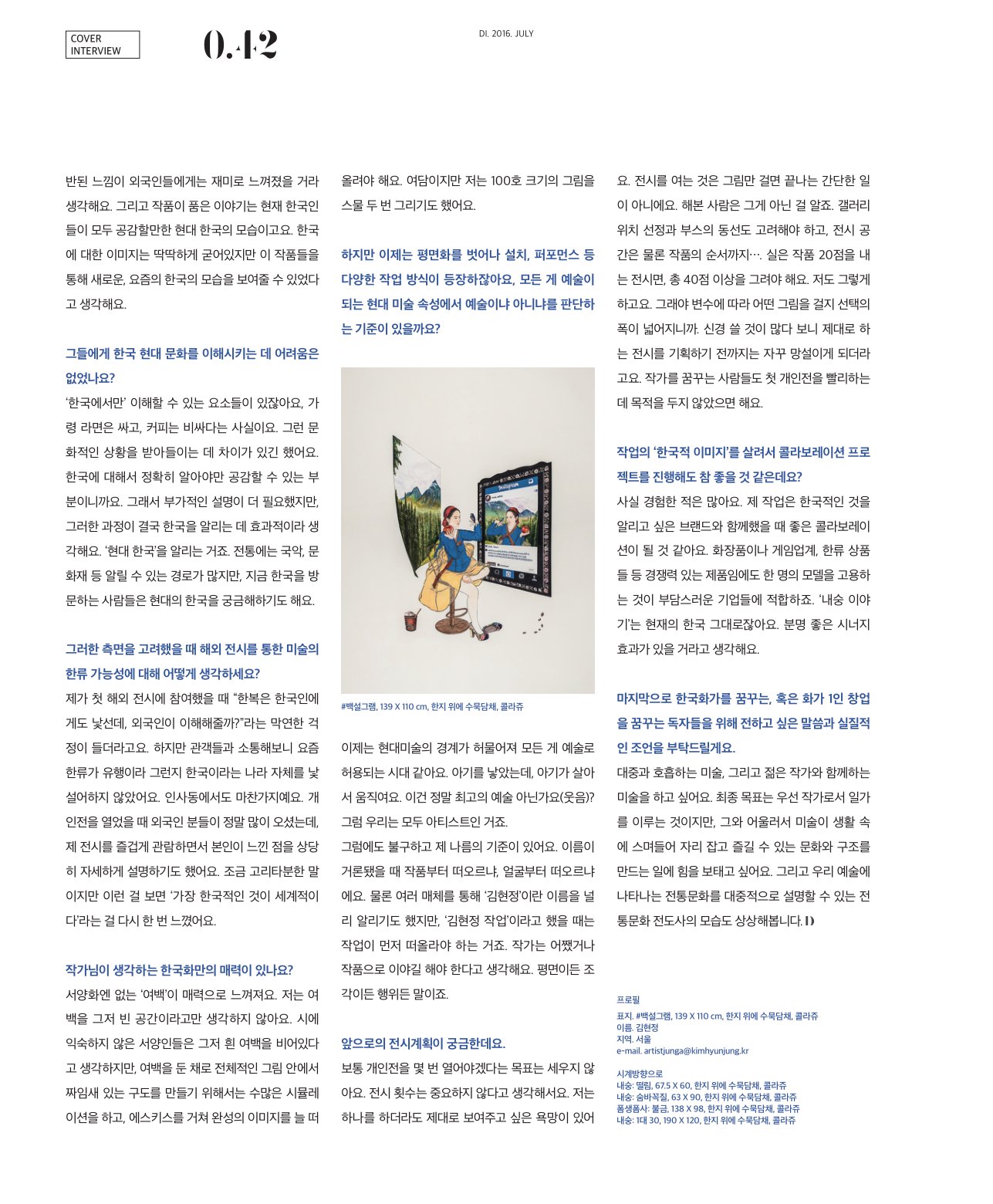
My paintings basically follow traditional Oriental-painting coloring technique. I keep the technique while borrowing collage to add a contemporary element. The semi-transparent skirt rendered in ink tones takes up a large portion of my subject matter — to express 'your inside is completely visible,' I dye thin hanji and then apply collage.
Collage began to be used in the transition from modern to contemporary art, but in Korea there had been no attempt to paste materials or hanji this way. Honestly the idea came to me in a flash, but it seems to bring out the feel of hanbok that I love, so I plan to keep developing it going forward.
The exhibition itself feels like a playground, much like the contemporary subject matter and playful material in your work.
My recent exhibition <Naesoong Amusement Park> isn't simply a place to view works — it's a playground where the viewer can actually indulge in their own hobby of 'appreciating art.' A place where the viewer can experience painting and sculpture together with the artist, create meaningful memories, and enjoy a good romp before leaving. So I decorated the exhibition like a playground, with events and participatory spaces. I wanted viewers to appreciate the works and genuinely enjoy the exhibition by sharing an art activity with the artist.
It feels quite different from the relatively quiet, solemn atmosphere of a typical art museum.
I wanted the exhibition space itself to match the character of the work — a space filled with laughter. Every exhibition has a different character, doesn't it (laughs)? I'm happiest at the moment I'm painting, and I wanted viewers to feel that too, so I planned it to be as fun and witty as possible. In our tough contemporary society, I hoped this could be an exhibition where at least during the moment of viewing, people could laugh heartily and enjoy themselves.
There must have been anguish and effort behind your cheerful subject matter…. People who don't paint themselves can't see that process of anguish. Did that ever worry you?
The more easily read and enjoyed a work is, the more it has to go through a long process of deliberation and anguish. Honestly, I agonize a great deal while creating my work. But it's sometimes upsetting to see viewers who assume the works just pop out effortlessly.
Some even attribute it to promotion and marketing, saying my paintings only became visible after I gained recognition. But in fact I've continuously worked on the theme I've been contemplating since 2010, painting without a single day off for four years. I work as regularly and strictly as possible, with set clock-in and clock-out times like at a company. I even work through the night sometimes (laughs). For the <Naesoong Amusement Park> exhibition too, the works took five years, and the planning took about two years. Since the media only shows the glamorous side, I feel it's a pity that the labor behind that glamour goes unseen.
Still, it seems you've earned a lot of goodwill from the public through active communication with viewers.
I think it's because the universal subject matter, which many people can relate to, aligns with the values of beauty I pursue. People also seem to like the elements of wit I deliberately stage.
You recently opened the solo exhibition <21st-Century Genre Painting Stories> at the Korean Cultural Center in Berlin, Germany. Was the response from foreign audiences as good as from Korean viewers?
Dr. Britta Schmitz selected and evaluated my work, which made the exhibition in Germany possible. At the opening I got to meet various local painters, gallerists, and collectors, and far more people came and offered congratulations than I expected. I also did an interview with Bild, a major German daily with a circulation of over a million. I think they were probably drawn to the method, imagery, and story within my work.
Honestly, I had a lot of worries before the Berlin exhibition. In the U.S., people would come up wanting to take photos with me just because I was wearing hanbok, but I worried that response might not be there in Germany. Contrary to my worries, though, people liked seeing me in hanbok and liked the work, and showed interest by wanting to take photos too. What I liked most was that, as a country with a developed literary tradition, Germans listened seriously to the stories behind the work. Seeing them try to accept and understand what I was saying, I marveled — 'ah, this must be what separates a developed country: whether or not there's interest in art.'
It seems the idea of showing contemporary imagery through a traditional Korean-painting method was particularly interesting to them.
Yes, exactly. The woman in the work wears hanbok, a traditional garment, yet the imagery is contemporary. I think the contrasting feeling this creates came across as interesting to foreigners. And the story the work carries is a contemporary Korea that Koreans today can all relate to. The image of Korea abroad tends to be fixed and rigid, but I think these works let me show a new, present-day Korea.
Was it hard to make them understand contemporary Korean culture?
There are elements only understandable 'in Korea' — for instance, the fact that ramyeon is cheap and coffee is expensive. There were differences in how they accepted that kind of cultural context, since it's something you can only relate to once you truly understand Korea. So additional explanation was needed, but I think that process ultimately helps effectively spread awareness of Korea — spreading awareness of 'contemporary Korea.' For tradition, there are many channels to promote it, like traditional music and cultural heritage, but people visiting Korea now are also curious about contemporary Korea.
Considering that aspect, what do you think about the potential for a K-wave in art through overseas exhibitions?
When I participated in my first overseas exhibition, I had a vague worry — "Hanbok is unfamiliar even to Koreans, so will foreigners understand it?" But once I communicated with viewers, I found that, perhaps due to the current popularity of the Korean wave, they weren't unfamiliar with Korea as a country at all. It's the same in Insa-dong. When I held my solo exhibition, a great many foreigners came, and while enjoying the exhibition, they explained what they felt in quite a lot of detail. It's a somewhat clichéd saying, but seeing this, I felt once again that 'what is most Korean is most global.'
Is there a charm unique to Korean painting, in your view?
I find the 'blank space' that Western painting doesn't have to be its charm. I don't think of blank space as simply empty space. Westerners unfamiliar with poetry might think a white blank space is just empty, but to create a well-structured composition within the overall painting while leaving that blank space, you have to run countless simulations, go through sketches, and constantly keep the finished image in mind. As an aside, I once painted a 100-ho-sized painting twenty-two times.
But now, moving beyond flat painting, various working methods like installation and performance have emerged — in this era of contemporary art where anything can become art, is there a criterion for judging what is and isn't art?
#SnowWhitegram, 139 x 110 cm, ink and light color on hanji, collage
It feels like an era where the boundaries of contemporary art have dissolved, and everything is allowed to be art. If you give birth to a baby, and the baby lives and moves — isn't that really the highest art (laughs)? Then we're all artists.
Even so, I have my own criterion. When a name is mentioned, does the work come to mind first, or the face? Of course I've made the name 'Kim Hyun Jung' widely known through various media, but when people say 'Kim Hyun Jung's work,' the work itself should come to mind first. I think an artist ultimately has to speak through their work, whether it's flat painting, sculpture, or performance.
I'm curious about your future exhibition plans.
I don't usually set a goal like 'I should hold this many solo exhibitions.' I don't think the number of exhibitions matters. Even if I only do one, I have the desire to show it properly. Holding an exhibition isn't a simple matter of just hanging up paintings and being done. Anyone who's done it knows that's not how it works. You have to consider the gallery's location and the flow of the booth space, not to mention the exhibition space and even the order of the works…. Actually, if an exhibition shows 20 works, you need to have painted a total of over 40. I do the same. That way, depending on variables, you have a wider range of choices for which painting to hang. There's so much to consider that I keep hesitating until I can plan an exhibition properly. I hope people who dream of becoming an artist won't place their priority on holding their first solo exhibition quickly.
Wouldn't it be great to run collaboration projects making use of the 'Korean imagery' in your work?
I actually have a lot of experience with that. I think my work would make for a good collaboration when paired with a brand wanting to promote something Korean. It suits companies in cosmetics, gaming, or Korean-wave merchandise — companies with competitive products who might find hiring a single model too burdensome. 'Naesoong Stories' is present-day Korea itself. I'm sure there would definitely be good synergy.
Finally, could you share some words and practical advice for readers who dream of becoming a Korean painter, or of starting out as a one-person artist-entrepreneur?
I want to do art that breathes together with the public, and art alongside young artists. My ultimate goal is first to establish myself as an artist in my own right, but alongside that, I want to help build a culture and structure in which art can settle into everyday life and be enjoyed. And I also imagine myself as a kind of ambassador for traditional culture, able to explain to the public the traditional culture that appears in our art.
Profile
Cover. #SnowWhitegram, 139 x 110 cm, ink and light color on hanji, collage
Name. Kim Hyun Jung
Region. Seoul
e-mail. artistjunga@kimhyunjung.kr
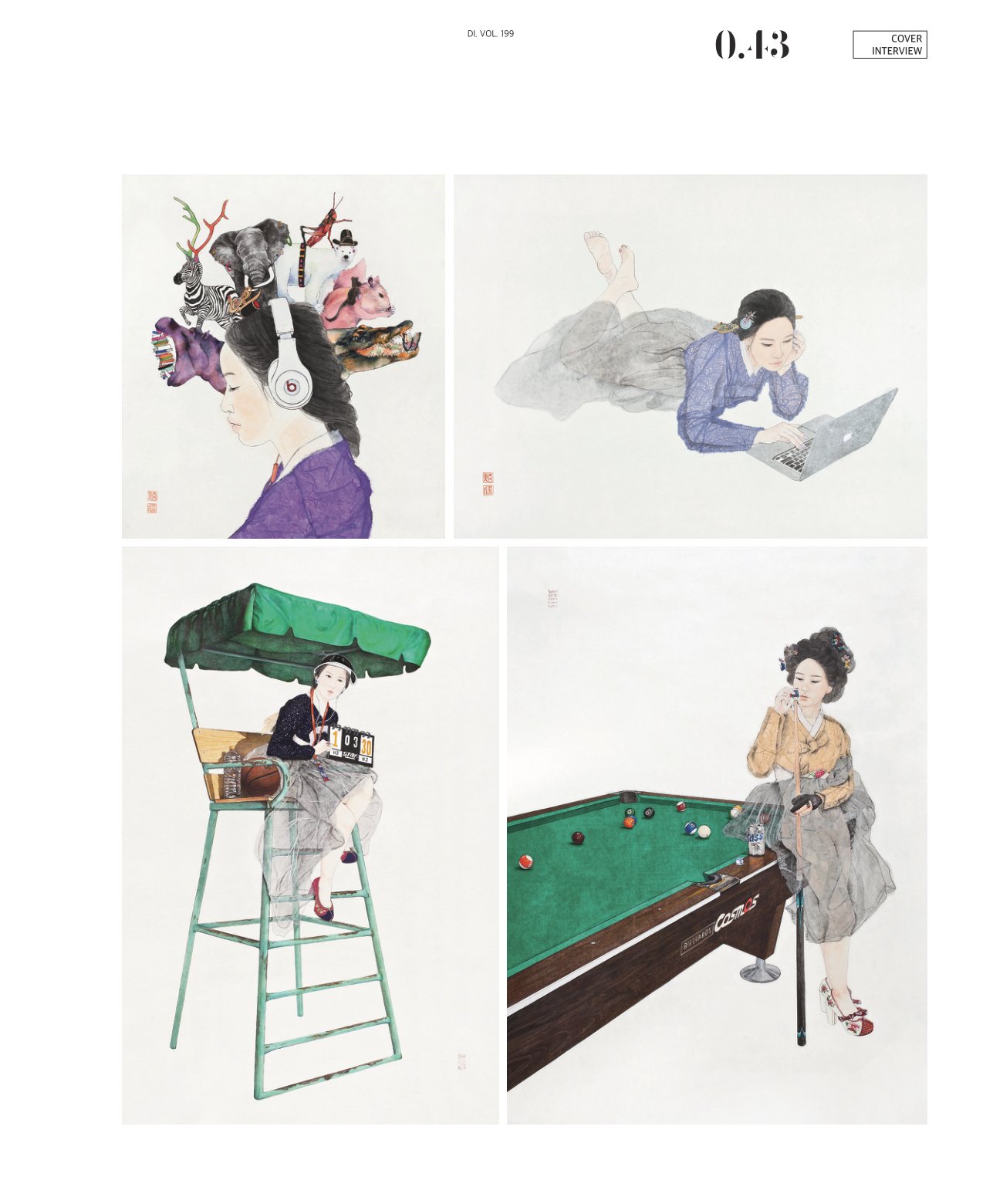
Clockwise from top
Naesoong: Trembling, 67.5 x 60, ink and light color on hanji, collage
Naesoong: Hide and Seek, 63 x 90, ink and light color on hanji, collage
Live for Style: Fri-YAY, 138 x 98, ink and light color on hanji, collage
Naesoong: One Against Thirty, 190 x 120, ink and light color on hanji, collage