






Monthly Art World | Kim Hyun Jung’s Naesoong! I See It, I See It All!
Monthly Art World's February 2015 issue ran an in-depth interview with Kim Hyun Jung in its 'Artist 2' section under the title 'Naesoong! I See It, I See It All!' It covered the runaway success of her solo exhibition at Gana Insa Art Center, the self-portrait-like quality of her sheer hanbok imagery in the Naesoong series, her convictions on self-promotion, and her plans for social drawing and the upcoming Naesoong Amusement Park.
View full text
Kim Hyun Jung
Naesoong! I See It, I See It All!
Kim, Hyun jung
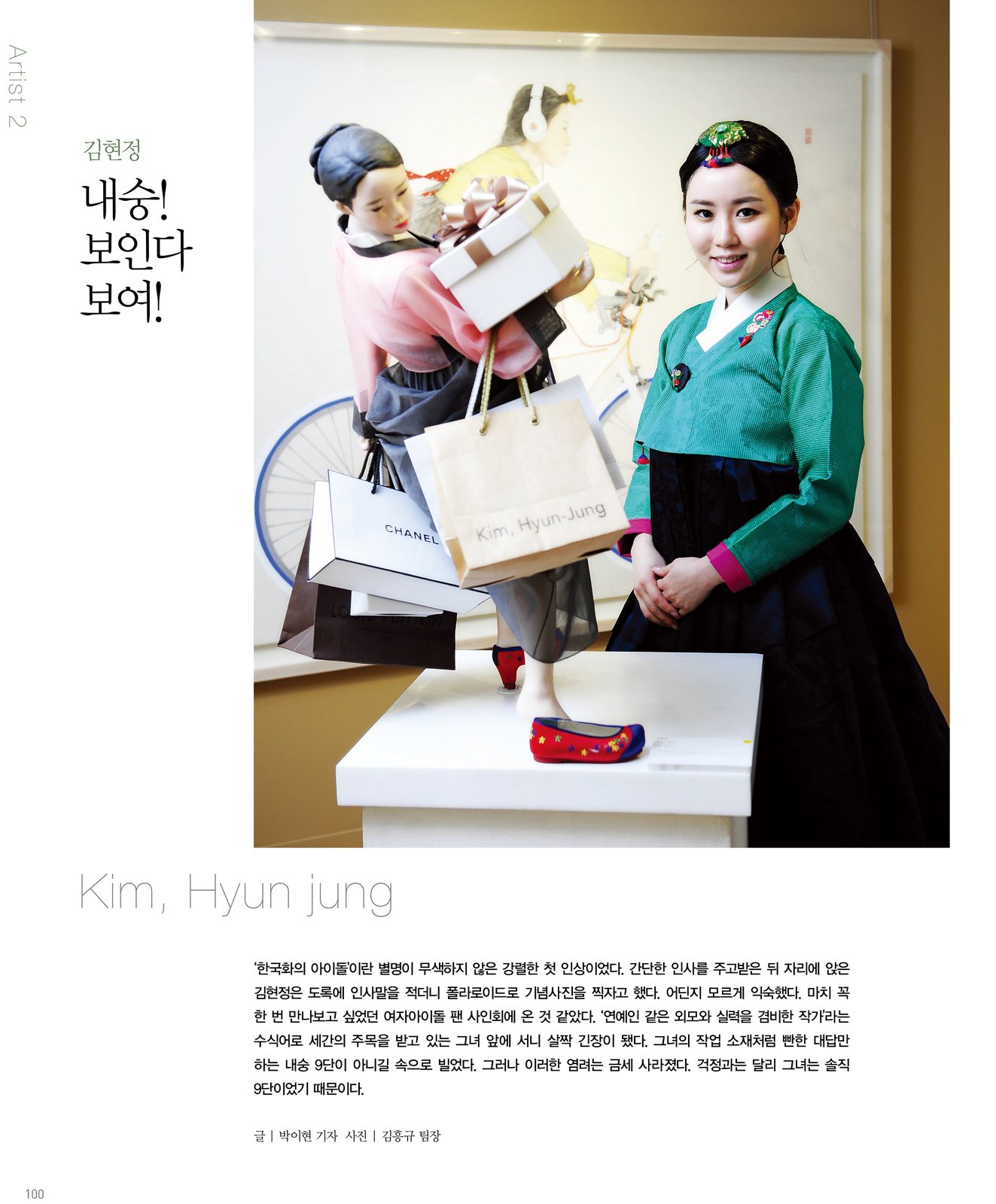
It was a striking first impression that lived up to the nickname "idol of Korean painting." After a brief greeting, Kim Hyun Jung sat down, wrote a note of greeting in the catalogue, and then suggested we take a Polaroid together to commemorate the occasion. Somehow it felt familiar — as if I had come to a fan signing for a girl-group idol I'd always wanted to meet. Standing before her, someone celebrated with the label "an artist with the looks and skill of a celebrity," I felt a flicker of nerves. I silently hoped she wouldn't be a master of "naesoong" (pretense) herself, giving only the pat, expected answers her own subject matter depicts. But that worry vanished almost immediately. Contrary to my fears, she turned out to be a master of candor instead.
Text | Park I-hyun, reporter Photos | Kim Hong-gyu, team leader
Pretense Hidden in the Folds of a Skirt
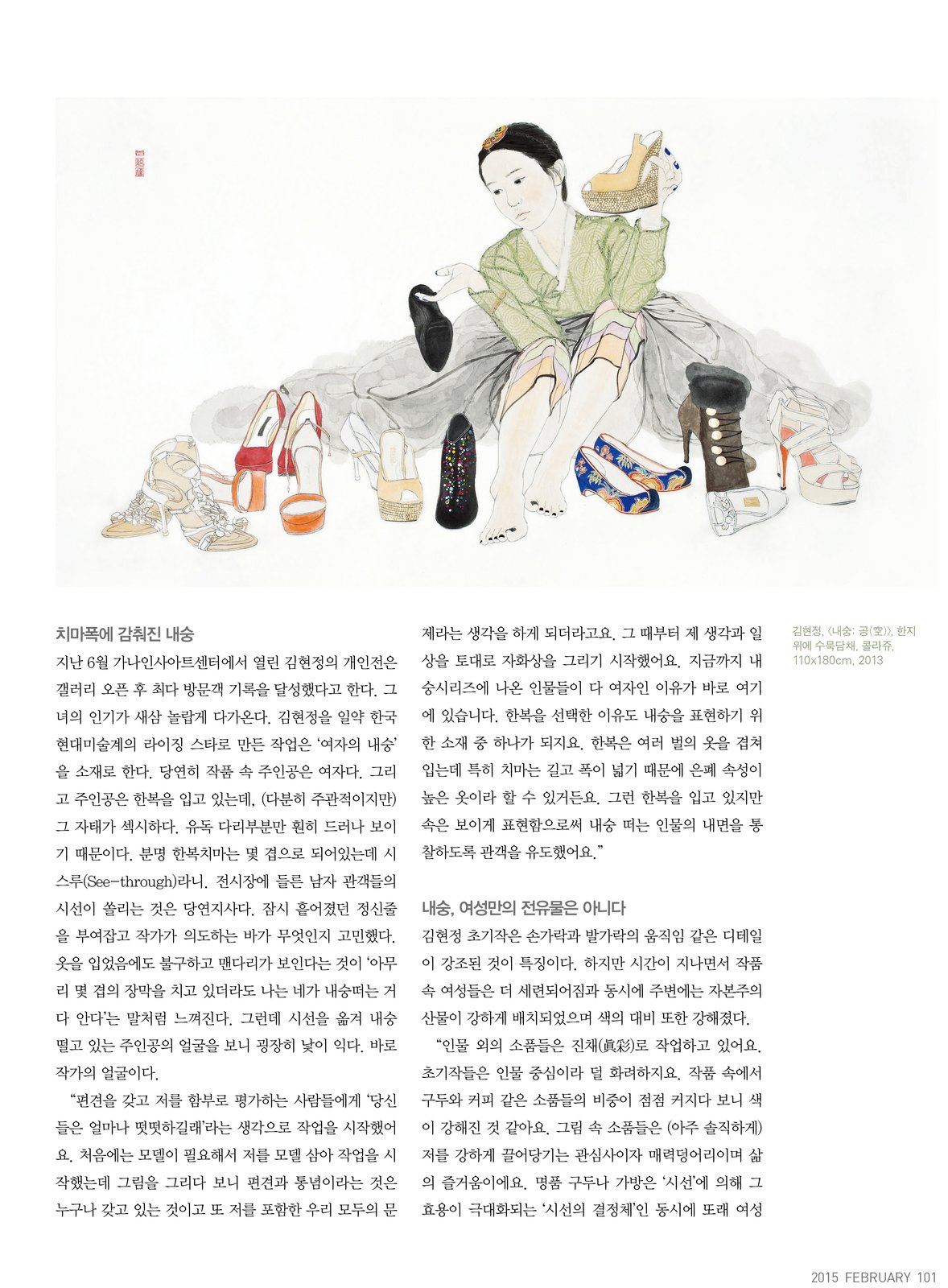
Kim Hyun Jung's solo exhibition last June at Gana Insa Art Center reportedly set a record for the gallery's highest number of visitors since it opened. Her popularity feels newly astonishing all over again. The work that catapulted Kim Hyun Jung into a rising star of Korea's contemporary art scene takes "a woman's pretense" as its subject. Naturally, the protagonist in her work is a woman. And that protagonist wears hanbok — and (admittedly, this is subjective) her bearing is sexy. That's because, oddly, only her legs are left in plain view. The hanbok skirt is clearly layered several times over, and yet — sheer, see-through. It's only natural that the gaze of male visitors at the exhibition gets drawn there. Pulling my scattered attention back together, I thought about what the artist intended. Even though the figure is dressed, her bare legs are visible — and that feels like it's saying, "No matter how many layers of curtain you put up, I know full well you're being coy." Then, shifting my gaze to the face of this coquettish protagonist, I realize it looks extremely familiar. It is the artist's own face.
"I started this work thinking, 'How honest can you really claim to be,' directed at people who carelessly judge me through their prejudices. At first I needed a model, so I used myself, but as I kept painting I came to realize that prejudice and convention are things everyone carries — and that it's a problem for all of us, myself included. That's when I began painting self-portraits based on my own thoughts and daily life. That's exactly why every figure that has appeared in the Naesoong series so far has been a woman. The reason I chose hanbok is also tied to expressing naesoong: hanbok layers many garments, and the skirt in particular is long and wide, making it a garment with a strong quality of concealment. Even while wearing such a garment, I made the inside visible, guiding the viewer to look inward at the psychology of a person putting on airs."
Naesoong Isn't Only for Women
Kim Hyun Jung's early works were characterized by an emphasis on fine details like the movement of fingers and toes. But over time, the women in her work have grown more sophisticated, while the objects surrounding them have taken on a stronger presence of capitalist consumer goods, and the contrast of color has intensified as well.
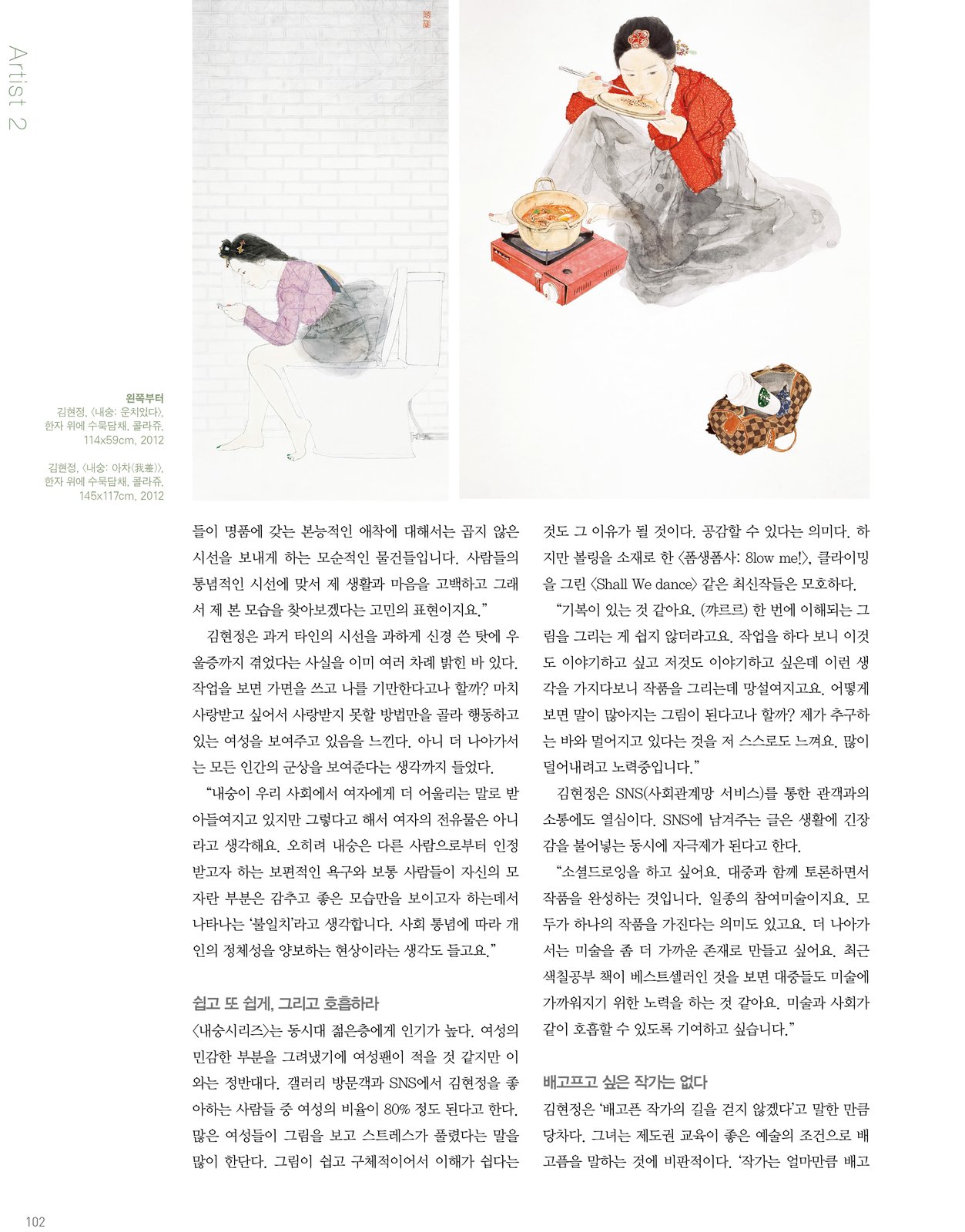
"I work the props other than the figure in jinchae [heavy mineral pigment]. My early works centered on the figure, so they're less vivid. As props like shoes and coffee cups have come to take up more space in the composition, I think the colors have naturally become stronger. The props in my paintings are — quite honestly — things that strongly attract me, objects of fascination, and simple pleasures of life. Luxury shoes or bags are 'crystallizations of the gaze' whose utility is maximized precisely by other people's attention, and at the same time they're contradictory objects that draw disapproving looks toward the instinctive attachment women my age feel toward luxury goods. It's an expression of my struggle to confess my everyday life and mind in the face of people's conventional gaze, and in doing so, to search for my true self."
Kim Hyun Jung has already spoken more than once about having suffered from depression in the past because she was overly conscious of other people's opinions. Looking at her work, you might say she's confessing that she once wore a mask and deceived herself. It feels as if she is showing us a woman who, wanting so badly to be loved, unwittingly chooses only the behaviors that make her unlovable. Or, taking it further, it feels like she is showing us the human condition itself.
Easy, and Easier Still — Breathe
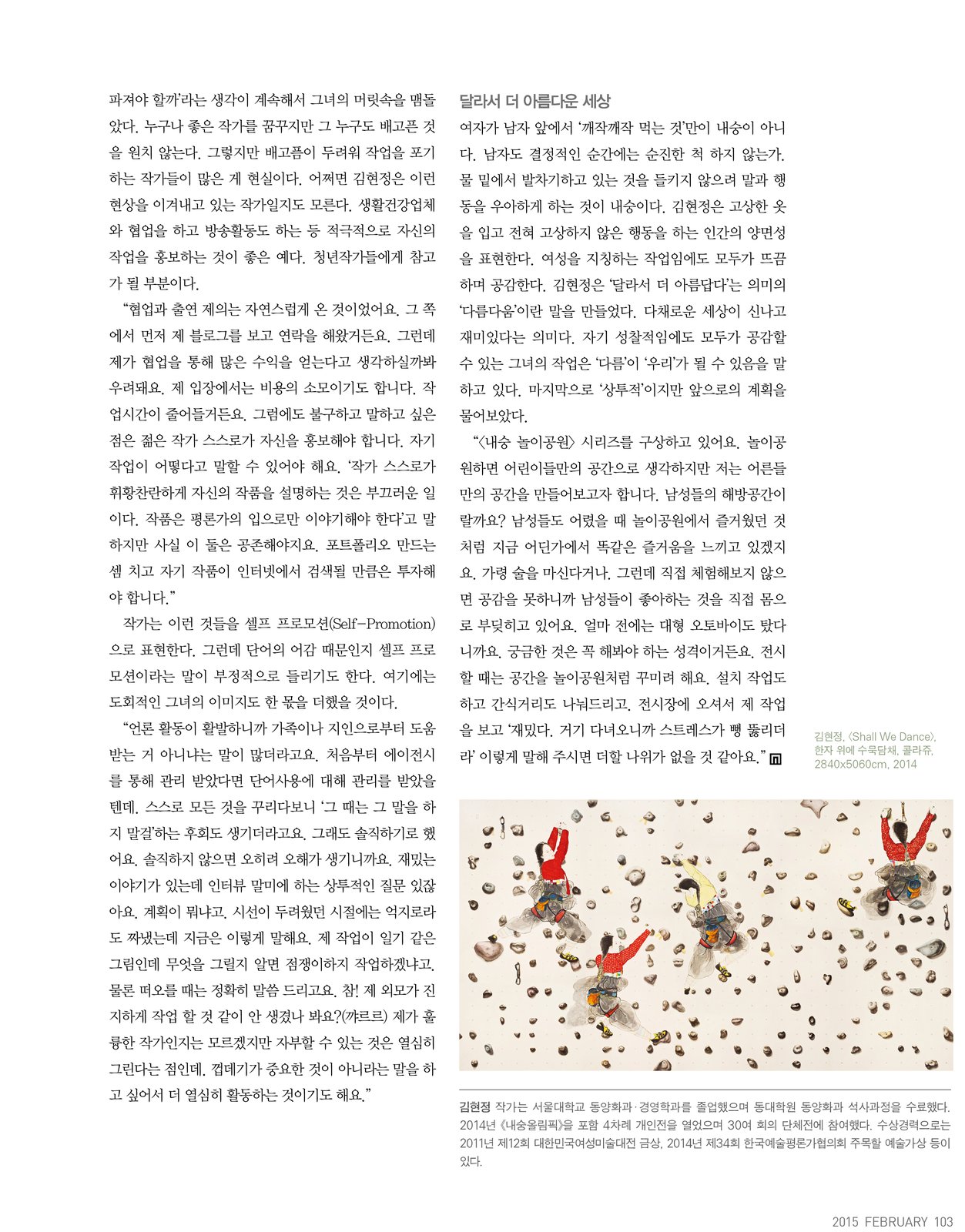
The Naesoong series is highly popular among the young generation of today. You might expect it to have few female fans, since it depicts sensitive aspects of womanhood, but the opposite is true. Apparently, women make up roughly 80% of gallery visitors and the people who follow Kim Hyun Jung on social media. Many women say that looking at the paintings relieves their stress — likely in part because the paintings are simple and concrete, making them easy to understand. That means people can relate to them. Still, her most recent works, such as Show Me the Money: 8low Me!, based on bowling, or Shall We Dance, depicting climbing, are more ambiguous.
"I think there are ups and downs. (laughs) It's not easy to make a painting that's understood in a single glance. As I keep working, there's this and that I also want to say, and having all these thoughts makes me hesitate over the painting. In a way, it becomes a painting that talks too much, I suppose? I can feel myself drifting from what I'm actually pursuing. I'm trying hard to pare things back."
Kim Hyun Jung is also diligent about communicating with her audience through social media. She says the comments people leave add a sense of tension to her daily life while also serving as a stimulant.
"I want to try social drawing — completing a work while discussing it with the public. It's a kind of participatory art. There's also meaning in everyone getting to feel they own a piece of the work. Going further, I want to make art a nearer, more familiar presence. Seeing that coloring books have become bestsellers lately, it seems the public is also making an effort to draw closer to art. I want to contribute so that art and society can breathe together."
No Artist Wants to Go Hungry
Kim Hyun Jung says, quite boldly, "I won't walk the path of the starving artist." She is critical of institutional education that treats hunger as a hallmark of good art. The question "how hungry does an artist need to become?" kept circling in her mind. Everyone dreams of being a good artist, but no one actually wants to be hungry. And yet, in reality, plenty of artists give up their work for fear of that very hunger. Kim Hyun Jung may be an artist overcoming that very phenomenon. Her active promotion of her own work — collaborating with lifestyle and health brands, appearing on broadcasts — is a good example, and one worth young artists taking note of.
"The collaboration and appearance offers came naturally — they reached out to me first after seeing my blog. But I worry people might think I earn a great deal of income through these collaborations. From my perspective, it's also a cost — it eats into my working time. Even so, what I want to say is that young artists need to promote themselves. You have to be able to speak about your own work. People say 'it's embarrassing for an artist to gaudily explain their own work — that should be left to the critics,' but honestly, the two should coexist. Treat it like building a portfolio: you need to invest enough that your work can actually be found when people search for it online."
The artist calls this self-promotion. But perhaps because of how the phrase sounds, "self-promotion" can carry a negative ring — and her urbane image may add to that impression.
"Because I'm active in the media, I often hear people say I must be getting help from family or acquaintances. If I'd been managed by an agency from the start, my choice of words would have been managed too. Since I've built everything myself, there are moments I regret — 'I shouldn't have said that.' Still, I decided to stay honest. If you're not honest, misunderstandings only grow worse. Funny story — there's that clichéd question interviewers always ask at the end, about your plans. Back when I was afraid of others' opinions, I used to force out an answer. Now I just say: my work is like a diary, so if I knew exactly what I'd paint next, I'd be a fortune teller, not an artist. Of course, when something does come to me clearly, I say so precisely. Oh! I suppose I don't look like someone who works seriously? (laughs) I'm not sure if I'm a great artist, but the one thing I can claim with pride is that I work hard — and it's precisely because I want to say that appearances aren't what matters that I work even harder."
A World More Beautiful for Being Different
Pretense isn't only "nibbling daintily in front of a man." Don't men also play innocent at decisive moments? Pretense is kicking your legs frantically under the water while keeping your words and gestures elegant so no one notices. Kim Hyun Jung expresses the duality of a human being who wears refined clothes while behaving in ways that are anything but refined. Even though the work is framed around women, everyone recognizes something of themselves in it and feels a jolt of recognition. Kim Hyun Jung coined the term "darŭmdaum" — meaning "more beautiful for being different." It suggests that a world full of diversity is exciting and fun. Even though her work is deeply introspective, it manages to resonate with everyone, showing that "different" can become "us." Finally, I asked — clichéd as it may be — about her plans going forward.
"I'm developing a series called Naesoong Amusement Park. People tend to think of amusement parks as spaces only for children, but I want to create a space only for adults. A space of liberation for men, you might say? Just as men once felt joy at amusement parks as boys, I imagine they're feeling the same kind of joy somewhere right now — say, while drinking. But you can't really relate to something without experiencing it yourself, so I'm throwing myself bodily into the things men enjoy. Not long ago I even rode a big motorcycle. I'm the type who has to try whatever I'm curious about. For the exhibition, I plan to decorate the space like an amusement park — with installation pieces, and snacks to hand out. If visitors come see my work and say, 'That was fun, going there really blew away my stress,' there would be nothing more I could ask for."
[Profile]
Kim Hyun Jung graduated from Seoul National University with degrees in Oriental Painting and Business Administration, and completed her master's coursework in Oriental Painting at the same graduate school. As of 2014 she has held four solo exhibitions, including Naesoong Olympics, and has taken part in more than 30 group exhibitions. Her awards include the Gold Prize at the 12th Korea Women's Art Grand Exhibition in 2011 and the 34th Korean Art Critics Association's Artist to Watch award in 2014.