






Hyundai Oilbank | The Woman Who Feigns Coyness, and the Woman Who Doesn’t
This is a dialogue between Korean painter Kim Hyun Jung and Hyundai Chemical employee Lee Jong-chan, published in the 'Surprise Interview' section of the February 2017 issue of Hyundai Oilbank's in-house magazine. Being the same age, the two discussed the meaning behind the 'Naesung' series and her creative philosophy, as well as recent news including her invited solo exhibition at the Metropolitan Museum of Art in New York. Written by Lee Sun-joo, photographed by Lee Seung-heon, costumes provided by Park Sul-nyeo Hanbok.
View full text
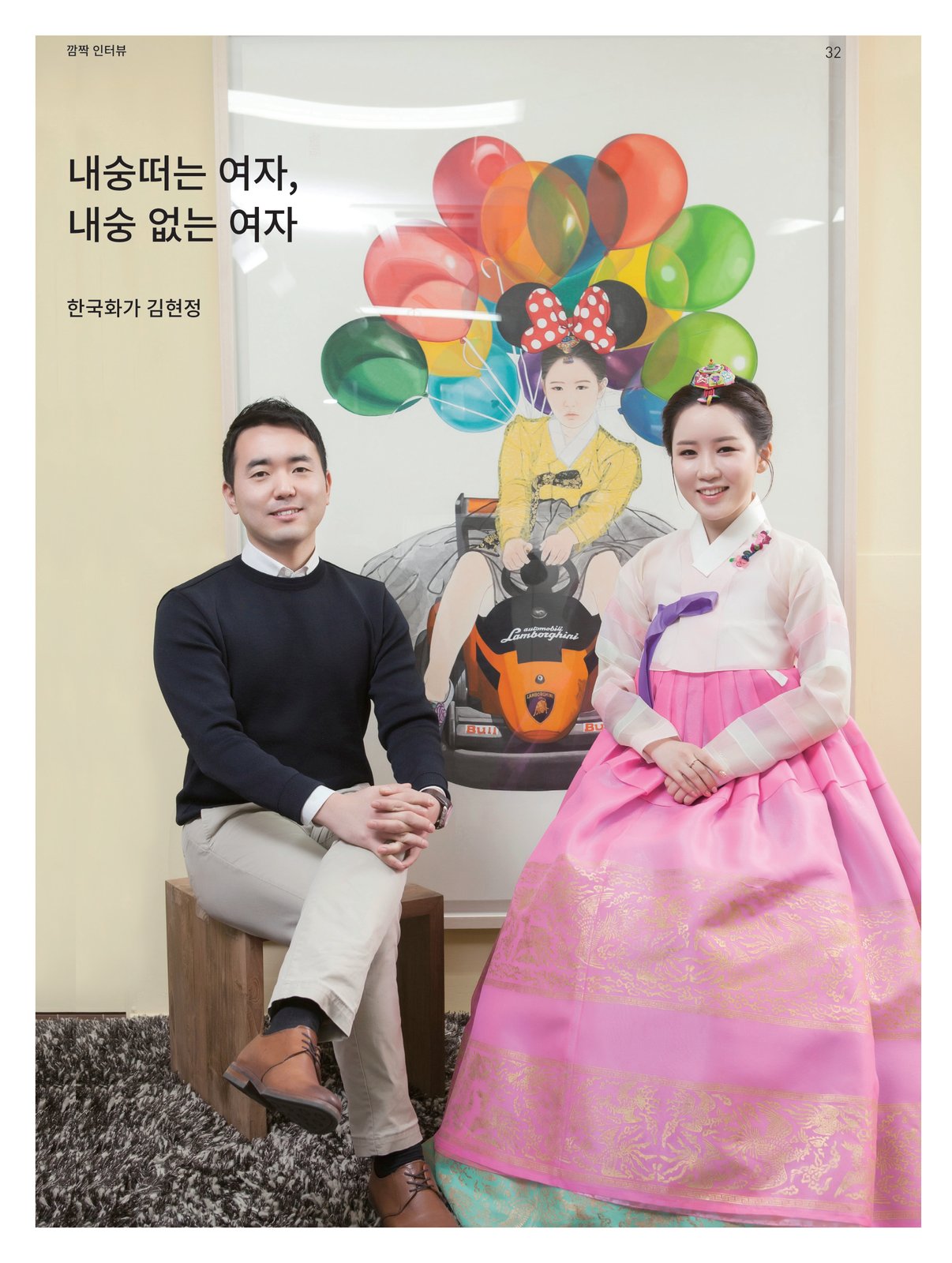
The Woman Who Feigns Coyness, the Woman Who Doesn't
Korean painter Kim Hyun Jung
A demurely dressed woman in hanbok, skirt hiked all the way up, straddles a fast-food delivery motorcycle with an air of total nonchalance, or slurps down ramyeon in the most unguarded of postures. That such delicate, gracefully folded hands would strike such utterly relaxed poses in clothing meant for refined comportment feels, in its own way, like a quiet act of defiance. Korean painter Kim Hyun Jung shatters the constraints demanded by 'hanbok' — a garment that calls for composed, dignified behavior — with provocative poses, summoning up the keyword 'Naesung,' and that is precisely why her work always feels fresh, entertaining, and relatable. After all thirteen works in her 2013 solo exhibition 'Naesung Stories' sold out within two days, Kim Hyun Jung went on to become the youngest Korean artist ever invited to hold a solo exhibition at the Metropolitan Museum of Art in New York, in January 2016. Also selected by Dong-A Ilbo as one of the '100 People Who Will Shine Korea in Ten Years,' she was visited by her same-age peer, Hyundai Chemical employee Lee Jong-chan.
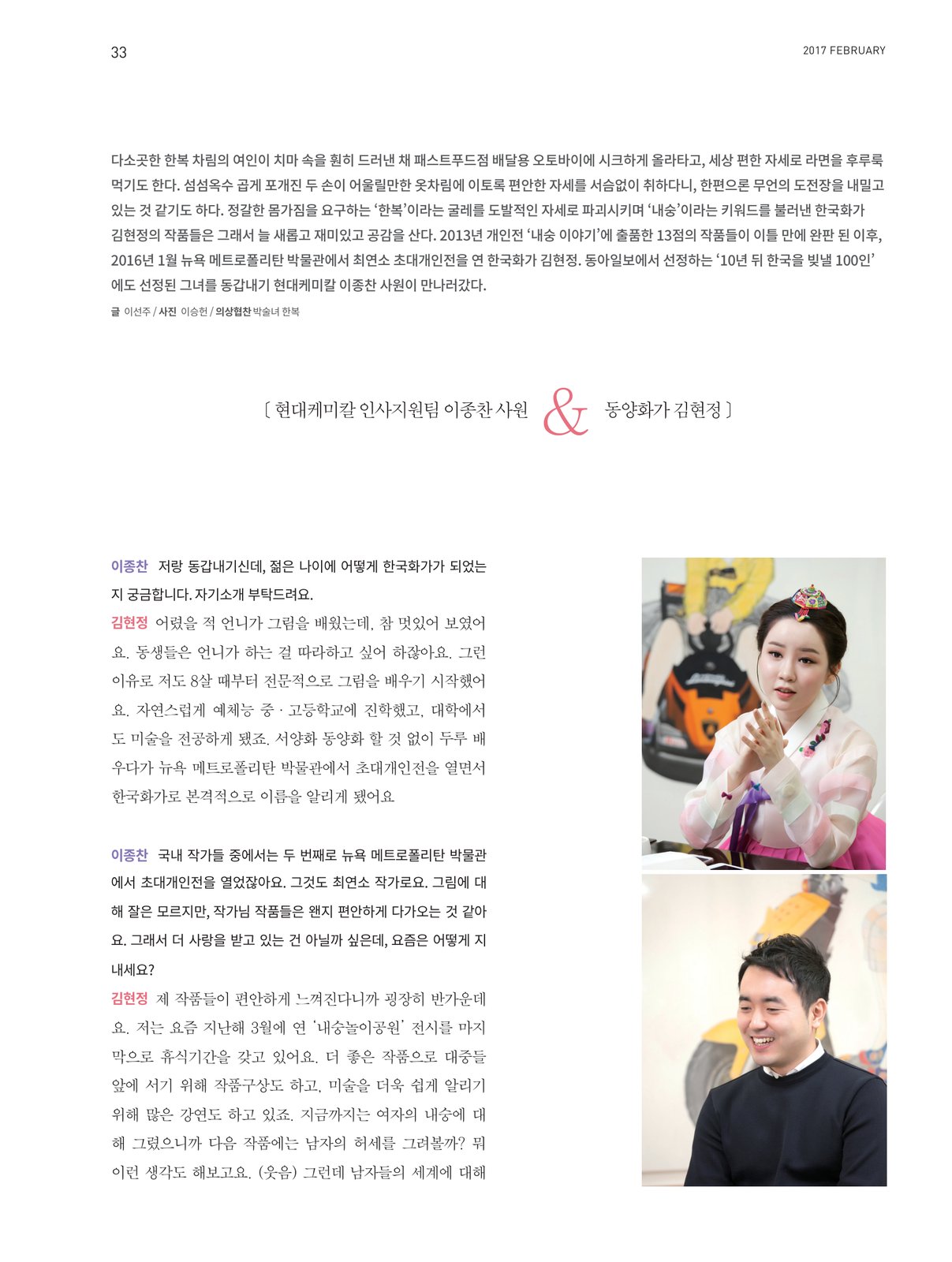
[Hyundai Chemical HR Support Team, Lee Jong-chan & Oriental painter Kim Hyun Jung]
Lee Jong-chan: We're the same age, so I'm curious how you became a Korean painter at such a young age. Could you introduce yourself?
Kim Hyun Jung: When I was little, my older sister was learning to paint, and it looked so cool. Younger siblings always want to copy what their older sibling does, right? That's why I started learning to paint professionally from the age of eight. Naturally, I went on to an arts-focused middle and high school, and majored in art in university as well. I studied both Western and Oriental painting broadly, and it was really the invited solo exhibition at the Metropolitan Museum of Art in New York that put my name out there in earnest as a Korean painter.
Lee Jong-chan: You're the second Korean artist ever to hold an invited solo exhibition at the Metropolitan Museum of Art in New York — and the youngest, at that. I don't know much about art, but your works somehow feel approachable to me. I imagine that's part of why they're so beloved. How have you been lately?
Kim Hyun Jung: I'm so glad to hear you say my work feels approachable. These days, since wrapping up my 'Naesung Amusement Park' exhibition last March, I've been in a resting period. I'm conceiving new work to present something even better to the public, and I've also been giving a lot of lectures to make art more accessible. Up to now I've painted women's Naesung, so lately I've been wondering — maybe next I should paint men's bravado? (laughs) Though I don't know much about the world of men, so I'm not sure it'll actually become a piece. Since I have the chance, let me ask you: what kinds of bravado do men have?
Lee Jong-chan: Hmm, let's see... insisting on paying the bill first at a drinking gathering? (laughs) I don't think we can talk with you without mentioning 'Naesung.' I understand the figures in your work are tied to that keyword — what exactly does 'Naesung' mean to you?
Kim Hyun Jung: The dictionary definition of 'naesoong' is 'appearing meek on the outside while being sly within.' The word itself tends to be treated in our society as something exclusively belonging to women, but I don't see it that way. I see it as a universal desire, regardless of gender, to be recognized and approved of by others. Naesung, ultimately, means behaving differently in order to present a better image. Since everyone instinctively has the desire to hide their shortcomings and show their best side, I came to see it as a phenomenon where individuals yield their sense of identity to social convention.
Lee Jong-chan: That makes me curious what kind of Naesung you yourself might have. Please be honest — what shortcomings are you hiding, and what good side are you showing?
Kim Hyun Jung: Somehow I have the feeling I need to answer this one well. (laughs) My own Naesung has a broad meaning and a narrow one. The narrow-sense Naesung is picking at your food in front of a guy you're interested in. Wanting to look prettier is instinctive for women, right? But my narrow-sense Naesung level isn't very high. Especially since a lot of women eat sparingly in front of a man they like — I, on the other hand, am 100% a big eater. I eat an enormous amount!
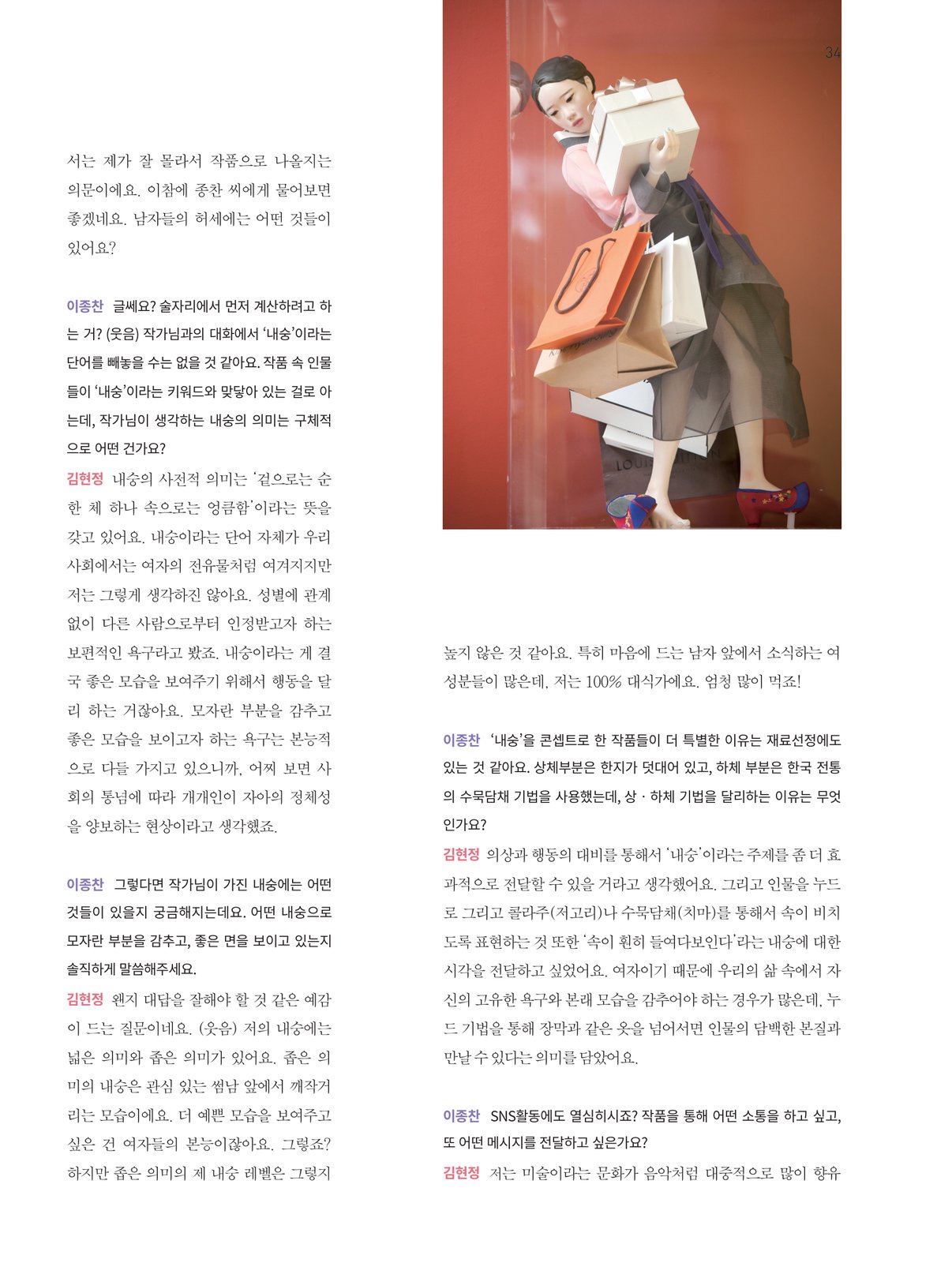
Lee Jong-chan: I think what makes the works built around the 'Naesung' concept even more special is the choice of materials. The upper body is done with hanji attached, and the lower body uses traditional Korean ink-wash coloring — why the different techniques for upper and lower body?
Kim Hyun Jung: I thought I could convey the theme of 'Naesung' more effectively through the contrast between costume and behavior. And by painting the figure nude and then, through collage (for the jeogori) or light ink-color (for the skirt), making it appear see-through, I wanted to convey the sense of 'Naesung,' where the truth shows right through. Because we're women, there are many situations in life where we have to hide our own genuine desires and true selves — through the nude technique, I wanted to convey the idea that once you look past the curtain-like clothing, you can meet the plain, honest essence of the person underneath.
Lee Jong-chan: You're also quite active on social media, aren't you? What kind of communication do you hope to have through your work, and what message do you want to convey?
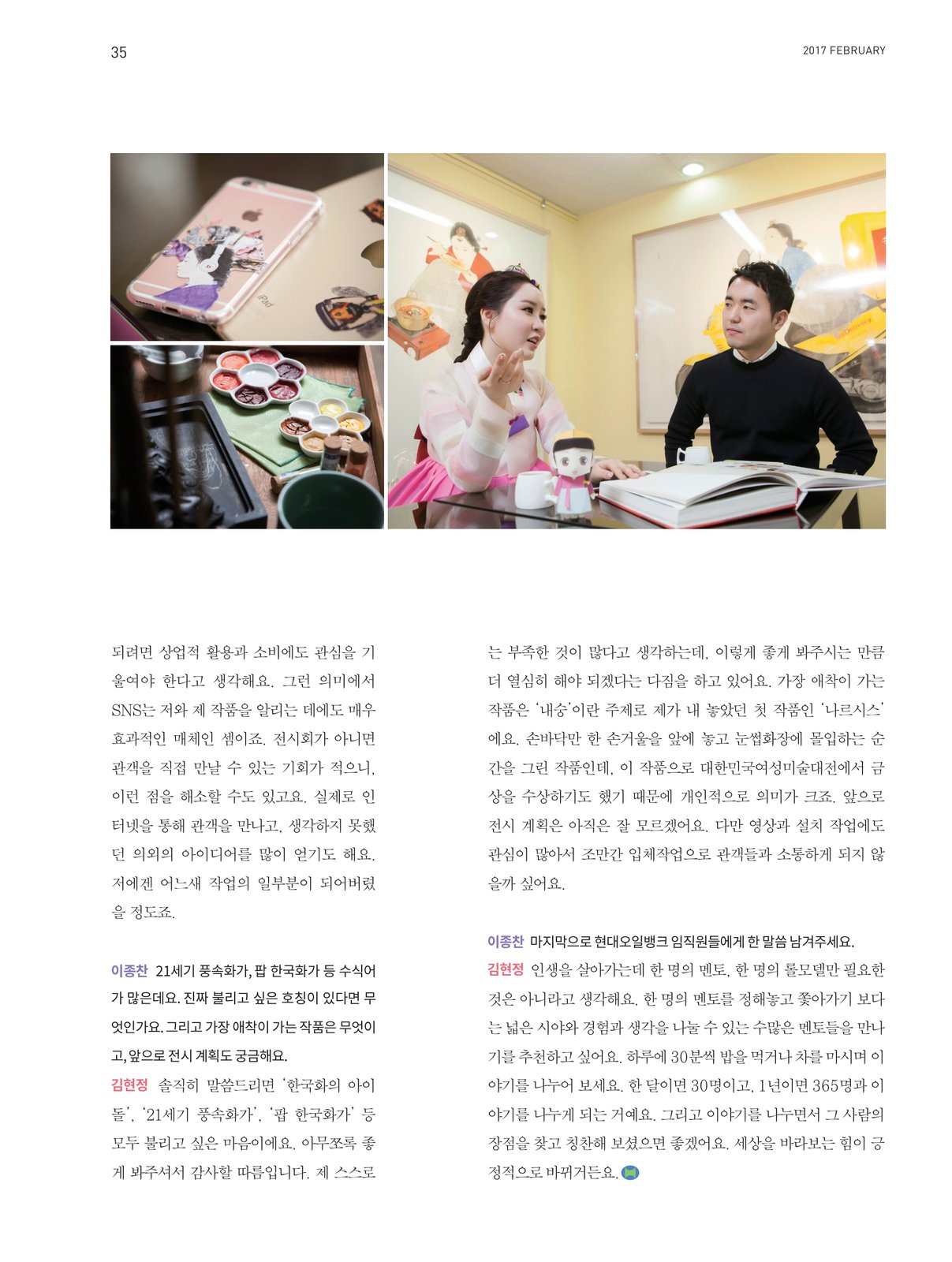
Kim Hyun Jung: I think that for a culture like art to be enjoyed by the public the way music is, we need to pay attention to commercial use and consumption as well. In that sense, social media is a very effective medium for promoting both me and my work. Apart from exhibitions, there are few opportunities to meet the audience directly, so this helps make up for that. In fact, I meet audiences through the internet and often get unexpected ideas I never would have thought of. It's become, at this point, part of my creative process.
Lee Jong-chan: Finally, could you leave a word for the employees of Hyundai Oilbank?
Kim Hyun Jung: I don't think you need just one mentor or one role model to get through life. Rather than fixing on a single mentor to follow, I'd recommend meeting many mentors who can share a broad perspective, experience, and ideas with you. Try talking with someone over a meal or tea for thirty minutes a day. That's thirty people a month, and 365 people a year. And as you talk with them, I hope you'll try to find that person's strengths and compliment them. It changes, in a positive way, the strength with which you see the world.
Lee Jong-chan: You've been given many epithets — '21st-century genre painter,' 'pop Korean painter' — is there one you'd actually like to be called? And what's the work you feel most attached to, and what are your exhibition plans going forward?
Kim Hyun Jung: Honestly, I'd be happy to be called any of them — 'idol of Korean painting,' '21st-century genre painter,' 'pop Korean painter.' I'm simply grateful people see me so kindly. I think there's still a lot I lack, but being seen this way makes me determined to work even harder. The work I feel most attached to is 'Narcissus,' the very first piece I made under the theme of 'Naesung.' It depicts the moment of being completely absorbed in applying eyebrow makeup in front of a palm-sized hand mirror, and it holds special meaning for me because it won the gold prize at the Korea Women's Art Exhibition. I don't have firm exhibition plans yet, but since I'm also very interested in video and installation work, I imagine I'll be reaching out to audiences through three-dimensional work before long.
Written by Lee Sun-joo / Photographed by Lee Seung-heon / Costumes provided by Park Sul-nyeo Hanbok