






Cultural Heritage Administration | Interview Held Inside the Gansong Old House
A dialogue published in the Spring 2021 issue (Vol. 45) of the Cultural Heritage Administration's quarterly magazine 'Cultural Heritage Window,' in the section 'Looking In: A Cultural Heritage Date Through Different Eyes.' At the Gansong Old House, the former residence of Gansong Jeon Hyung-pil, curator Park Ji-young of the National Research Institute of Cultural Heritage's Fine Arts Heritage Research Division met with Korean painter Kim Hyun Jung to discuss reinterpreting traditional subjects in a contemporary way, her research into traditional materials, and 21st-Century New Genre Painting: New Year's Scene, an homage to Shin Yun-bok's Dano Pungjeong. Filming was conducted in compliance with COVID-19 prevention guidelines.
View full text
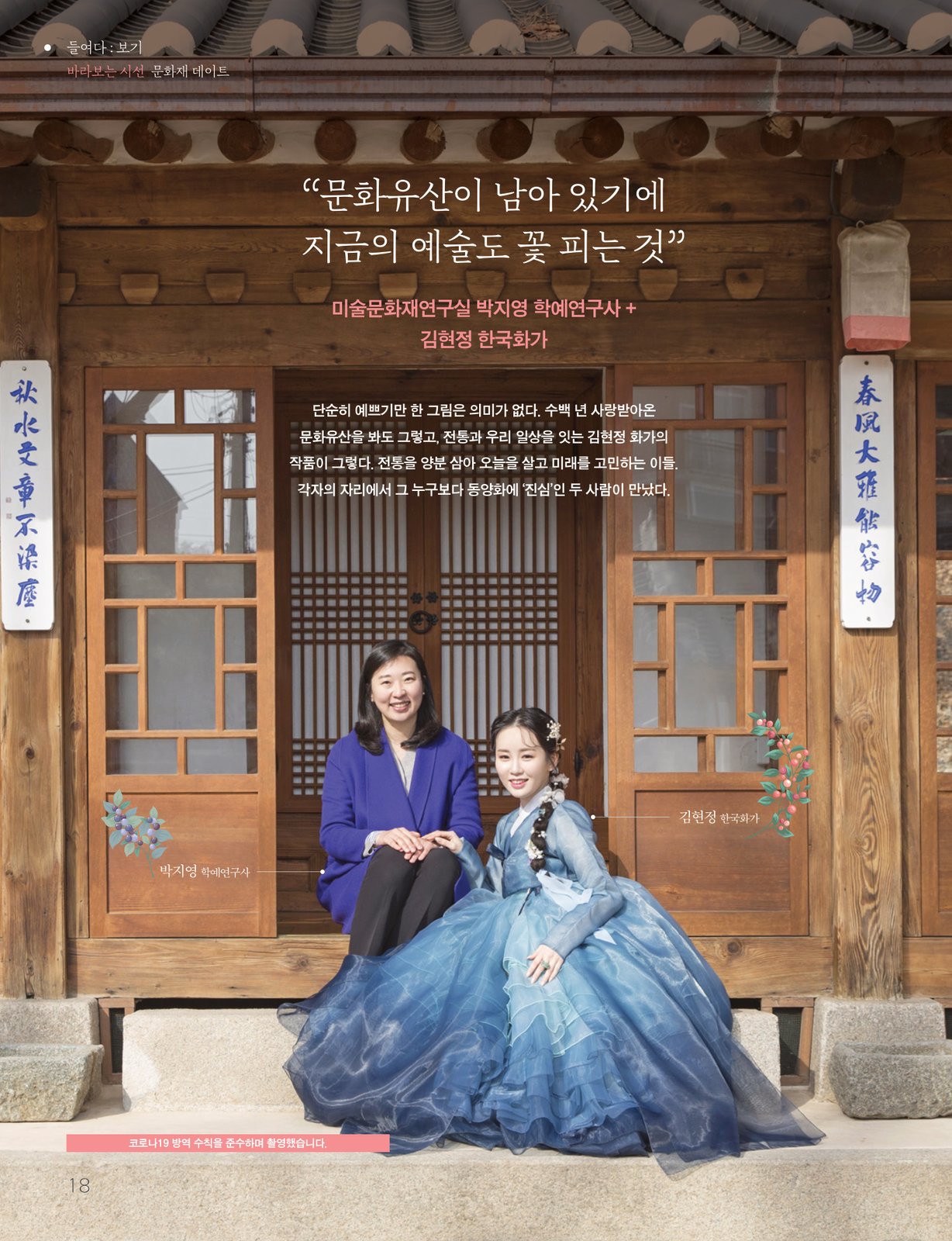
"It's because our cultural heritage has endured that today's art can also flourish"
Park Ji-young, Curator, Fine Arts Heritage Research Division + Kim Hyun Jung, Korean Painter
A painting that is merely pretty holds no real meaning. This is true of cultural heritage that has been cherished for centuries, and it's equally true of Kim Hyun Jung's work, which connects tradition to our everyday lives. Both live off the nourishment of tradition while inhabiting the present and pondering the future. Two people, each in their own field, more sincerely devoted to Oriental art than anyone else, met for this conversation.
(Filming was conducted in compliance with COVID-19 prevention guidelines.)
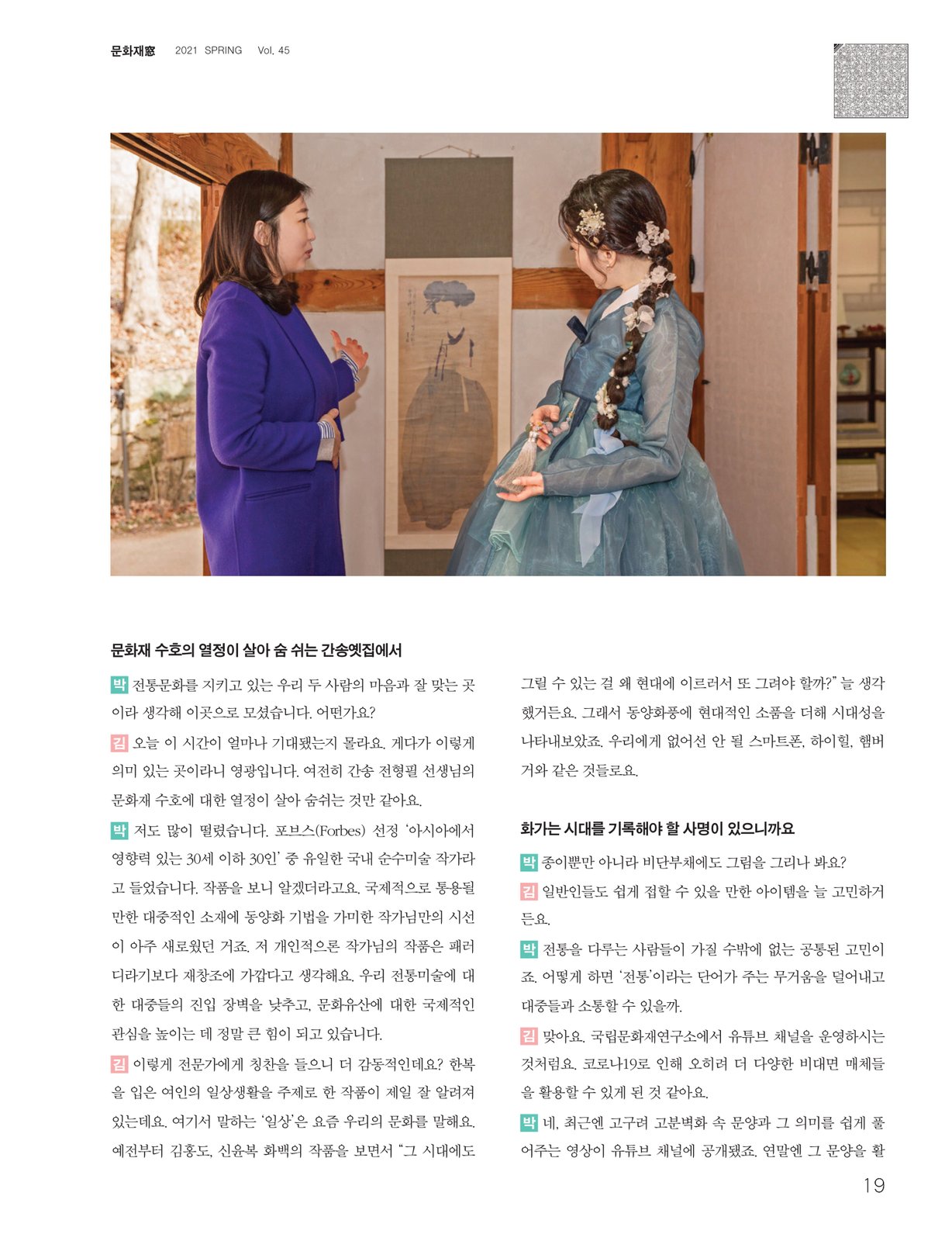
At the Gansong Old House, Where the Passion for Protecting Cultural Heritage Still Breathes
Park: I thought this place would resonate well with both our hearts, as two people devoted to preserving traditional culture, so I invited you here. How do you find it?
Kim: You have no idea how much I looked forward to this time today. And to think it's such a meaningful place — I'm honored. It feels as though Gansong Jeon Hyung-pil's passion for protecting our cultural heritage still lives and breathes here.
Park: I was quite nervous myself. I heard you're the only pure fine arts artist from Korea named to Forbes' '30 Under 30 Asia.' Looking at your work, I could see why — your perspective, blending Oriental painting technique with popular subject matter that could resonate internationally, felt genuinely fresh. Personally, I think of your work less as parody and more as re-creation. It's doing a great deal to lower the barrier of entry for the public into our traditional art, and to raise international interest in our cultural heritage.
Kim: Hearing such praise from an expert like you makes it all the more moving. My best-known works are on the theme of the everyday life of a woman dressed in hanbok — and the 'everyday' I mean here refers to our contemporary culture. I've always wondered, looking at the works of painters like Kim Hong-do and Shin Yun-bok, "why should we paint again, today, something that could already be painted back then?" So I tried adding contemporary props to an Oriental painting style, to capture the spirit of our own era — things indispensable to us now, like smartphones, high heels, and hamburgers.
Painters Have a Duty to Record Their Era
Park: I understand you paint not just on paper, but also on silk fans?
Kim: I'm always thinking about items that ordinary people could easily encounter.
Park: That's a common concern for anyone working with tradition — how to lighten the weight that the word 'tradition' carries, and communicate with the public.
Kim: Exactly. Like how the National Research Institute of Cultural Heritage runs a YouTube channel. I think COVID-19 has actually pushed us to make use of even more diverse non-contact media.
Park: Yes, recently a video explaining the patterns found in Goguryeo tomb murals and their meanings, in an easy-to-understand way, was released on our YouTube channel. At year's end, we also created illustrated New Year's cards and Christmas cards using those patterns and shared them on social media. We keep working to deliver and communicate our cultural heritage to the public in a way that's more enjoyable and informative. In that sense, I think you're a pioneer — your work is full of the kind of wit that draws the public's attention. Where do you usually get this kind of inspiration?
Kim: I love art museums and museums. The one limitation is that, in person, you can't fully savor every single piece among so many works. So I always make sure to bring related books along — and these days, exhibition catalogs are truly of a very high quality. That's all thanks to the hard work of curators like yourself.
Park: Even looking at the same work, I imagine the perspective differs.
Kim: When I look at Kim Hong-do's Ssireum (Wrestling), I imagine it as the scene of a mixed martial arts match. And it's in that same spirit that I created 21st-Century New Genre Painting: New Year's Scene as an homage to Shin Yun-bok's Dano Pungjeong. I remember picking up my brush in a hurry, struck by the thought that, just as the Dano festival scenery has now disappeared, the warm culture of public bathhouses where strangers scrub each other's backs might also vanish someday in the distant future. A painter, after all, has a duty to record their era.
Tradition Shines Brighter the More It's Engaged With
Park: You've held a brush since you were eight years old, so the word 'record' seems to suit you just as well as 'painting' does.
Kim: Yes, I still keep every single piece I've ever painted, without throwing anything away. I have a habit of occasionally flipping back through old paintings — not so much out of nostalgia, but more to check whether they're 'still holding up unchanged.' But even with careful storage, the colors gradually shift a little. That's also when I first became deeply interested in materials — of course, it also depends on how much good material you use.
Park: You've hit exactly on it. Traditional materials and techniques — hanji, silk, pigments — can only develop further the more contemporary artists use them. In that sense, I think what you're doing is truly meaningful work.
Kim: My hands-on experience, learned through direct trial and error, has been a great help. Thanks to that, I now mix watercolor paint with animal glue myself to create my own Oriental-painting pigments. It's a bit like how the more you understand your ingredients, the more delicious the dish that comes out.
Park: I'm sorry to say this to you directly, but I really hope you get a lot more competitors in the future. (Laughs) Only then can our traditional painting grow together with you, right? I believe tradition becomes something anyone can easily understand once there's a point of connection with the contemporary. Our Fine Arts Heritage Research Division has spent the past 50-plus years researching countless pieces of our art and cultural heritage — calligraphy and painting, crafts, Buddhist art, and more — and we share the results with the public through various academic events, publications, and our website. I hope you'll be able to make use of these research findings and continue your vibrant creative activity, just as you have been.
Kim: As I said earlier, the honor is truly mine. I think tradition shines all the brighter the more it's engaged with. And I hope, too, that today's meeting isn't an end, but rather a beginning.
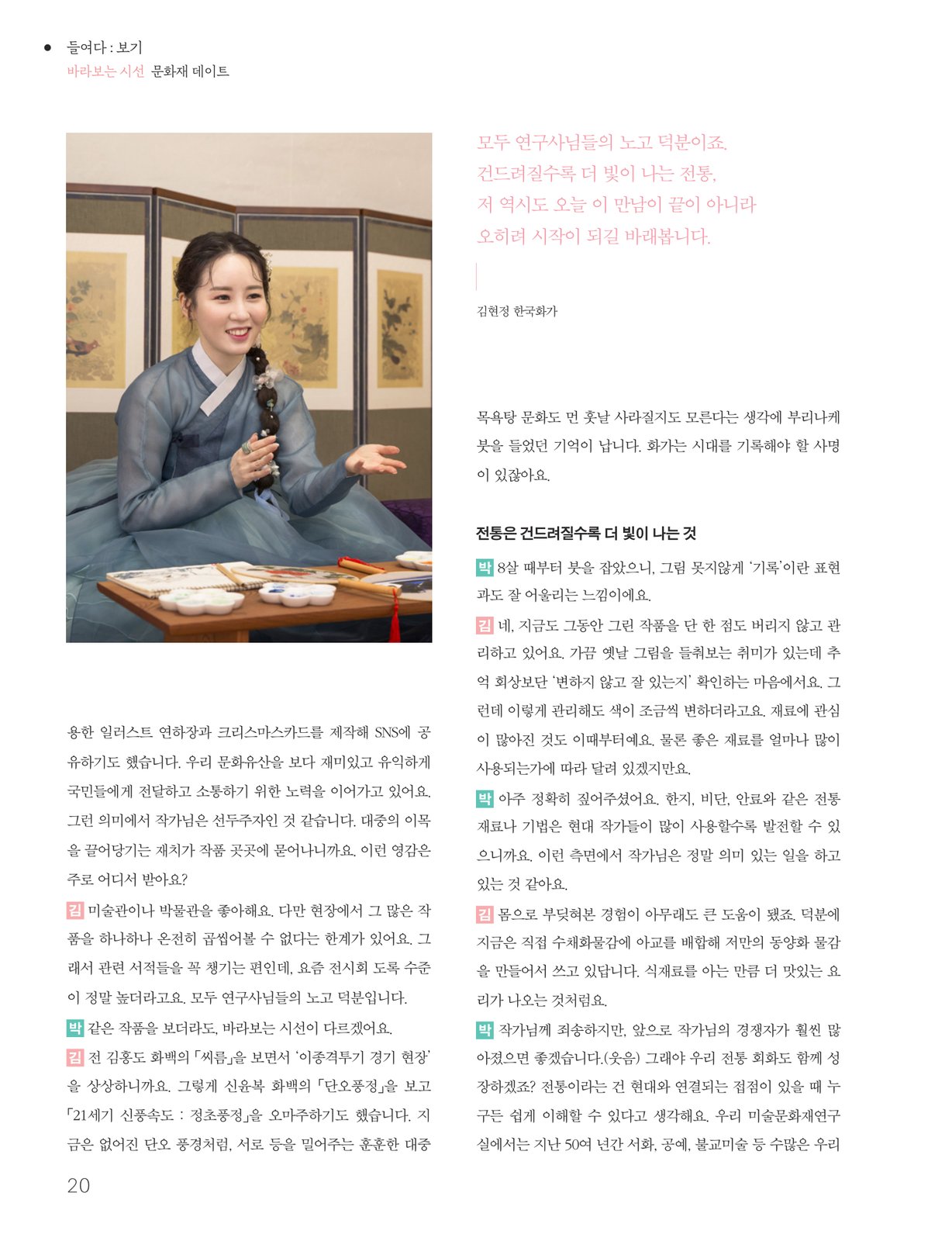
"It's all thanks to the hard work of you researchers. Tradition shines brighter the more it's engaged with — and I hope today's meeting isn't an end, but rather a beginning." — Kim Hyun Jung, Korean Painter
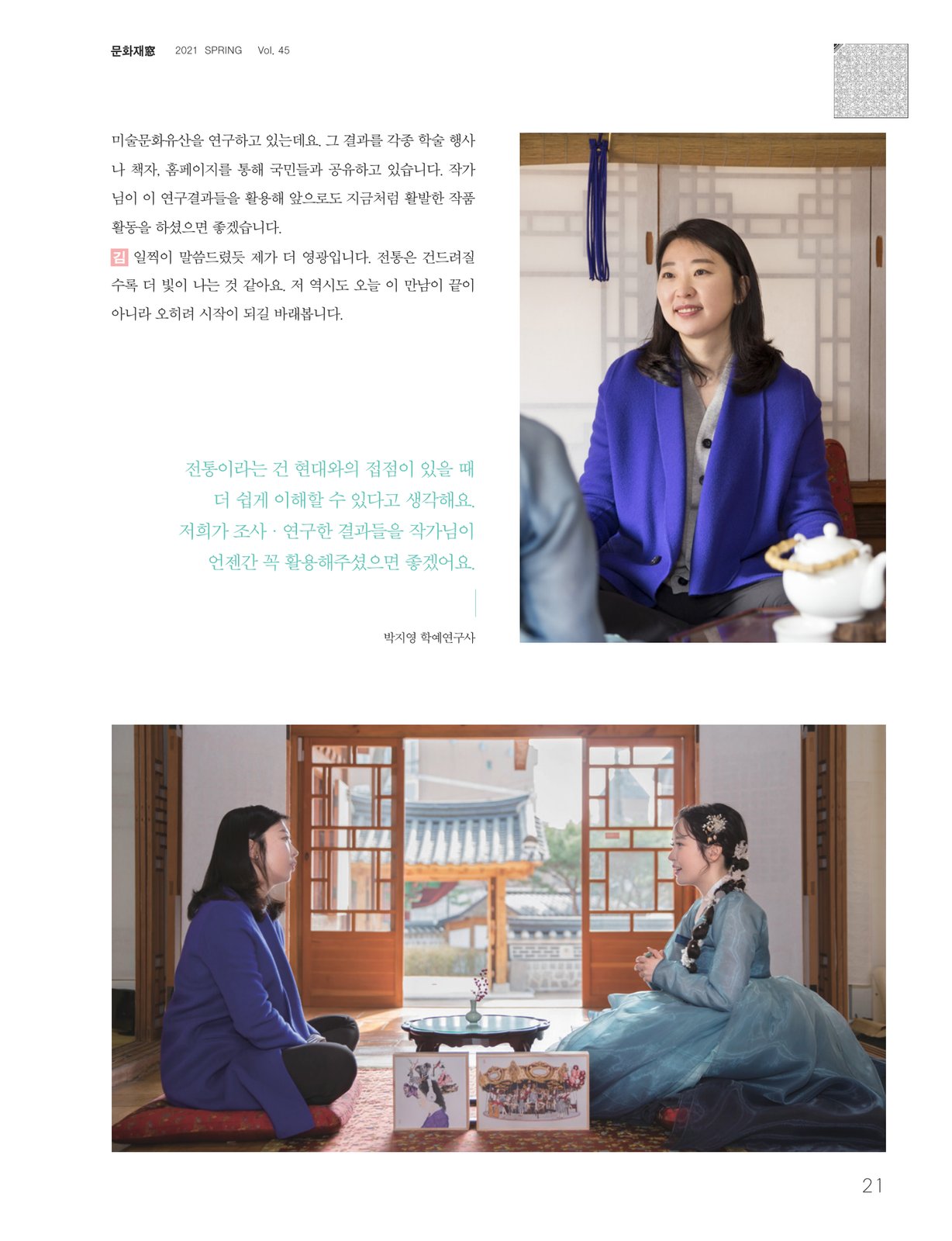
"I believe tradition becomes easier to understand once there's a point of connection with the contemporary. I really hope that one day, you'll make use of the results of the research we've surveyed and studied." — Park Ji-young, Curator