









ELOQUENCE | Artist Kim Hyun Jung’s Naesoong Story
The September 2013 issue of lifestyle magazine ELOQUENCE featured Kim Hyun Jung across an English-language interview special, 'Hyunjung Kim' (pp.20-25), and a Korean-language version (pp.26-27). Presented as an interview, it covers the artist's intent and the sexual readings of her 'Feign' series, which depicts hanbok-clad figures enjoying shopping while a nude body shows through the translucent hanbok beneath, her inspiration from Do-Ho Suh and Takashi Murakami, and the financial hardships she faces as a young artist. Edited by Hannuri Kim, photographed by Na Jhin.
View full text
[Cover/title page] Hyunjung Kim
EDITOR: HANNURI KIM
IMAGES COURTESY: HYUNJUNG KIM
PHOTO BY NA JHIN
WWW.ARTISTJUNGA.BLOG.ME
[English interview]
When people think about Hanbok, a traditional Korean outfit, they have certain expectations. Hyunjung Kim deliberately defies those expectations by painting a picture that shows Hanbok in an unstressed everyday-life manner. Responsible for an ironically even lovelier look is probably the designer's own persona, a modern Korean woman who enjoys shopping and can't live without her phone. Eloquence met the young, witty artist for an insightful chat.
Hanbok elements play a significant role in your work. How did that come about?
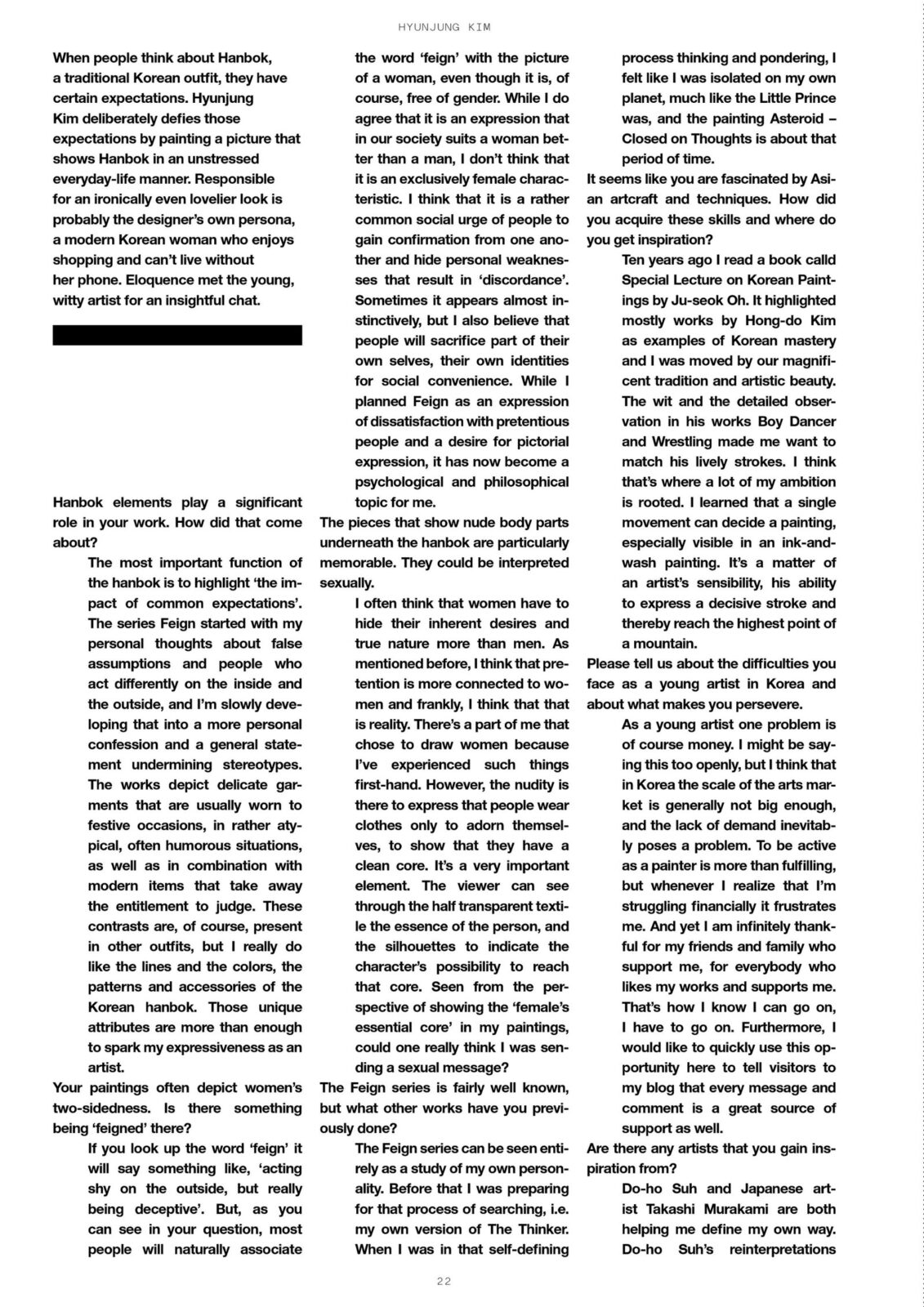
The most important function of the hanbok is to highlight 'the impact of common expectations'. The series Feign started with my personal thoughts about false assumptions and people who act differently on the inside and the outside, and I'm slowly developing that into a more personal confession and a general statement undermining stereotypes. The works depict delicate garments that are usually worn to festive occasions, in rather atypical, often humorous situations, as well as in combination with modern items that take away the entitlement to judge. These contrasts are, of course, present in other outfits, but I really do like the lines and the colors, the patterns and accessories of the Korean hanbok. Those unique attributes are more than enough to spark my expressiveness as an artist.
Your paintings often depict women's two-sidedness. Is there something being 'feigned' there?
If you look up the word 'feign' it will say something like, 'acting shy on the outside, but really being deceptive'. But, as you can see in your question, most people will naturally associate the word 'feign' with the picture of a woman, even though it is, of course, free of gender. While I do agree that it is an expression that in our society suits a woman better than a man, I don't think that it is an exclusively female characteristic. I think that it is a rather common social urge of people to gain confirmation from one another and hide personal weaknesses that result in 'discordance'. Sometimes it appears almost instinctively, but I also believe that people will sacrifice part of their own selves, their own identities for social convenience. While I planned Feign as an expression of dissatisfaction with pretentious people and a desire for pictorial expression, it has now become a psychological and philosophical topic for me.
The pieces that show nude body parts underneath the hanbok are particularly memorable. They could be interpreted sexually.
I often think that women have to hide their inherent desires and true nature more than men. As mentioned before, I think that pretention is more connected to women and frankly, I think that that is reality. There's a part of me that chose to draw women because I've experienced such things first-hand. However, the nudity is there to express that people wear clothes only to adorn themselves, to show that they have a clean core. It's a very important element. The viewer can see through the half transparent textile the essence of the person, and the silhouettes to indicate the character's possibility to reach that core. Seen from the perspective of showing the 'female's essential core' in my paintings, could one really think I was sending out a sexual message?
The Feign series is fairly well known, but what other works have you previously done?
The Feign series can be seen entirely as a study of my own personality. Before that I was preparing for that process of searching, i.e. my own version of The Thinker. When I was in that self-defining process thinking and pondering, I felt like I was isolated on my own planet, much like the Little Prince was, and the painting Asteroid – Closed on Thoughts is about that period of time.
It seems like you are fascinated by Asian artcraft and techniques. How did you acquire these skills and where do you get inspiration?
Ten years ago I read a book called Special Lecture on Korean Paintings by Ju-seok Oh. It highlighted mostly works by Hong-do Kim and I was moved by our magnificent tradition and artistic beauty. The wit and the detailed observation in his works Boy Dancer and Wrestling made me want to match his lively strokes. I think that's where a lot of my ambition is rooted. I learned that a single movement can decide a painting, especially visible in an ink-and-wash painting. It's a matter of an artist's sensibility, his ability to express a decisive stroke and thereby reach the highest point of a mountain.
Please tell us about the difficulties you face as a young artist in Korea and about what makes you persevere.
As a young artist one problem is of course money. I might be saying this too openly, but I think that in Korea the scale of the arts market is generally not big enough, and the lack of demand inevitably poses a problem. To be active as a painter is more than fulfilling, but whenever I realize that I'm struggling financially it frustrates me. And yet I am infinitely thankful for my friends and family who support me, for everybody who likes my works and supports me. That's how I know I can go on, I have to go on. Furthermore, I would like to quickly use this opportunity here to tell visitors to my blog that every message and comment is a great source of support as well.
Are there any artists that you gain inspiration from?
Do-ho Suh and Japanese artist Takashi Murakami are both helping me define my own way. Do-ho Suh's reinterpretations of elements of Korean beauty make me nod along to his insightful explanations. I would like to take our art, our hanboks and hanji (Korean traditional paper) and present their subtle beauty proudly all over the world. And Takashi Murakami is an artist whose works have taught me that art can coexist with capitalistic industrialization and still be a part of our everyday lives. One of my dreams is to see art being as much a part of everybody's life as music, to see it being a base for joy that anybody can easily pick up. He showed me that art can become a way to nestle on industrialized territory.
It seems as if one can see your own lifestyle depicted in your works. What kind of person are you?
That's something I would completely leave up to the spectator. I actually like shopping and very lively things, but on the other hand I enjoy being by myself and like any other artist I am a rather emotional person. This might be the right time to unburden myself – as a girl who likes lively things – from something I'd like to say about the expression 'dwenjang (spoiled) girl'. I think that it is denigrating and suppressing women's hopes of a bright and vivid life. Everybody has those desires, not just women. I would like to see more confidence and acceptance of people's tastes and preferences. That's one of the things I realized about myself during my working process.
What kind of artist would you like to become?
I would like to be an artist who scratches people where it itches. I usually answer this question with, 'artists are people who express other peoples' desires'. Artists are more sensitive and emotionally charged than other people. They are able to express what others might not be able to understand in the first place or issues they can identify with but don't know how to let out. Artists are professionals. I try to be a sensitive, worldly person, interactive and keen on life.
[Image] 1: FEIGN 1AM, 2012 / 2: FEIGN PORTRAIT OF INNER EGO, 2012
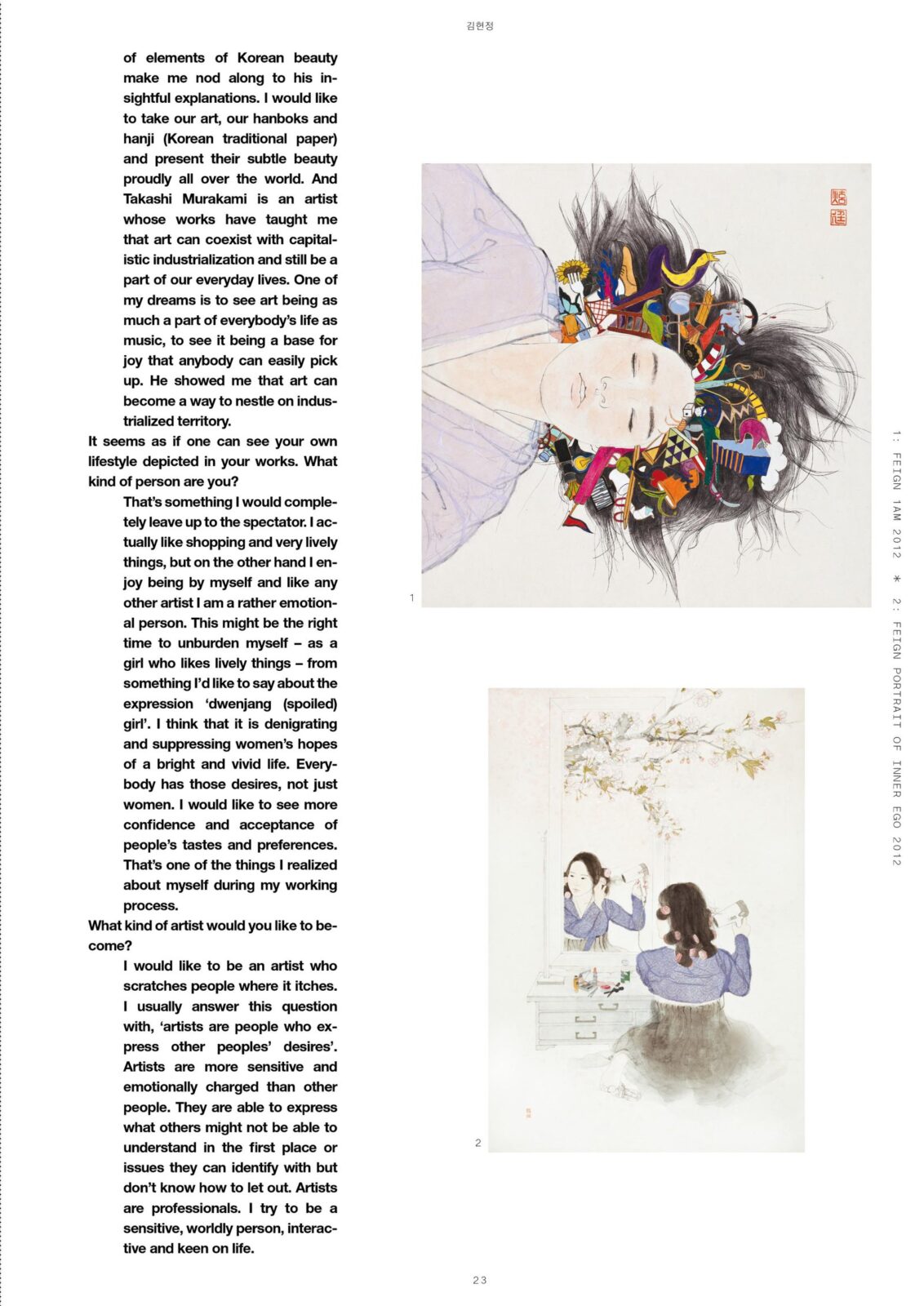
[Image] FEIGN FLUTTER, 2013
[Large pull-quote page] "Seen from the perspective of showing the 'female's essential core' in my paintings, could one really think I was sending out a sexual message?"
(Korean caption below) Could one really think there was a sexual message in the fact that what one can look directly into, in my paintings, is 'a woman's inner heart'?
[Korean interview (Korean-language edition)]
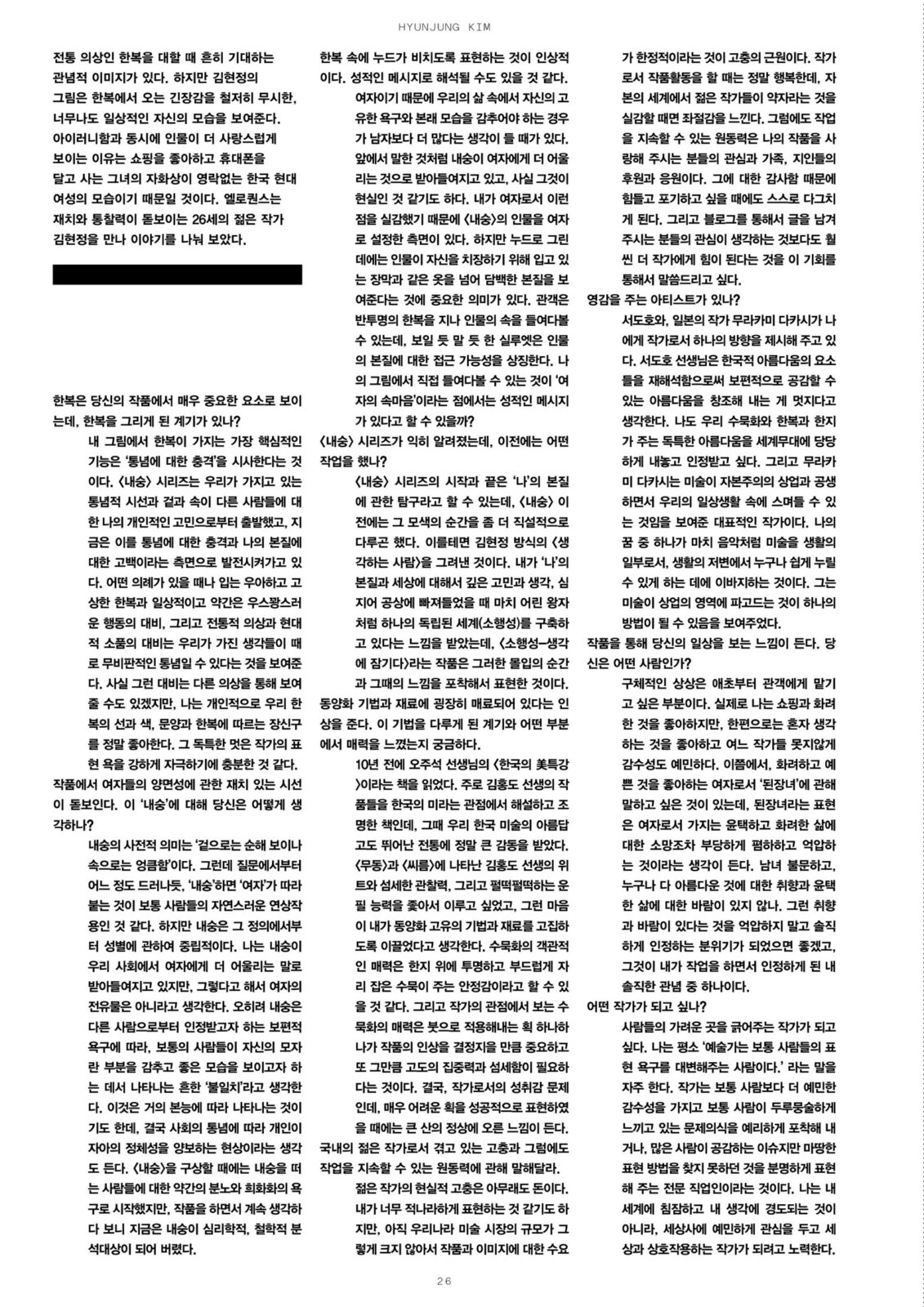
When facing traditional hanbok, there are certain conventional images people expect. But Kim Hyun Jung's paintings entirely ignore the tension that hanbok is supposed to carry, showing an all-too-everyday version of herself instead. Ironically, this makes the figure even more lovable — probably because her self-portrait, a woman who loves shopping and can't live without her phone, is exactly the image of a contemporary Korean woman. Eloquence met and spoke with Kim Hyun Jung, a witty, insightful twenty-six-year-old artist.
Hanbok seems to be a very important element in your work — was there a particular moment that led you to paint it?
The most essential function hanbok performs in my paintings is to signal 'the shock of convention.' Naesoong started from my own personal worry about conventional perspectives and about people whose outside and inside differ, and I'm now developing that into both a shock to convention and a confession about my own essential nature. The contrast between an elegant, formal hanbok worn for some ceremony and everyday, slightly ridiculous behavior, and the contrast between traditional clothing and modern props, shows that the ideas we hold can sometimes be followed uncritically. Of course, that kind of contrast could be shown through other clothing too, but personally, I really love the lines and colors of our hanbok, its patterns, and the accessories that go with it. That unique charm is more than enough to stir an artist's desire for expression.
Your work has a witty eye for women's two-sidedness. What do you think about this 'naesoong'?
The dictionary definition of naesoong is something like, 'appearing gentle on the outside, but sly on the inside.' But as your question itself reveals, most people naturally associate 'naesoong' with 'woman.' But naesoong, even in its very definition, is gender-neutral. I think naesoong is accepted in our society as a word that suits women better, but I don't think it's women's exclusive property. Rather, I think naesoong is a common form of 'discordance' that appears when ordinary people, driven by the universal desire to be recognized by others, try to hide their own flaws and show a better side. This appears almost instinctively, but I also think it's ultimately a phenomenon in which the individual, due to social convention, cedes part of their identity. When I first conceived Naesoong, I started from a bit of anger and a desire to caricature people who feign — but as I kept working and thinking about it, naesoong has now become a subject of psychological and philosophical analysis for me.
It's striking how you express nudity showing through the hanbok. It could be interpreted as a sexual message.
There are times I feel that, because I'm a woman, I've had to hide my own desires and true self more than others in my life. As I said before, naesoong is accepted as suiting women better, and honestly, that seems to be reality. Because I've personally felt this as a woman, there's an aspect of why I set the figure in Naesoong as a woman. But drawing her nude has an important meaning beyond that — it goes past the curtain-like clothing a figure wears to adorn herself, and reveals her plain essence. The viewer can look through the translucent hanbok into the figure's interior, and the barely-visible silhouette symbolizes the possibility of reaching that essence. Given that what one can directly look into, in my paintings, is 'a woman's inner heart' — could one really call that a sexual message?
The Naesoong series has become quite well known — what kind of work did you do before that?
The beginning and end of the Naesoong series could be called an inquiry into the essence of 'me.' Before Naesoong, I used to handle that moment of searching more directly. For example, I painted my own version of The Thinker. When I was deeply absorbed in worry, thought, and even fantasy about the essence of 'me' and about the world, I felt as if, like the Little Prince, I had built my own separate world — an asteroid — and the work Asteroid — Sunk in Thought captures that moment of immersion and the feeling from that time.
You seem quite fascinated by Oriental painting techniques and materials. What led you to work with this technique, and what parts of it do you find appealing?
Ten years ago I read a book called A Special Lecture on the Beauty of Korea by the late Oh Ju-seok. It mostly illuminates the works of Kim Hong-do from the perspective of Korean beauty, and I was deeply moved by the beautiful, outstanding tradition of our Korean art. I wanted to match the wit, the detailed observation, and the vivid brushwork visible in his works Dancing Boy and Wrestling, and I think that feeling is what led me to insist on the techniques and materials unique to Oriental painting. Objectively, the appeal of ink-wash painting probably lies in the sense of stability that comes from ink, settling transparently and softly on hanji. And from an artist's perspective, the appeal of ink wash is that each single brushstroke is important enough to determine the entire impression of the work, and requires that much concentration and delicacy. In the end, it's a matter of an artist's sense of achievement — when you successfully render a very difficult stroke, it feels like reaching the summit of a great mountain.
Please tell us about the hardships you face as a young artist in Korea, and about what drives you to keep working despite it.
The realistic hardship for a young artist is, of course, money. I might be expressing this too bluntly, but our country's art market still isn't large enough, and that inevitably limits demand for artworks and images, which is the root of the difficulty. Being active as an artist is truly wonderful, but whenever I realize how vulnerable young artists are in the world of capital, it's frustrating. Even so, what keeps me working is the interest of people who love my work, and the support and cheering of my family and friends. Out of gratitude for that, I push myself even when I'm struggling and want to give up. And I'd like to take this opportunity to say that the attention from people who leave comments on my blog gives me far more strength than they might imagine.
Is there any artist who inspires you?
Do-ho Suh and the Japanese artist Takashi Murakami are both showing me a direction as an artist. I think it's wonderful how Do-ho Suh reinterprets elements of Korean beauty to create beauty that resonates universally. I too want to proudly present the unique beauty of our ink-wash painting, our hanbok, and our hanji to the world stage and have it recognized. And Takashi Murakami is a representative artist who showed that art can coexist with capitalist commerce while still seeping into our everyday lives. One of my dreams is to help make art, like music, a part of everyday life — something anyone can easily enjoy as a foundation for joy in daily life. He showed me that art penetrating into the realm of commerce can itself be one method for achieving that.
It feels like one can see your everyday life through your work. What kind of person are you?
I'd like to leave the concrete imagining entirely up to the viewer. In truth, I like shopping and glamorous things, but on the other hand, I like thinking alone, and like any other artist, I have quite sensitive emotions. This seems like the right moment to say something about the term 'doenjang girl,' as a woman who likes glamorous, pretty things — I think that expression unfairly belittles and suppresses even a woman's hope for an affluent, glamorous life. Regardless of gender, doesn't everyone have a taste for beautiful things and a wish for an affluent life? I wish there were an atmosphere where, instead of suppressing such tastes and wishes, we could honestly acknowledge them — and that's one of the honest notions about myself that I've come to accept through my work.
What kind of artist do you want to become?
I want to be an artist who scratches where people itch. I often say, 'an artist is someone who represents ordinary people's desire for expression.' I mean a professional who, with sharper sensitivity than an ordinary person, sharply captures problems that ordinary people feel only vaguely, or clearly expresses things that resonate with many people but for which they haven't found a proper way to express. I try to become an artist who doesn't sink into my own world or become fixated on my own thoughts, but instead pays keen attention to worldly affairs and interacts with the world.
[Image] 1: FEIGN HERITAGE OF THE MIND, 2014 / 2: OOPS, 2013