







ELOQUENCE 엘로컨스 | 김현정 작가 내숭이야기
라이프스타일 매거진 <ELOQUENCE> 2013년 9월호는 영문 인터뷰 특집 'Hyunjung Kim'(pp.20-25)과 국문판(pp.26-27)에 걸쳐 김현정 작가를 소개했다. 한복을 입은 인물이 쇼핑을 즐기고 반투명한 한복 아래 누드가 비치는 '내숭(Feign)' 시리즈의 제작 의도와 성적 해석에 대한 작가의 생각, 서도호·무라카미 다카시에게서 받은 영감, 젊은 작가로서 겪는 경제적 어려움 등을 인터뷰 형식으로 다뤘다. 에디터는 한누리, 사진은 나진이 맡았다.
전체 본문 보기
[표지/타이틀 페이지] Hyunjung Kim
EDITOR: HANNURI KIM
IMAGES COURTESY: HYUNJUNG KIM
PHOTO BY NA JHIN
WWW.ARTISTJUNGA.BLOG.ME
[영문 인터뷰]
When people think about Hanbok, a traditional Korean outfit, they have certain expectations. Hyunjung Kim deliberately defies those expectations by painting a picture that shows Hanbok in an unstressed everyday-life manner. Responsible for an ironically even lovelier look is probably the designer's own persona, a modern Korean woman who enjoys shopping and can't live without her phone. Eloquence met the young, witty artist for an insightful chat.
Hanbok elements play a significant role in your work. How did that come about?
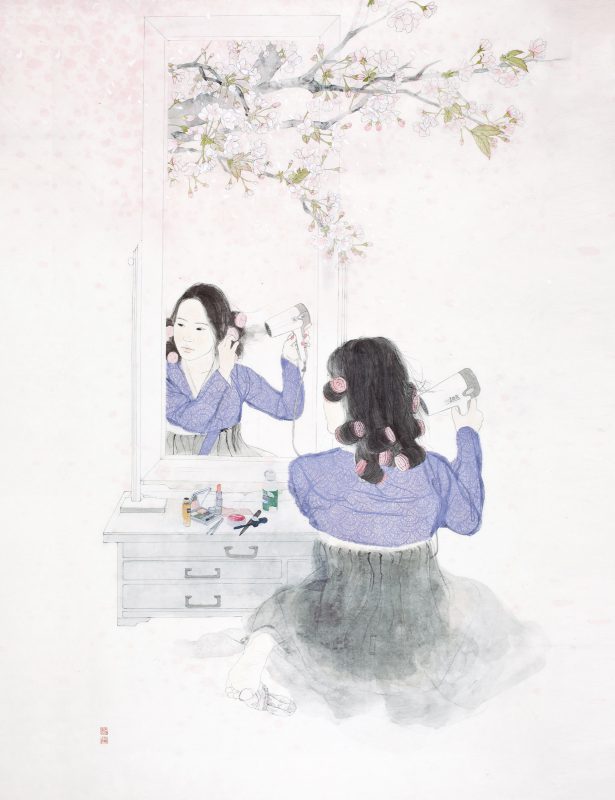
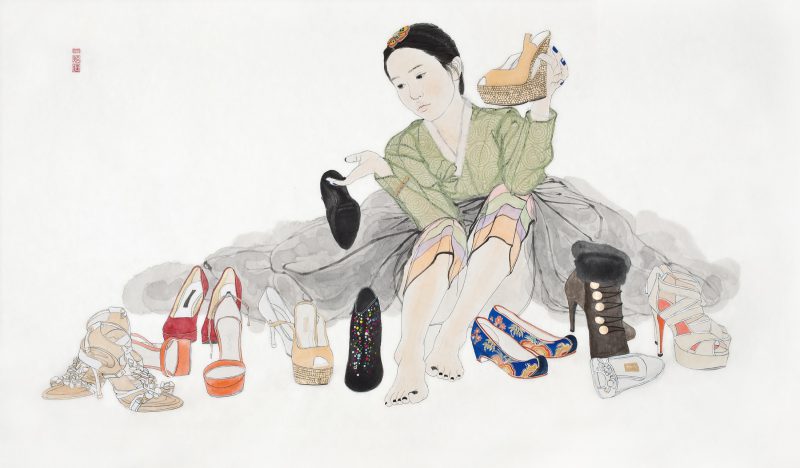
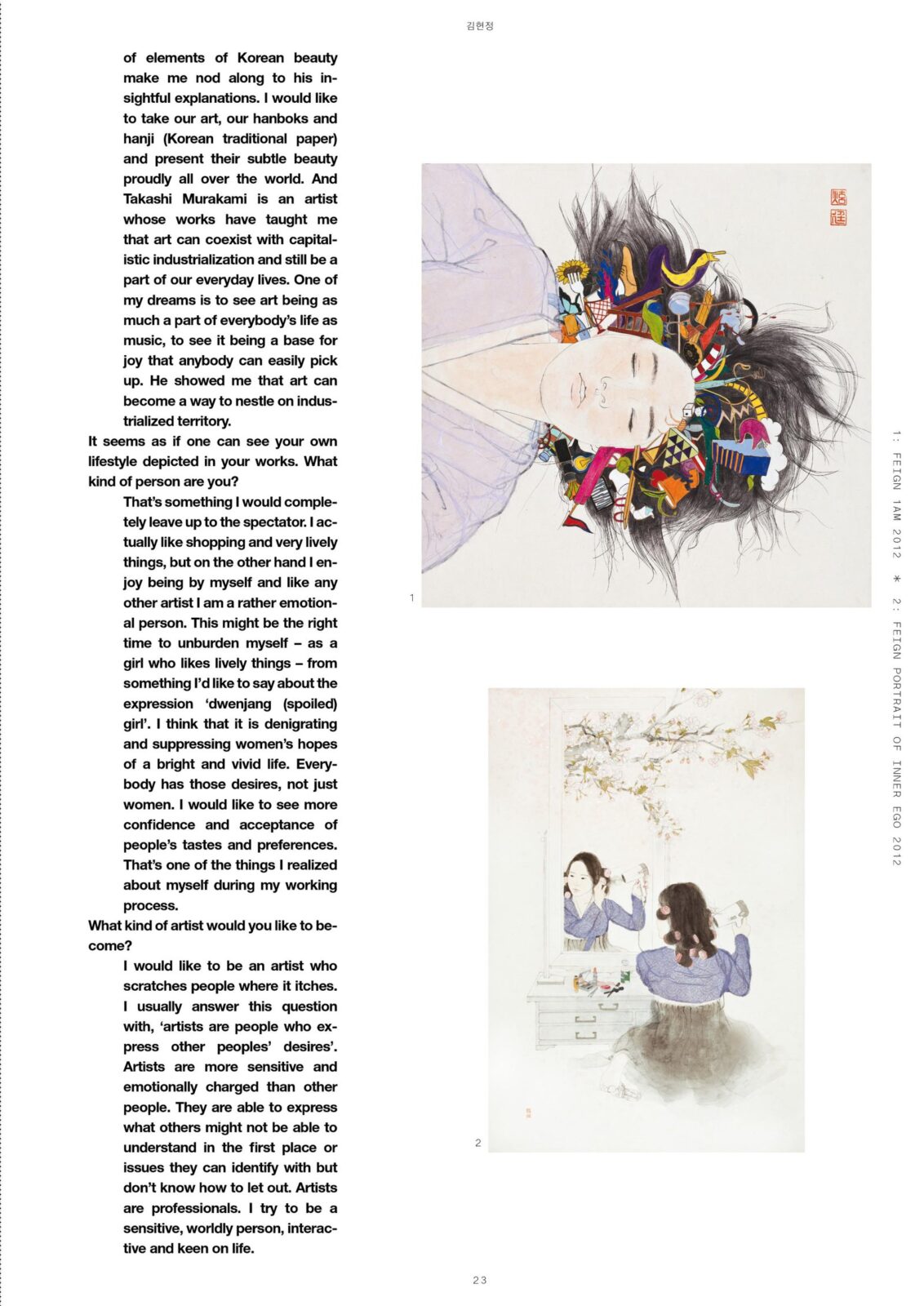
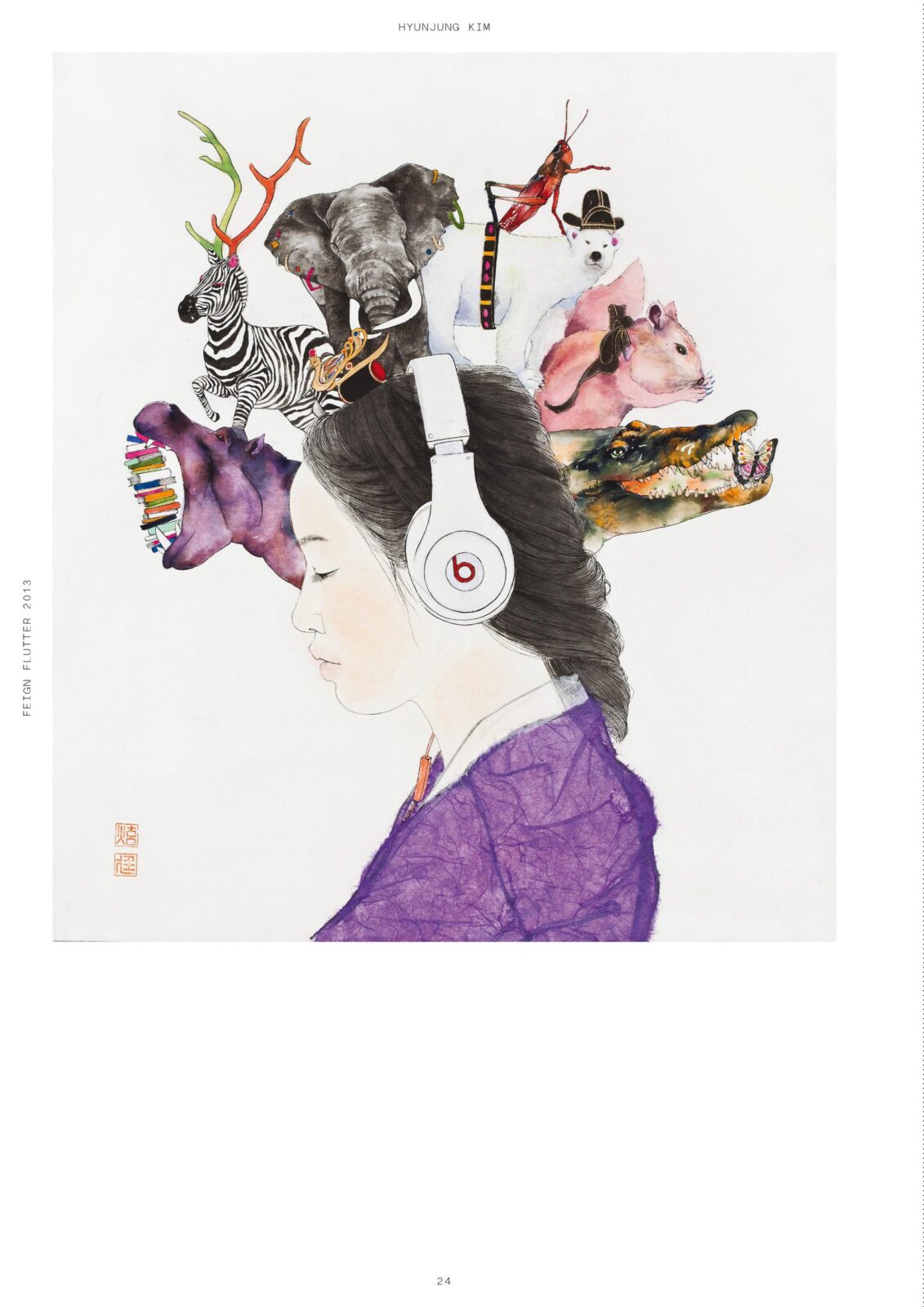
The most important function of the hanbok is to highlight 'the impact of common expectations'. The series Feign started with my personal thoughts about false assumptions and people who act differently on the inside and the outside, and I'm slowly developing that into a more personal confession and a general statement undermining stereotypes. The works depict delicate garments that are usually worn to festive occasions, in rather atypical, often humorous situations, as well as in combination with modern items that take away the entitlement to judge. These contrasts are, of course, present in other outfits, but I really do like the lines and the colors, the patterns and accessories of the Korean hanbok. Those unique attributes are more than enough to spark my expressiveness as an artist.
Your paintings often depict women's two-sidedness. Is there something being 'feigned' there?
If you look up the word 'feign' it will say something like, 'acting shy on the outside, but really being deceptive'. But, as you can see in your question, most people will naturally associate the word 'feign' with the picture of a woman, even though it is, of course, free of gender. While I do agree that it is an expression that in our society suits a woman better than a man, I don't think that it is an exclusively female characteristic. I think that it is a rather common social urge of people to gain confirmation from one another and hide personal weaknesses that result in 'discordance'. Sometimes it appears almost instinctively, but I also believe that people will sacrifice part of their own selves, their own identities for social convenience. While I planned Feign as an expression of dissatisfaction with pretentious people and a desire for pictorial expression, it has now become a psychological and philosophical topic for me.
The pieces that show nude body parts underneath the hanbok are particularly memorable. They could be interpreted sexually.
I often think that women have to hide their inherent desires and true nature more than men. As mentioned before, I think that pretention is more connected to women and frankly, I think that that is reality. There's a part of me that chose to draw women because I've experienced such things first-hand. However, the nudity is there to express that people wear clothes only to adorn themselves, to show that they have a clean core. It's a very important element. The viewer can see through the half transparent textile the essence of the person, and the silhouettes to indicate the character's possibility to reach that core. Seen from the perspective of showing the 'female's essential core' in my paintings, could one really think I was sending out a sexual message?
The Feign series is fairly well known, but what other works have you previously done?
The Feign series can be seen entirely as a study of my own personality. Before that I was preparing for that process of searching, i.e. my own version of The Thinker. When I was in that self-defining process thinking and pondering, I felt like I was isolated on my own planet, much like the Little Prince was, and the painting Asteroid – Closed on Thoughts is about that period of time.
It seems like you are fascinated by Asian artcraft and techniques. How did you acquire these skills and where do you get inspiration?
Ten years ago I read a book calld Special Lecture on Korean Paintings by Ju-seok Oh. It highlighted mostly works by Hong-do Kim and I was moved by our magnificent tradition and artistic beauty. The wit and the detailed observation in his works Boy Dancer and Wrestling made me want to match his lively strokes. I think that's where a lot of my ambition is rooted. I learned that a single movement can decide a painting, especially visible in an ink-and-wash painting. It's a matter of an artist's sensibility, his ability to express a decisive stroke and thereby reach the highest point of a mountain.
Please tell us about the difficulties you face as a young artist in Korea and about what makes you persevere.
As a young artist one problem is of course money. I might be saying this too openly, but I think that in Korea the scale of the arts market is generally not big enough, and the lack of demand inevitably poses a problem. To be active as a painter is more than fulfilling, but whenever I realize that I'm struggling financially it frustrates me. And yet I am infinitely thankful for my friends and family who support me, for everybody who likes my works and supports me. That's how I know I can go on, I have to go on. Furthermore, I would like to quickly use this opportunity here to tell visitors to my blog that every message and comment is a great source of support as well.
Are there any artists that you gain inspiration from?
Do-ho Suh and Japanese artist Takashi Murakami are both helping me define my own way. Do-ho Suh's reinterpretations of elements of Korean beauty make me nod along to his insightful explanations. I would like to take our art, our hanboks and hanji (Korean traditional paper) and present their subtle beauty proudly all over the world. And Takashi Murakami is an artist whose works have taught me that art can coexist with capitalistic industrialization and still be a part of our everyday lives. One of my dreams is to see art being as much a part of everybody's life as music, to see it being a base for joy that anybody can easily pick up. He showed me that art can become a way to nestle on industrialized territory.
It seems as if one can see your own lifestyle depicted in your works. What kind of person are you?
That's something I would completely leave up to the spectator. I actually like shopping and very lively things, but on the other hand I enjoy being by myself and like any other artist I am a rather emotional person. This might be the right time to unburden myself – as a girl who likes lively things – from something I'd like to say about the expression 'dwenjang (spoiled) girl'. I think that it is denigrating and suppressing women's hopes of a bright and vivid life. Everybody has those desires, not just women. I would like to see more confidence and acceptance of people's tastes and preferences. That's one of the things I realized about myself during my working process.
What kind of artist would you like to become?
I would like to be an artist who scratches people where it itches. I usually answer this question with, 'artists are people who express other peoples' desires'. Artists are more sensitive and emotionally charged than other people. They are able to express what others might not be able to understand in the first place or issues they can identify with but don't know how to let out. Artists are professionals. I try to be a sensitive, worldly person, interactive and keen on life.
[이미지] 1: FEIGN 1AM, 2012 / 2: FEIGN PORTRAIT OF INNER EGO, 2012
[이미지] FEIGN FLUTTER, 2013
[대형 인용구 페이지] "Seen from the perspective of showing the 'female's essential core' in my paintings, could one really think I was sending out a sexual message?"
(하단 한글 캡션) 나의 그림에서 직접 들여다볼 수 있는 것이 '여자의 속마음'이라는 점에서는 성적인 메시지가 있다고 할 수 있을까?
[한글 인터뷰 (국문판)]
전통 의상인 한복을 대할 때 흔히 기대하는 관념적 이미지가 있다. 하지만 김현정의 그림은 한복에서 오는 긴장감을 철저히 무시한, 너무나도 일상적인 자신의 모습을 보여준다. 아이러니함과 동시에 인물이 더 사랑스럽게 보이는 이유는 쇼핑을 좋아하고 휴대폰을 달고 사는 그녀의 자화상이 영락없는 한국 현대 여성의 모습이기 때문일 것이다. 엘로퀀스는 재치와 통찰력이 돋보이는 26세의 젊은 작가 김현정을 만나 이야기를 나눠 보았다.
한복은 당신의 작품에서 매우 중요한 요소로 보이는데, 한복을 그리게 된 계기가 있나?
내 그림에서 한복이 가지는 가장 핵심적인 기능은 '통념에 대한 충격'을 시사한다는 것이다. 〈내숭〉 통념적 시좌와 겉과 속이 다른 사람들에 대한 나의 개인적인 고민으로부터 출발했고, 지금은 이를 통념에 대한 충격과 나의 본질에 대한 고백이라는 측면으로 발전시켜가고 있다. 어떤 의례가 있는 우아하고 상한 한복과 일상적이고 약간은 우스꽝스러운 행동의 대비, 그리고 전통적 의상과 현대적 소품의 대비는 우리가 가진 생각들이 때로 무비판적으로 답습할 수 있다는 것을 보여준다. 사실 그런 대비는 다른 의상을 통해 보여줄 수도 있겠지만, 나는 개인적으로 우리 한복의 선과 색, 문양과 한복에 따르는 장신구를 정말 좋아한다. 그 독특한 멋은 작가의 표현 욕구를 자극하기에 충분한 부분이다.
작품에서 여자들의 양면성에 관한 재치 있는 시선이 돋보인다. 이 '내숭'에 대해 당신은 어떻게 생각하나?
내숭의 사전적 의미는 '겉으로는 순해 보이나 속으로는 엉큼함'이다. 그런데 질문에서부터 속속 드러나듯, '내숭'하면 '여자'가 따라붙는 것이 보통 사람들의 자연스러운 연상작용인 것 같다. 하지만 내숭은 그 정의에서부터 성별에 관하여 중립적이다. 나는 내숭이 우리 사회에서 여자에게 더 어울리는 말로 받아들여지고 있지만, 그렇다고 해서 여자의 전유물은 아니라고 생각한다. 오히려 내숭은 다른 사람으로부터 인정받고자 하는 보편적 욕구에 따라, 보통의 사람들이 자신의 모적 부분을 감추고 좋은 모습을 보이고자 하는 데서 나타나는 흔한 '불일치'라고 생각한다. 이것은 거의 본능에 따라 나타나는 것이기도 한데, 결국 사회의 통념에 의한 개인이 자아의 정체성을 양보하는 현상이라는 생각도 든다. 〈내숭〉을 구상할 때는 내숭을 떠는 사람들에 대한 약간의 분노와 희화화의 욕구로 시작했지만, 작품을 하면서 계속 생각하다 보니 지금은 내숭이 심리학적, 철학적 분석대상이 되어 버렸다.
한복 속에 누드가 비치도록 표현하는 것이 인상적이다. 성적인 메시지로 해석될 수도 있을 것 같다.
여자이기 때문에 우리의 삶 속에서 자신의 고유한 욕구와 본래 모습을 감추어야 하는 경우가 남보다 더 많다는 생각이 들 때가 있다. 앞에서 말한 것처럼 내숭이 여자에게 더 어울리는 것으로 받아들여지고 있고, 사실 그것이 현실인 것 같기도 하다. 내가 여자로서 이런 점을 실감했기 때문에 〈내숭〉의 인물을 여자로 설정한 측면이 있다. 하지만 누드로 그린 데에는 인물이 자신을 치장하기 위해 입고 있는 장막과 같은 옷을 넘어 담백한 본질을 보여준다는 것에 중요한 의미가 있다. 관객은 반투명의 한복을 지나 인물의 속을 들여다볼 수 있는데, 보일 듯 말 듯 한 실루엣은 인물의 본질에 대한 접근 가능성을 상징한다. 나의 그림에서 직접 들여다볼 수 있는 것이 '여자의 속마음'이라는 점에서는 성적인 메시지가 있다고 할 수 있을까?
〈내숭〉 시리즈가 익히 알려졌는데, 이전에는 어떤 작업을 했나?
〈내숭〉 시리즈의 시작과 끝은 '나'의 본질에 관한 탐구라고 할 수 있는데, 〈내숭〉 이전에는 그 모색의 순간을 좀 더 직설적으로 다루곤 했다. 이를테면 김현정 방식의 〈생각하는 사람〉을 그려낸 것이다. 내가 '나'의 본질과 세상에 대해서 깊은 고민과 생각, 심지어 공상에 빠져들었을 때 마치 어린 왕자처럼 하나의 독립된 세계(소행성)를 구축하고 있다는 느낌을 받았는데, 〈소행성-생각에 잠기다〉라는 작품은 그러한 몰입의 순간과 그때의 느낌을 포착해서 표현한 것이다.
동양화 기법과 재료에 굉장히 매료되어 있다는 인상을 준다. 이 기법을 다루게 된 계기와 어떤 부분에서 매력을 느꼈는지 궁금하다.
10년 전에 오주석 선생님의 〈한국의 美특강〉이라는 책을 읽었다. 주로 김홍도 선생의 작품들을 한국의 미라는 관점에서 해설하고 조명한 책인데, 그때 우리 한국 미술의 아름답고도 뛰어난 전통에 정말 큰 감동을 받았다. 〈무동〉과 〈씨름〉에 나타난 김홍도 선생의 위트와 섬세한 관찰력, 그리고 펄떡펄떡하는 운필 능력을 좇아서 이루고 싶었고, 그런 마음이 내가 동양화 고유의 기법과 재료를 고집하도록 이끌었다고 생각한다. 수묵화의 객관적인 매력은 한지 위에 투명하고 부드럽게 자리 잡은 수묵이 주는 안정감이라고 할 수 있을 것 같다. 그리고 작가의 관점에서 보는 수묵화의 매력은 붓으로 적용해내는 획 하나하나가 작품의 인상을 결정지을 만큼 중요하고 또 그만큼 고도의 집중력과 섬세함이 필요하다는 것이다. 결국, 작가로서의 성취감 문제인데, 매우 어려운 획을 성공적으로 표현하였을 때에는 큰 산의 정상에 오른 느낌이 든다.
국내의 젊은 작가로서 겪고 있는 고충과 그림에도 작업을 지속할 수 있는 원동력에 관해 말해달라.
젊은 작가의 현실적 고충은 아무래도 돈이다. 내가 너무 적나라하게 표현하는 것 같기도 하지만, 아직 우리나라 미술 시장의 규모가 그렇게 크지 않아서 작품과 이미지에 대한 수요가 한정적이라는 것이 고충의 근원이다. 작가로서 작품활동을 할 때는 정말 행복한데, 자본의 세계에서 젊은 작가들이 약자라는 것을 실감할 때면 좌절감을 느낀다. 그럼에도 작업을 지속할 수 있는 원동력은 나의 작품을 사랑해 주시는 분들의 관심과 가족, 지인들의 후원과 응원이다. 그에 대한 감사함 때문에 힘들고 포기하고 싶을 때에도 스스로 다그치게 된다. 그리고 블로그를 통해서 글을 남겨 주시는 분들의 관심이 생각하는 것보다 훨씬 더 작가에게 힘이 된다는 것을 이 기회를 통해서 말씀드리고 싶다.
영감을 주는 아티스트가 있나?
서도호와, 일본의 작가 무라카미 다카시가 나에게 작가로서 하나의 방향을 제시해 주고 있다. 서도호 선생님은 한국적 아름다움의 요소들을 재해석함으로써 보편적으로 공감할 수 있는 아름다움을 창조해 내는 게 멋지다고 생각한다. 나도 우리 수묵화와 한복과 한지가 주는 독특한 아름다움을 세계무대에 당당하게 내놓고 인정받고 싶다. 그리고 무라카미 다카시는 미술이 자본주의의 상업과 공생하면서 우리의 일상생활 속에 스며드는 것임을 보여준 대표적인 작가이다. 나의 꿈 중 하나가 마치 음악처럼 미술을 생활의 일부로서, 생활의 저변에서 누구나 쉽게 누릴 수 있게 하는 데에 이바지하는 것이다. 그는 미술이 상업의 영역에 파고드는 것도 하나의 방법이 될 수 있음을 보여주었다.
작품을 통해 당신의 일상을 보는 느낌이 든다. 당신은 어떤 사람인가?
구체적인 상상은 애초부터 관객에게 맡기고 싶은 부분이다. 실제로 나는 쇼핑과 화려한 것을 좋아하지만, 한편으로는 혼자 생각하는 것을 좋아하고 여느 작가들 못지않게 감수성도 예민하다. 이쯤에서, 화려하고 예쁜 것을 좋아하는 여자로서 '된장녀'에 관해 말하고 싶은 것이 있는데, 된장녀라는 표현은 여자로서 가지는 윤택하고 화려한 삶에 대한 소망조차 부당하게 폄하하고 억압하는 것이라는 생각이 든다. 남녀 불문하고, 누구나 다 아름다운 것에 대한 취향과 윤택한 삶에 대한 바람이 있지 않나. 그런 취향과 바람이 있는 것을 억압하지 말고 솔직하게 인정하는 분위기가 되었으면 좋겠고, 그것이 내가 작업을 하면서 인정하게 된 내 솔직한 관념 중 하나이다.
어떤 작가가 되고 싶나?
사람들의 가려운 곳을 긁어주는 작가가 되고 싶다. 나는 평소 '예술가는 보통 사람들의 표현 욕구를 대변해주는 사람이다.'라는 말을 자주 한다. 작가는 보통 사람보다 더 예민한 감수성을 가지고 보통 사람이 두루뭉술하게 느끼고 있는 문제의식을 예리하게 포착해 내거나, 많은 사람이 공감하는 이슈지만 마땅한 표현 방법을 찾지 못하던 것을 분명하게 표현해 주는 전문 직업인이라는 것이다. 나는 내 세계에 침잠하고 내 생각에 경도되는 것이 아니라, 세상사에 예민하게 관심을 두고 세상과 상호작용하는 작가가 되려고 노력한다.
[이미지] 1: FEIGN HERITAGE OF THE MIND, 2014 / 2: OOPS, 2013