







JoongAng Ilbo | The Idol of Korean Painting… The Untold Story Behind Her ‘Elegant Hanbok Beauty’ [Monthly JoongAng]
An interview with painter Kim Hyun Jung, introduced as a ‘Best Influencer’ in the ‘Monthly JoongAng’ section of JoongAng Ilbo’s online edition (September 27, 2025). It covers how she gained mass popularity through social media and came to be called the ‘idol of Korean painting,’ the story behind her signature ‘Naesung’ series, corporate collaboration cases with the Korea Racing Authority, Megastudy, Haitai Confectionery and others, and her future goal of founding a foundation.
View full text
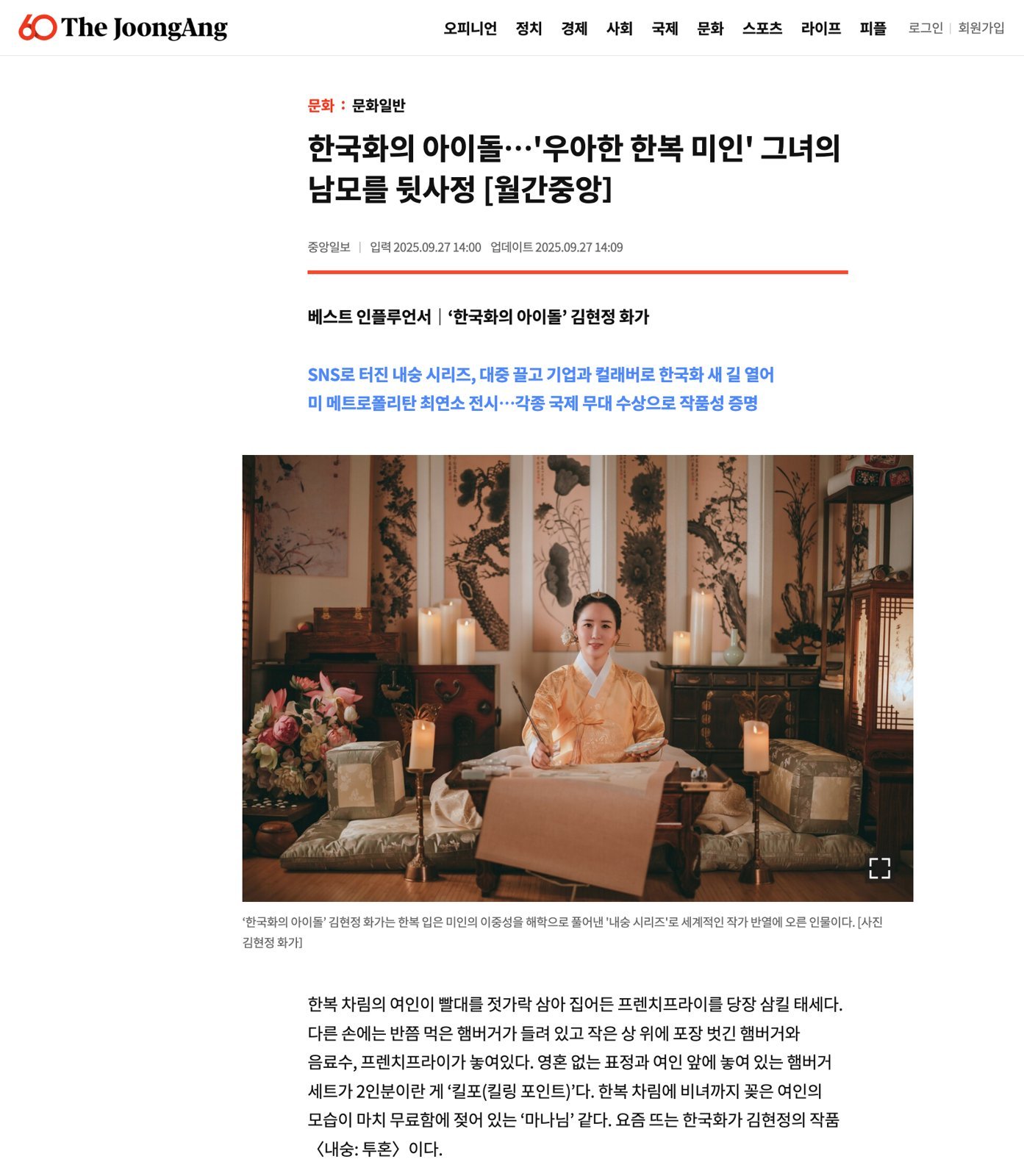
A woman in hanbok, using a straw as chopsticks, is about to devour a French fry she has just picked up. In her other hand is a half-eaten hamburger, and on a small table in front of her sit an unwrapped burger, a drink, and more fries. Her soulless expression, and the fact that the burger set in front of her is a meal for two, is the ‘kill-point.’ Dressed in hanbok with a hairpin in place, the woman looks like a bored, idle noblewoman. This is <Naesung: Fighting Spirit>, a work by the rising Korean painter Kim Hyun Jung.
“I’d ordered a burger set as a late-night snack during an all-nighter. But Korean painting is similar to watercolor, so you can’t get any grease on it. So I was holding a straw, trying to eat it somehow, and suddenly I found myself absurd. That’s what I captured.” Kim Hyun Jung explained one of the works from her signature ‘Naesung series’ this way. Where in the world is a person whose inside and outside are perfectly transparent and identical? The painter saw that very obvious truth as material she could unpack through humor instead.
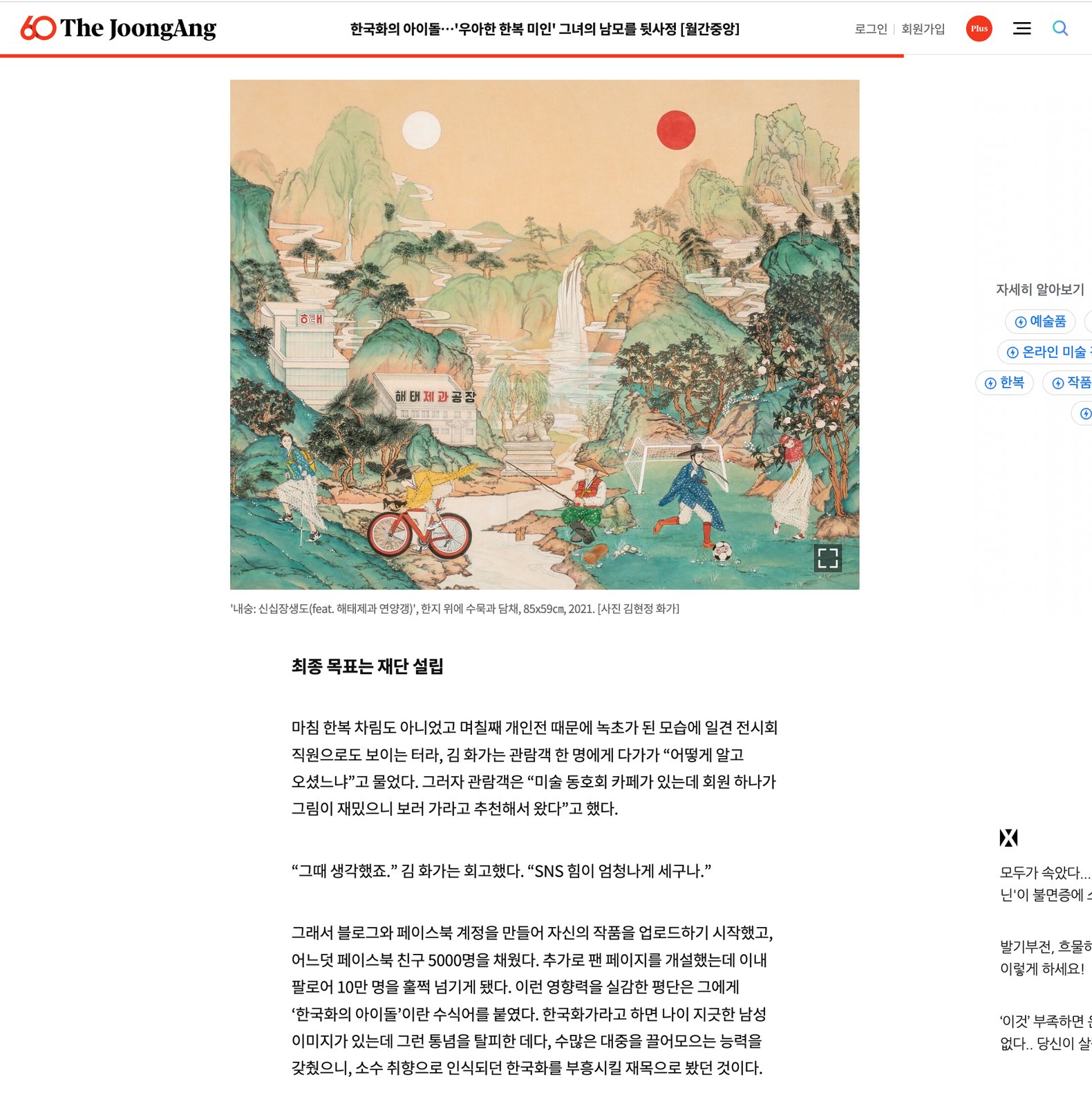
The Naesung series, which captures hanbok and contemporary everyday life together, presented the message of ‘reinterpreting Korean sensibility in the most sophisticated way’ — a message that aligned with the promotional strategies of companies looking to differentiate their established brand image, leading to numerous collaborations and, naturally, wider public recognition. Even those not well versed in the art world will likely recognize, on closer look, quite a few works as hers.
A representative example is the peony-flower background pattern designed for Woori Card’s ‘Card-ui-Jeongseok’ (Card Basics). There is also the series of Korean-painting-style illustrations on the packaging of Haitai Confectionery’s Yeoyangkaeng, found on supermarket shelves, and her work applied to the BI design and bridge footage of the 2019 MBC Drama Awards. Having built her name recognition this way, Kim became the youngest Korean to hold a solo exhibition at New York’s Metropolitan Museum of Art in 2016, and the following year was selected for Forbes’ ‘30 under 30 Asia.’
But the birth of an artist inevitably involves an untold labor pain of its own, and Kim was no exception in rising to stardom. During her school years, she graduated from Sunhwa Arts Middle and High School before entering the Department of Oriental Painting at Seoul National University, later double-majoring in business administration. On paper, it looks like a textbook elite track. Looked at another way, it means she endured an environment from early childhood spent competing with gifted peers in the art world who shared the same goal. “I started at an art academy prep for entrance exams from age eight. It wasn’t out of any grand ambition — I just followed my older sister, who’d started art early. So the sight of fighting through the entrance-exam war with paint on my face and hands was something I’d grown used to since childhood.”
A School Life Where Only First Place Mattered
Kim went through a war of practical exams and interviews starting from her middle school entrance. Getting calluses and blisters on her fingers from brushwork wasn’t even something to brag about. “All I thought about was first place. First place, first place. But in the art world — unlike music or dance, where a born genius just keeps taking first place — the ranking flips depending on the exam’s theme or subject matter. So there was no answer besides practice.”
She hadn’t originally intended to pursue Oriental painting. If anything, Western painting or design would have been more familiar to her. But from her first year of high school, she was told she had talent for Oriental painting, and she herself judged, from both sensibility and temperament, that it suited her. “I was shocked by the way ink bleeds and spreads into Korean paper, and the way color seeps into that bleeding. Ah, I thought — this kind of art exists too.”
The shock continued through the genre paintings of the great Korean-painting masters Kim Hong-do and Sin Yun-bok. In Western painting there is a narrative technique called mise-en-scène, which subtly hints at a work’s story through the composition and pose of figures and the arrangement of objects. Our genre paintings have a similar technique. If Western painting is somewhat suffocatingly meticulous, ours is a bit looser, more at ease — that’s the difference. Which is why there is laughter, and there is wit. In other words, this is also called ‘un-chi’ (韻致), a certain flavor or charm.
“But in my senior year of high school, in my first attempt, I failed to get into Seoul National University. It was the first failure of my life.”
Depression soon followed. The hardest thing to bear was other people’s gaze. In a system that constantly ranks people, there is no shortage of envy and jealousy. Hating that, she gripped her brush all the more fiercely, and in the end graduated top of her class in practical skills from Sunhwa Arts High School — but failed at the entrance exam that mattered most. She could not help but crumble mentally. The following is a passage the then-20-year-old Kim confided to a psychological counselor at the time.
‘I am standing barefoot on a stage strewn with shards of glass. The whole audience is pointing fingers at me, but somehow I still have to trample forward on it.’
The Naesung Series, Made Popular Through Social Media
The following year she gained admission to Seoul National University’s Department of Oriental Painting, as if in vindication, but it took two more years to fully shake off her sense of defeat. The place that healed her psychologically was her studio. She thought to try painting on the theme of human duality — people who approach with a smiling face but, once turned away, take off the mask and gossip; people who put on airs of refinement while being anything but refined underneath. “Wearing hanbok makes you look demure, doesn’t it? So I wanted to poke at that once — a figure in hanbok doing something that didn’t fit that image.” In that sense, the Naesung series was originally born to criticize the very type of person Kim herself despised.
But a single comment from a visitor at a solo exhibition of the Naesung series made her look back at herself. ‘The figures in your paintings all resemble you, don’t they?’ someone said. “I painted them in a half-asleep state without paying much attention to the features, but hearing that comment, I looked closer and realized — it was my own face. That’s when it hit me. Naesung is, in fact, a confessional self-portrait. This was my own story. Once I accepted that, I felt at ease. From then on, I began to hope my work would come across to others as something cheerful.”
So did she ever regret choosing Korean painting? Strictly speaking, art is perceived as a hungry profession, and since art isn’t among life’s basic necessities, there are few clients besides the small pool of collectors. She double-majored in business administration precisely because she wanted to understand the art market. “If I’d really wanted to study the art market properly, I should have gone into economics. At the time I didn’t even know that much — I had no interest in anything besides art.”
But that too proved no easy path. The business school mostly studied from English-language textbooks; where another student might understand the material in two hours, Kim couldn’t grasp even a quarter of it after a full twenty hours of concentration. On top of that, there was an odd atmosphere on campus of looking down on arts students. In group projects, it was often assumed someone else would handle the presentation or the research, and she’d just be left to put the slides together. Still, she held on out of sheer stubbornness. If she didn’t hit her study quota, she wouldn’t let herself sleep, and whatever she committed to, she had to finish. On top of that, there could be no criticism that she was so obsessed with her second major that she wasn’t focused on her actual major.
“Still, I managed to work out my own formula for success in the art world. I calculated the number of works by various painters held and exhibited in major museums around the world, and found that to succeed, you need at least 2,000 pieces. Picasso left behind roughly 13,500 works, so I’m in better shape than that, but it’s still not a small number.”
In the end, Kim graduated second in her class from Seoul National University’s College of Fine Arts. For that she received the Alumni Association President’s Award, which she says is, personally, the achievement she’s proudest of, more than any other line on her résumé.
The moment that brought the ‘Naesung series,’ which made Kim’s name known, into the public eye owed a great deal to the reach of social network services (SNS). After graduating from university, she held a solo exhibition in Insa-dong, Jongno, and was startled one day to see a crowd filling the side street nearby. She was confident in her skill, but she was fresh out of student status, the equivalent of a ‘trainee’ in office terms. There was no way she had the fame or recognition to draw a crowd, and no matter how impressive a work might be, this was Insa-dong, lined with galleries holding exhibitions. And yet, it struck even her as strange that people were flocking specifically to her solo show.
The Ultimate Goal: Founding a Foundation
As it happened, she wasn’t even wearing hanbok that day, and after days worn out from the exhibition, she looked, if anything, like exhibition staff — so Kim approached one visitor and asked, “How did you find out about this?” The visitor answered, “There’s an art-lovers’ online cafe, and one of the members recommended it, saying the paintings were fun, so I came to see it.”
“That’s when I thought,” Kim recalled. “The power of SNS is enormous.”
So she made a blog and a Facebook account and began uploading her work, eventually filling all 5,000 Facebook friend slots. She then opened a fan page, which soon passed 50,000 followers. Sensing this influence, critics attached to her the epithet ‘idol of Korean painting.’ Korean painters are typically imagined as older men, and here she broke that stereotype while also possessing the ability to draw in a huge public following — so they saw her as a talent who could revive Korean painting, which had been seen as a niche taste.
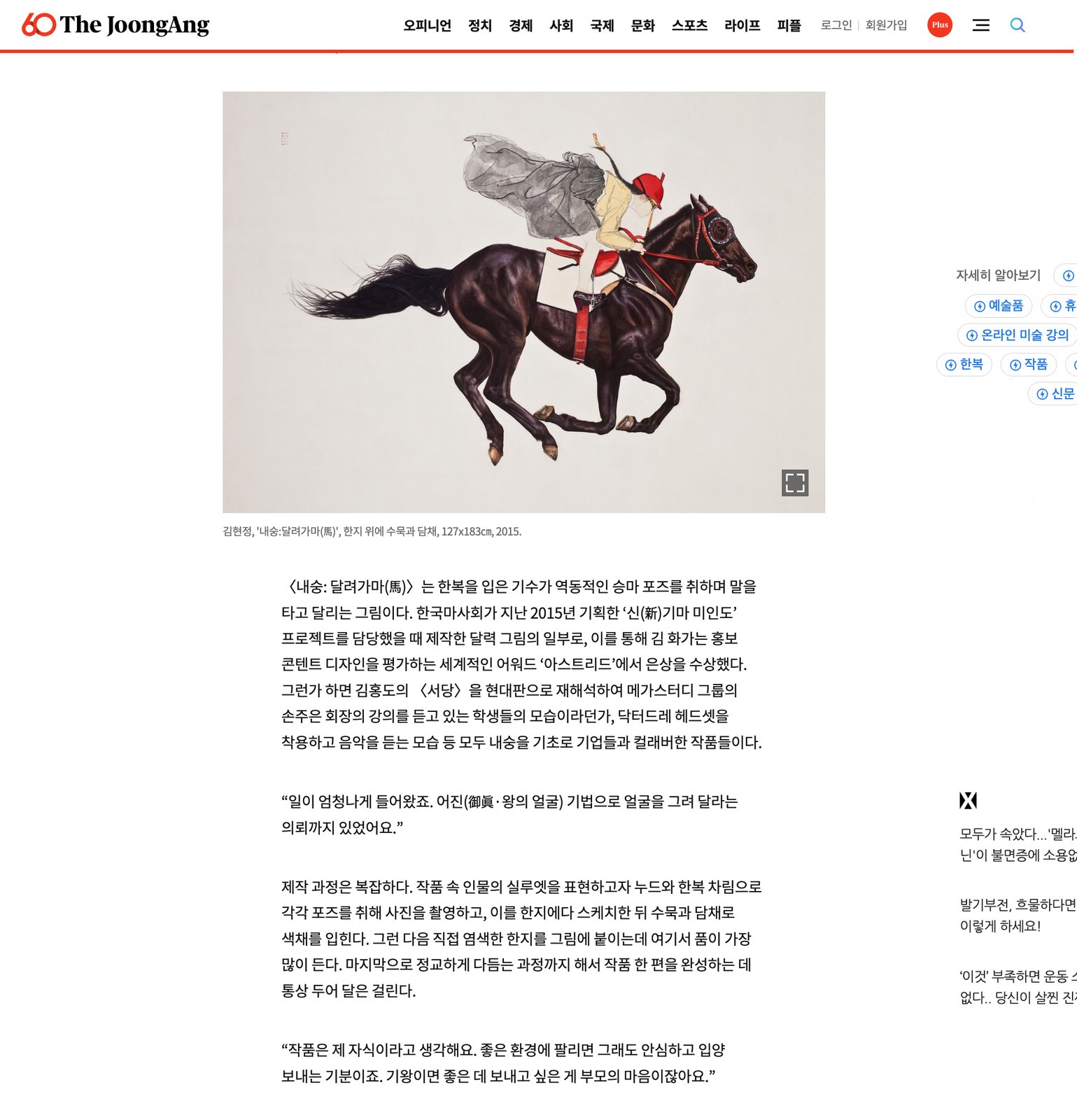
<I’ll Come Running(馬)> depicts a jockey in hanbok striking a dynamic riding pose atop a galloping horse. It was part of a calendar illustration produced when Kim took on the Korea Racing Authority’s 2015 ‘New Horsewoman Beauty’ project, and through it she won a Silver Award at Astrid, a global award evaluating promotional content design. There are also other Naesung-based works made in collaboration with companies: a woman in hanbok, stiffly posed, delivering McDonald’s on a motorcycle; a woman who twisted her ankle after going out to shop for luxury goods in heels that don’t suit her; a scene of a woman hunched over eating ramyeon so the broth won’t splash, only to spill Starbucks coffee she’d tucked into her designer bag.
“The work poured in like crazy. I even got a commission asking me to paint a face using eojin (御眞) technique, the traditional method for royal portraits.”
The production process is complex. To render the silhouette of the figure in the work, she photographs herself posing both nude and in hanbok, sketches this onto hanji, then colors it with ink-wash and light coloring. She then attaches hand-dyed hanji to the painting, which is where most of the labor goes. Finally comes a stage of meticulous refinement, and completing a single work typically takes around two months.
“I think of my works as my children. When one sells to a good environment, it feels like sending it off for adoption with peace of mind. Naturally, like any parent, I want to send it somewhere good.” So her ultimate goal as an artist is to establish her own foundation. She notes that Andy Warhol’s continued fame is also because he set up his own foundation, which manages his works even after his death, holding exhibitions steadily so he isn’t forgotten by the public.
After the interview ended, Kim hurried to pack her things, saying she had an all-nighter ahead of her. She’ll be holding an exhibition at Ewha Womans University Seoul Hospital from September 15 to November 17, and says she’s deep in thought about how to design it to lift patients’ spirits. “I hope people feel a little cheer, even briefly, after seeing my work. Even if life wears you down, I hope you can find strength by facing the humor of everyday life.”
_ Ahn Deok-gwan, Monthly JoongAng Reporter