






Maeil Business Newspaper | The Painter Kim Hyun Jung Pulls Back the Hanbok Skirt to Reveal the “Naesoong Story” [Fashion Documentary 8]
MK Fashion (Maeil Business Newspaper's fashion channel) spotlighted Korean painter Kim Hyun Jung's "Naesoong" series in an in-depth interview for its "Fashion Documentary" series on March 24, 2013. The artist explained why she chose self-portraiture as her subject, why she insists on hanji and ink-wash painting, and the desires of women in their twenties embedded in her work.
View full text
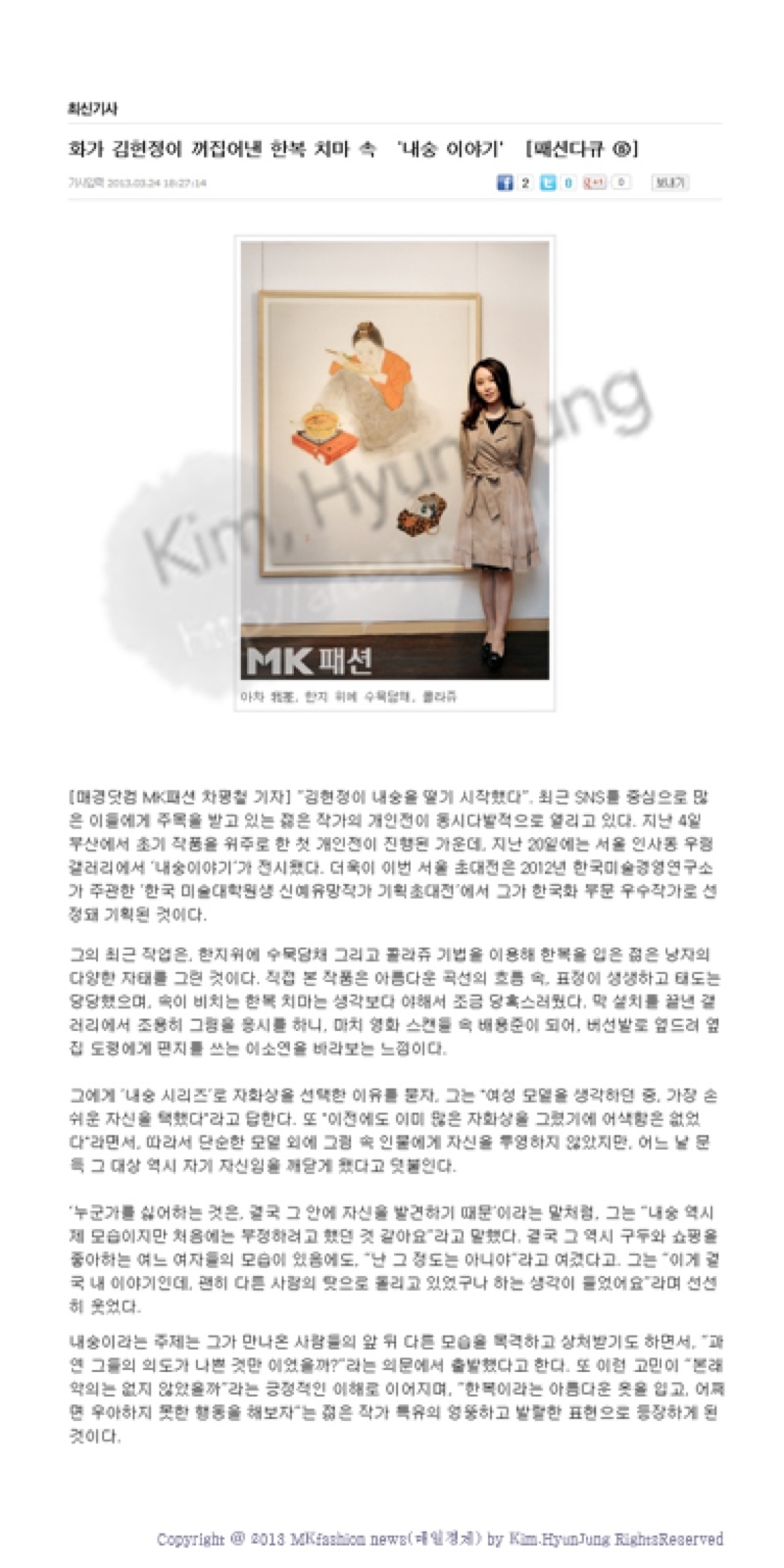
[MK Fashion, Reporter Cha Pyeong-cheol] "Kim Hyun Jung has begun to play coy." A young artist who has recently drawn attention across social media is holding solo exhibitions one after another. Following her first solo show of early works in Busan on the 4th, "Naesoong Story" opened on the 20th at Woorim Gallery in Insa-dong, Seoul. This invitational Seoul exhibition came about after she was selected as an outstanding artist in the Korean painting category at the 2012 "Promising New Korean Art Graduate Artists Invitational Exhibition," organized by the Korea Art Management Institute. Her recent work depicts young women in hanbok, captured in various poses using ink-wash coloring and collage on hanji. Seeing the works in person, I found the flow of their beautiful curves vivid in expression and confident in attitude, while the sheer hanbok skirts were, somewhat disconcertingly, racier than expected. Standing quietly before the paintings in the just-finished gallery, I felt like Bae Yong-joon in the film Scandal, gazing at Lee So-yeon as she lies on her stomach writing a letter to the young man next door.
Asked why she chose self-portraiture for the "Naesoong series," she replied, "While thinking about a female model, I chose the easiest option — myself." She added, "I had already drawn many self-portraits before, so there was no awkwardness," and that at first she didn't project herself onto the figures in the paintings beyond using herself as a mere model, but one day realized that the subject was, after all, herself. As the saying goes, "disliking someone is ultimately about discovering yourself within them" — she said, "Naesoong, too, is a part of who I am, but at first I think I tried to deny it." In the end, she too has the same traits as other women who enjoy shoes and shopping, though she used to think, "I'm not that bad." "I realized this was ultimately my own story, and I had been blaming it on other people," she said with an easy laugh.
She explained that the theme of "naesoong" (coy, two-faced behavior) began from witnessing — and sometimes being hurt by — the gap between how people present themselves and how they act behind the scenes, and from the question, "Was their intent really always malicious?" This reflection led to a more positive understanding — "Perhaps there was no real malice to begin with" — which took shape as the young artist's characteristically witty and playful expression: "Let's wear the beautiful clothing of hanbok, and perhaps behave in a less-than-elegant way." A woman wearing hanbok, her hair adorned with hairpins and ornaments, eats ramen from the lid of a simmering pot on a portable gas stove while gazing at a Louis Vuitton bag and a Starbucks takeaway cup. A few years ago, amid the height of the "doenjang-nyeo" (a derogatory term for status-obsessed young women) controversy, news that women in their twenties were skimping to buy luxury goods drew much criticism. But she cheerfully unpacked this harsh reality and honest desire in a single painting. "Ordinary women sometimes chase foreign or imported luxury goods without much thought, and I feel that's part of who I am too. So I tried to convey that through the eyes of an observer." "At first I thought about what themes people could relate to, and thought about the desires of people in their twenties like myself. For instance, with shopping — I've been so busy lately that I might only go once or twice a year, but in those moments I enjoy it more than anyone. I think it's the same stress relief most women feel. And I realized I have a bit of an addictive tendency — when I'm stressed, I have to at least browse online shopping malls. If I have no money, I even go somewhere like Daiso."
Among the exhibited paintings is one of a woman carrying shopping bags in both hands and a large box on top, looking back at her right danghye (traditional shoe) that has slipped off. It's reminiscent of a Joseon-era noblewoman on her honeymoon in Hawaii, hurrying toward the checkout counter as closing time approaches, only for her shoe to slip. Acha (My Fault), ink-wash coloring and collage on hanji. "I titled both the scene of eating ramen and the one with the slipped-off shoe 'Acha (我差).' That's the moment of thinking 'oh no' while shopping, but it's also written with the character for 'I' (我) and the character for 'fall short' (差), expressing my own sense of inadequacy."
In another painting, a woman with her nails freshly polished sits in hanbok, surrounded by sandals, danghye, high heels, wedge heels, and fur-trimmed short boots, deliberating over what to wear. "The painting with the shoes came from watching my mother every morning, looking at the shoes lined up in the entryway and wondering what to wear — I saw that same trait in myself, so I titled it with the character for 'empty' (空). We usually feel that no matter how much we buy, we never have the right clothes or shoes to wear. I wanted to express both that emptiness and the joy together." Naesoong: Emptiness, ink-wash coloring and collage on hanji.
Meanwhile, hanbok — which could be called an art of line — is, like Han Hyo-joo's costume in the film Masquerade, a symbol of elegance, but as in Untold Scandal with Lee Mi-sook (Kim Min-jung), it can also stir a very sensuous imagination. The women in her paintings wear innocent expressions, gathered under the theme of "naesoong," yet their translucent hanbok reveals bare skin — enough, perhaps, to embarrass an innocent young man, not unlike male students said to feel unable to fully express themselves at some coeducational schools today. "Before I paint the hanbok, I first paint the nude figure underneath, and then dress it. Even though this takes three times as long, the reason I insist on this method is that I want to draw out the story hidden beneath the wide skirt. Carefully painting the nude beneath is about asking what happens inside the clothing — and more broadly, what actually happens in any situation, not just hanbok — so I think the erotic quality comes through even as everything is expressed." "In a way, I think this could be tied to feminism. There's also the fact that in Korea, a woman being shown nude carries its own weight. I actually feel resistance toward being told, 'well, you're a woman, so—.' If you're a woman, why can't you take your clothes off? Is that wrong? I think feelings like this need to be expressed as honestly and openly as possible. In 2012, three of my paintings were made into phone cases, and at first my parents objected — partly because it was my own face, and partly because of the somewhat racy aspect, they thought it best not to do it. But now they support me, and sometimes my dad jokingly says I should cover this or that part a bit more."
Not long ago, Mayor Park Won-soon's hanbok fashion became a topic of discussion. Unlike many public figures who pair a fine hanbok with plain black shoes and leave something to be desired, he carefully matched his outfit down to the beoseon socks and traditional gatsin shoes, showing off an elegant style. So I asked about the hanbok worn by the women in her paintings. "Some I've purchased myself, and some I've borrowed from my mother. I also mostly wear hanbok by designer Park Sul-nyeo. I happened to meet Ms. Park while preparing for a relative's wedding. And in some paintings, I've simply changed the color."
Like Suh Do-ho, often named one of the greatest living Korean artists, or Bae Young-hwan, who held a solo exhibition at Plateau Gallery in 2012, drawing a line between artistic disciplines has become a rather meaningless exercise. Yet since the wave of Pop Art swept through Korea's art world in the 2000s, it has become somewhat rare to find traditional materials or techniques in young artists. So I asked her why she uses hanji and ink-wash. "The hanji I paint on is a paper called misaraji sun-ji. In Japanese, misaraji also refers to sun-ji, so in Korean it would essentially be 'sun-ji sun-ji.' For free ink bleeding and fine detail, I use anpi, the thinnest type of misaraji sun-ji. But the difficulty is that because it's so thin, it sometimes tears while I'm painting. Even after it dries, it can end up cracked." "I do think Korean painting has its own charm compared to oil or acrylic. I love the sense of translucency that comes from layering and overlapping. With oil, the finish can become more refined as the paint builds up thicker, but with Korean painting, it becomes more transparent as layers overlap. There are almost no other art materials like that. So Korean painting materials are the medium I can handle best, and I also want to share their particular beauty." Kim Hyun Jung, who once said she would keep painting even if just one person liked her work — but with back-to-back invitational exhibitions coming up in June at the Seoul Arts Center Hangaram Art Museum and in October at Jaedong Gallery, isn't that proof that many viewers are already caught up in the hem of her painted hanbok skirts?
[MK Fashion, Reporter Cha Pyeong-cheol, news@fashionmk.co.kr / Photos: Reporter Jin Yeon-su, courtesy of Woorim Gallery]