








King Sejong Institute | The Idol of Korean Painting, Korean Painter Kim Hyun Jung
An interview featuring Korean painter Kim Hyun Jung as the second guest in 'Nurivot Sarangbang' (Global Friends' Living Room), a special interview series marking the 10th anniversary of the founding of the King Sejong Institute Foundation. Structured as a Q&A answered directly by the artist, it covers the background and technique behind the 'Naesung series,' reactions to her overseas exhibitions, what led her to create a Korean-painting portrait of BTS, her social media and corporate collaboration activities, and her plans for 2022. Written by the King Sejong Institute Foundation's Public Relations and Cooperation Team; no separate photographer credit is given in the original.
View full text
A person sitting in front of a fridge eating pizza, riding a delivery motorcycle, playing pocket billiards. These may look like scenes from our everyday life, yet what draws the eye is that every figure is a woman dressed in beautiful hanbok -- and, what's more, these are painted in hangukhwa, Korea's traditional style of painting. We met Kim Hyun Jung, the Korean painter behind these works.
Q. Hello! Could you introduce and boast a little about "Korean painter Kim Hyun Jung" to King Sejong Institute learners around the world?
Hello! I'm Korean painter Kim Hyun Jung, often called "the idol of Korean painting." I create work under the 'Naesung series,' a confessional self-portrait exploring the gazes of others and social conventions.
If you look up 'naesoong' in the dictionary, it's defined as "appearing gentle on the outside while being sly within." Everyone wants to hide their shortcomings and be recognized by others, don't they? I, too, was never free from the pressure of external judgment and convention. That departure from such gazes, and the confessional self-portrait born from it, is exactly what 'Naesung Story' is.
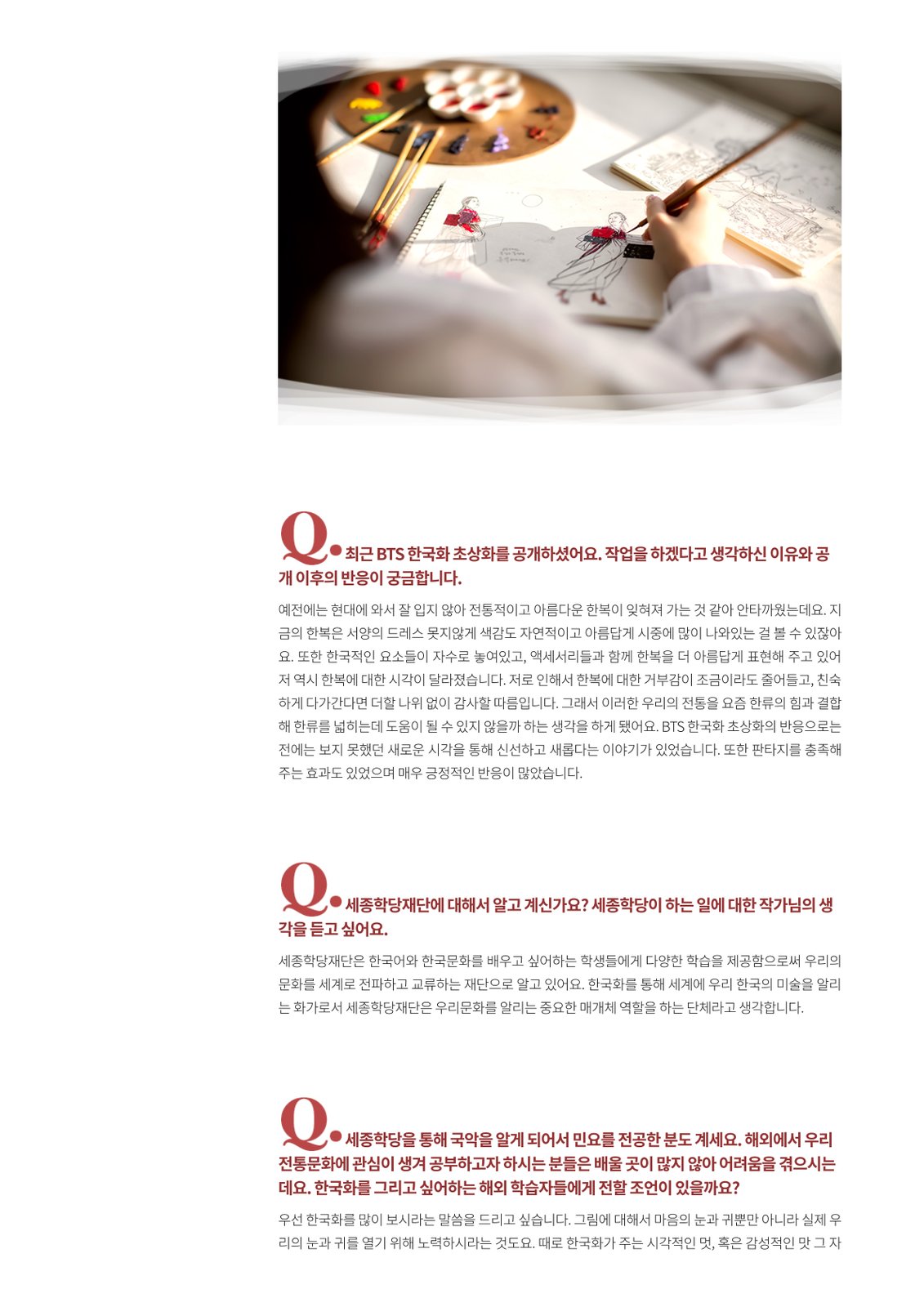
Technically, I've developed a new painting method that adds Western-style collage to traditional ink-and-wash coloring. I used hanji collage to bring out, in three dimensions, the crisp, rustling texture unique to a hanbok jeogori, and painted the hanbok skirt in ink to convey a sense of transparency. I paint the figures and props in light coloring. While preserving the traditional beauty of the East and of Oriental painting, I try to create work that can be comfortably enjoyed and related to in our own time.
Q. You pursued art continuously, from Sunhwa Arts Middle and High School through the Department of Oriental Painting at Seoul National University and graduate school. When did you first think you wanted to paint, when did you start Korean painting, and is there a special reason you chose Korean painting among the many fields of painting?
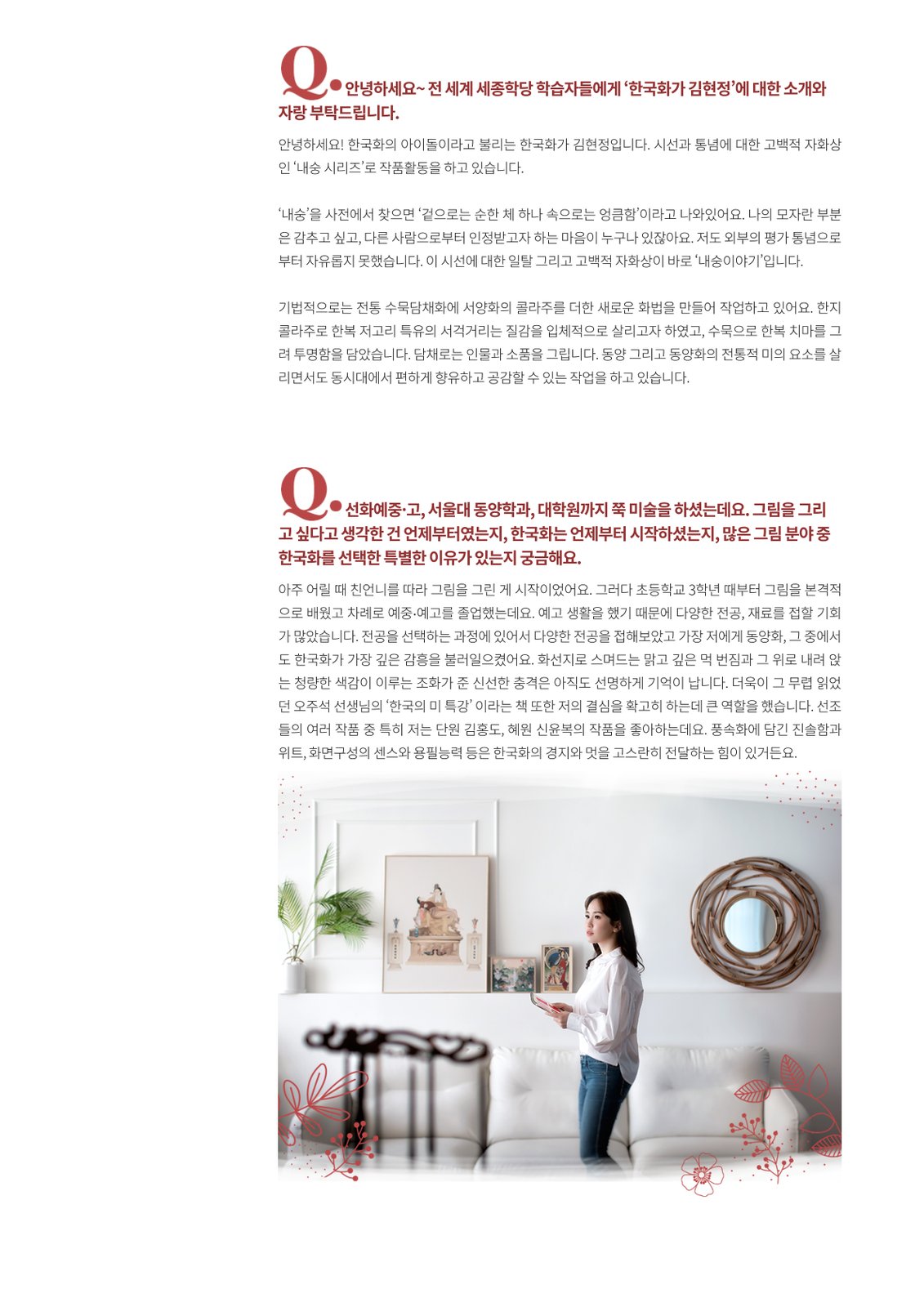
It all began very early, when I followed my older sister and drew alongside her. Then, from third grade in elementary school, I began learning to paint in earnest, and went on to graduate from arts middle school and arts high school in turn. Because I attended an arts high school, I had many chances to encounter various majors and materials. In the process of choosing a major, I explored many options, and Oriental painting -- Korean painting in particular -- moved me most deeply. I still vividly remember the fresh shock of the harmony between the clear, deep bleeding of ink into hanji and the cool colors settling over it. What's more, a book I read around that time, Oh Ju-seok's "Special Lectures on Korean Beauty," played a big role in solidifying my resolve. Among the many works of our ancestors, I especially love the works of Danwon Kim Hong-do and Hyewon Shin Yun-bok. The sincerity and wit contained in their genre paintings, and their sense of composition and brushwork, carry the power to convey the level and charm of Korean painting in full.
Q. Starting with your solo exhibition at the Metropolitan Museum of Art in New York, you have also held frequent overseas exhibitions in New York, Hong Kong, Beijing, and Berlin. There must have been quite a few visitors abroad who encountered Korean painting for the first time through your work -- how did audiences react?
Just as eating tacos or kebabs, or drinking lassi, becomes a meaningful experience for us, I think eating kimchi with chopsticks would be a unique experience of Korean culture for foreigners. Not only at the exhibition in Germany but also at the one in Hong Kong, I realized that things ordinary to us were entirely new to foreign visitors, requiring explanation, and I was struck by that cultural diversity. For instance, German audiences needed an explanation of what hanbok is, what hanji and ink are, and what the word 'naesoong' means. That's how unfamiliar our culture and paintings seemed to them. But despite that unfamiliarity, they found my work fascinating and enjoyed it with real curiosity. Watching this, I caught a glimpse of the possibility that our Korean painting could resonate globally as well. I'd like to develop my 'naesoong' further into something that can gain even more universal empathy, and someday hold another solo exhibition abroad.
Q. You're very active on social media -- Instagram, Facebook, YouTube -- with about 200,000 followers, and you've done many collaborations with the Korea Minting and Security Printing Corporation, credit card companies, confectionery brands, and more. Many people imagine a painter as someone who only paints alone in a studio, so there must be some intention behind your activity across such diverse fields. What is it?
The reason I'm so active on social media is that communicating with all kinds of people lets me constantly encounter new information and new technologies. These days, everyone talks about the Fourth Industrial Revolution, and the art world is no exception. A painting made by Google's AI painter Deep Dream sold at auction for 100 million won. The AI project 'The Next Rembrandt' imitated and recreated Rembrandt's distinctive style down to composition, color, and even oil-paint texture. It has become possible to revive the style of a painter who is no longer alive.
Rather than turning away from the changes of our time, I think we should keep pace with them -- or stay a step ahead -- and put these technologies to good, playful use, since they could open the door to pioneering entirely new fields, much like Nam June Paik's video art. Exhibitions that digitized old paintings were also fascinating to me, and I once had the chance to make my Naesung women into 3D prints, which was genuinely fun and fresh. There was nothing about trying something new that wasn't enjoyable in the process. So I feel lucky to have been born in Korea, a country that changes quickly and reflects those changes right away. Korea's creative fields will keep developing in more diverse forms, and I'll try to embrace all of these changes as quickly as I can.
And for creators to grow together, exchange among artists from diverse fields is essential. I myself run a studio called H&A CENTER, the Kim Hyun Jung Art Creative Center. Working with researchers from various fields -- film, textile art, social science, engineering, and more -- from ideation all the way through content production leads to effective results in lectures, collaborations, and many other areas as well. Through this experience, I've realized just how effectively the power of a knowledge community can develop the content industry. I plan to keep excitedly expanding my scope of activity so that art can contribute evenly across society as a whole.
Q. You recently unveiled a Korean-painting portrait of BTS. Could you tell us what led you to take on that project, and how people responded after it was revealed?
I used to feel sad that hanbok, traditional and beautiful as it is, was being forgotten because people rarely wear it anymore in modern life. But nowadays, you can see that hanbok on the market has colors just as natural and beautiful as Western dresses. Korean elements are also embroidered into it, and accessories are used to make hanbok even more beautiful, which changed my own perspective on hanbok as well. If, because of me, resistance to hanbok is even slightly reduced and people feel closer to it, I couldn't be more grateful. So I began to think this tradition of ours, combined with the current power of hallyu (the Korean Wave), could help broaden hallyu even further. As for the response to the BTS Korean-painting portrait, people said it felt fresh and new, offering a perspective they hadn't seen before. It also seemed to satisfy a kind of fantasy, and there was a great deal of very positive response.
Q. Do you know about the King Sejong Institute Foundation? We'd love to hear your thoughts on what King Sejong Institutes do.
I understand the King Sejong Institute Foundation as an organization that spreads and exchanges our culture with the world by providing various forms of learning to students who want to learn the Korean language and Korean culture. As a painter who introduces Korean art to the world through Korean painting, I think the King Sejong Institute Foundation plays an important role as a medium for spreading our culture.
Q. Some people have discovered Korean traditional music through King Sejong Institutes and gone on to major in folk singing. Overseas learners who become interested in our traditional culture and want to study it often struggle because there aren't many places to learn. Do you have any advice for overseas learners who want to paint Korean painting?
First of all, I'd like to say: please look at a lot of Korean painting. And try to open not only the eyes and ears of your heart but your actual eyes and ears as well. Sometimes it may be enough just to enjoy the visual charm or the emotional flavor that Korean painting offers on its own, but I think you'll enjoy it far more if you also learn about the history of Korean painting, its techniques, and the characteristics of its materials.
For example, there's a huge difference between viewing Korean or Oriental painting with the knowledge that the basic principle of appreciation is to move your gaze from the upper right to the lower left, versus viewing it without knowing that. It would be ideal to study separately through books, lectures, or videos, but if that's difficult, I'd recommend timing your exhibition visits to coincide with docent tours that offer explanations. Listening to a docent's explanation while appreciating Korean painting will let you feel its charm and appeal many times over.
Q. The art world, too, went through many difficulties because of COVID-19. You mentioned it actually became an opportunity for you to focus on your work. Are there any works or activities you're currently planning? What would you like to do in 2022?
I'm keeping what subjects I'll paint open for now. If I had to describe my direction as an artist, I'd say I want to make work that is painted with the heart, not the head. This means honest work. I think the ultimate dream of a painter is to keep working for a very long time and eventually reach the 'level' of work that is even more honest and can be conveyed straight from the heart. And this ties into the business achievements of Kim Hyun Jung Art Center, where I'm based. I want to be a Korean painter who represents Korea internationally, and a 'cultural envoy' who widely introduces the charm and beauty of Korean painting to the public.
The power of hallyu these days is truly remarkable. K-pop, K-drama, K-movies, and more -- Korean culture is being introduced to the world and enjoyed by people everywhere. At first, I wondered, "Korea is famous as a country with skillful hands, so why are there fewer Korean names among world-class artists than you'd expect?" That question made me feel the need to understand the current Korean art market, and I thought, wouldn't it be a good outcome if I too contributed to broadening hallyu? In 2017, I was selected for '30 Under 30 Asia,' chosen by America's largest business magazine, Forbes. Taking that as an opportunity, I plan to be even more active and dedicated to my work so that K-art and Korean painting can become widely known around the world. As a more specific plan along these lines, I've been thinking about expressing an Art Nouveau of Korean painting -- I'd like to fuse the delicate, beautiful imagery of Art Nouveau with my own Korean painting to complete something distinctive. And my first invitational exhibition of 2022 runs at the Paradise City Hotel in Incheon from January 28 to February 20 this year, so I hope you'll show it lots of interest. (Laughs)
Q. Finally, do you have any words of encouragement for learners around the world studying Korean language and culture at King Sejong Institutes?
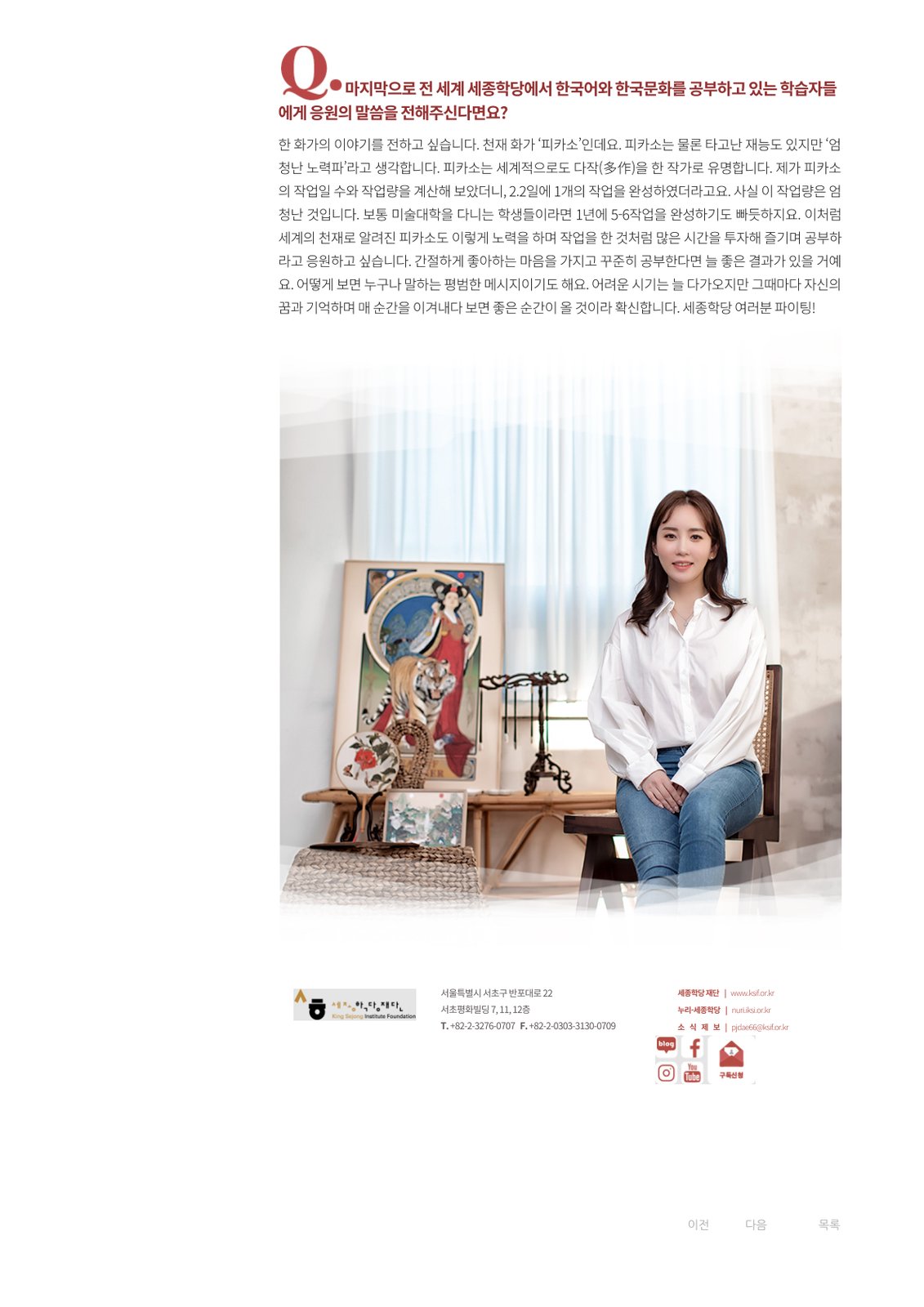
I'd like to share the story of one painter -- the genius painter Picasso. Picasso certainly had natural talent, but I also think of him as an incredibly hard worker. He's famous worldwide as a highly prolific artist. When I calculated Picasso's working days against his output, I found he completed one work every 2.2 days. That's actually an enormous volume of work -- students at art colleges are usually hard-pressed to complete five or six works in a year. Just as Picasso, known as a genius to the whole world, worked this hard, I'd like to encourage you to invest a great deal of time, enjoying your studies as you go. If you hold onto a genuine love for what you do and keep at it steadily, good results will always follow. In a way, this might be an ordinary message anyone would say. But difficult times always come, and I'm confident that if you remember your dream each time and get through every moment, good moments will come. Fighting, everyone at King Sejong Institute!