






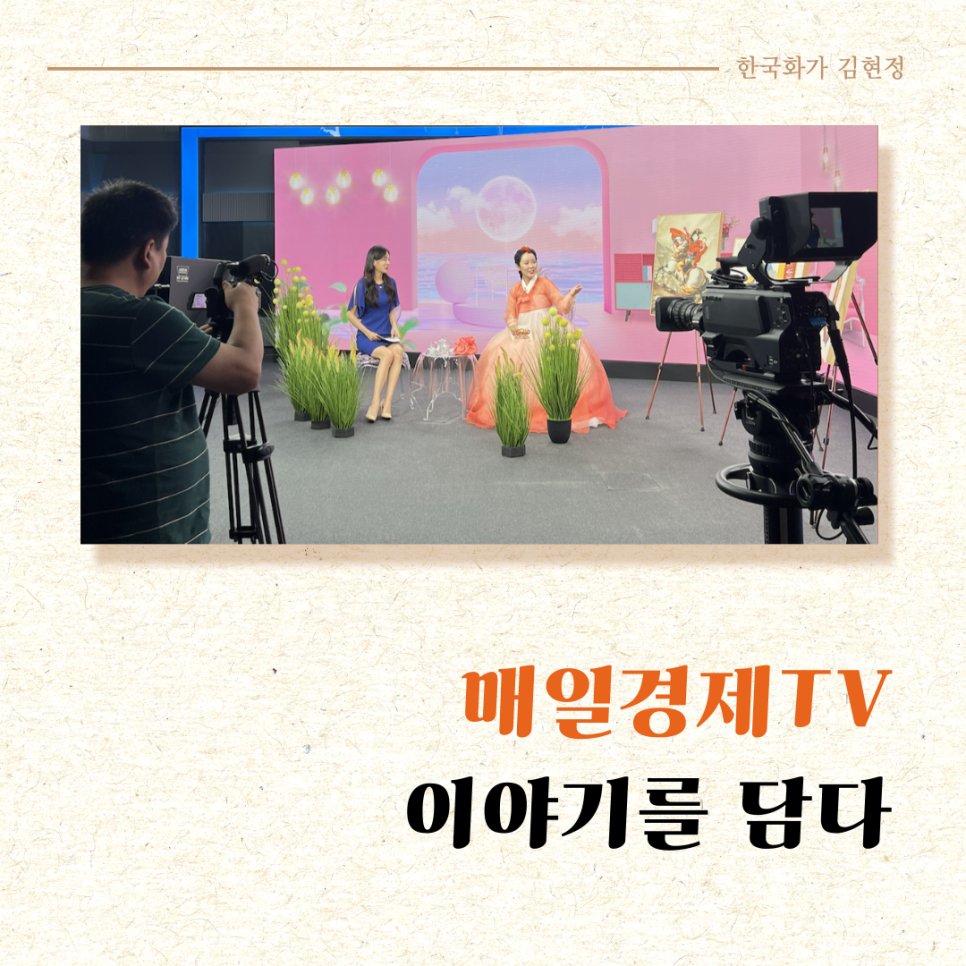

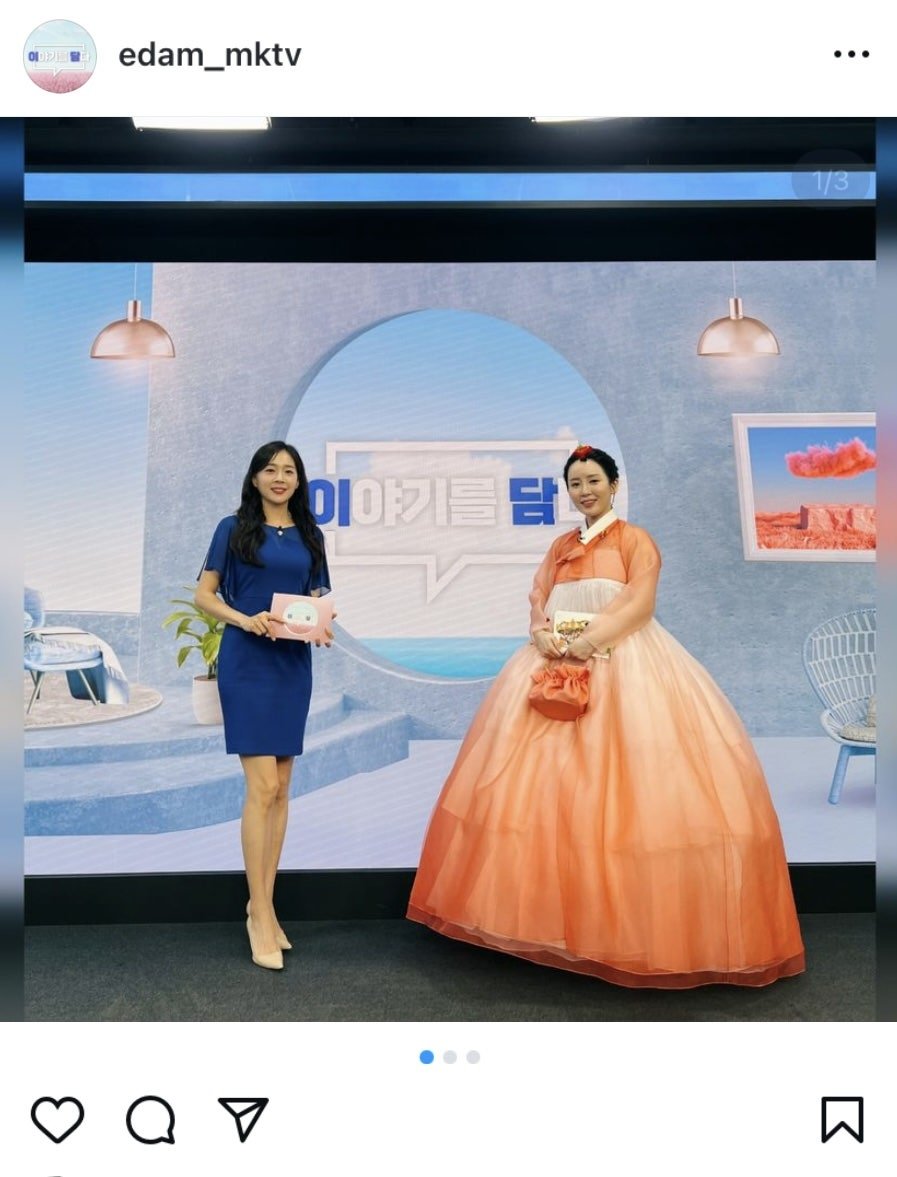
Maeil Business TV | Telling Stories, Episode 9
Korean painter Kim Hyun Jung appeared in episode 9 of Maeil Business TV's "Telling Stories" (broadcast August 15, 2024), where she talked with announcer Lee Dam about her work and artistic career.
View full text
"Stories to Share" brings you life stories from figures in politics, culture, business, and sports. Today's guest is a hot figure from the art and culture world — someone who seems demure yet is bold, who seems aloof yet is provocative, with an alluring sense of contrast. She is Kim Hyun Jung, the accomplished Korean painter known as the "idol of Korean painting" who led the popularization of the art form, and whose work appears in nine different middle and high school art textbooks.
Host: I think this is the first time I've seen an outfit suit someone this well. Hanbok really suits you.
Kim Hyun Jung: Ah, it feels a bit like a school uniform to me since I wear it so often, so I'm very comfortable in it.
Host: You always paint women in hanbok — is it fair to say you're painting yourself?
Kim Hyun Jung: Yes, that's right. It's my self-portrait. I started this series back in my college days. At the time, it wasn't easy to find models, so I used myself as a free model. It was also convenient for observation, and since I was the subject I saw most often, I comfortably started painting myself, and that's continued to this day.
Host: Hanbok isn't exactly a technique specific to Korean painting — was there a particular reason you chose hanbok as your subject?
Kim Hyun Jung: This series of paintings is called "Naesoong," and I chose hanbok as the medium to express this idea of "naesoong" (putting on a demure front). Honestly, I began painting because it hurt — at the time, I had an inner wound that came from putting on a refined appearance while behaving in ways that weren't refined at all, and to me, hanbok was the most refined clothing there was. When you wear hanbok, you naturally tend to behave demurely, so I wanted to capture, within the painting, the moments when I didn't behave that way.
I've done four major series, and the most famous is the first one I started, the "Naesoong" series. I captured moments of "naesoong" felt in everyday life. For example, the piece "You Who Move Me" was inspired by how much I love delivery food. When I held a solo exhibition at the Metropolitan Museum of Art in New York, a foreign visitor told me it was genius — how did I come up with delivery instead of a drive-through? In America, which is such a vast country, delivery culture felt unfamiliar to them. I briefly wondered whether to remain a "genius artist" in their eyes or to be honest, and I chose honesty — I told them that in Korea, delivery culture is so developed that we're even called the "delivery nation." It's an amusing story behind that painting.
Also, as an extension of the Naesoong series, once I entered my late twenties, I began feeling pressure around marriage as elders kept asking, "When are you getting married?" So I titled this series "A Tray of 30 Eggs: The Age to Marry." It's a parody based on the painting of Napoleon crossing the Alps, into which I inserted a traditional wedding scene in the style of Shin Yun-bok. I transformed the battle scene into a wedding-culture scene, and I gave particular emphasis to the shoes, meaning that even heading into a battlefield, one cannot give up on beauty — expressing how well today's mothers take care of themselves.
Host: The women in hanbok in your paintings have a see-through quality that reveals what's underneath — what meaning does that carry?
Kim Hyun Jung: There are many painters who paint hanbok, but the women in my paintings have this distinctive quality of being visible through their clothing. When I paint, it's a bit like playing with paper dolls — I first draw the silhouette of the figure, then render the hanbok on top of it, and for the jeogori (jacket) and skirt, I attach hanji (traditional Korean paper) that I dye myself and perforate by dripping water onto it — a material I call "suji." I felt that hanji, with its slightly crisp texture and its ability to let light show through, resonated well with hanbok, which is why I use this method.
Host: I'm also curious about your college years studying art.
Kim Hyun Jung: Actually, this "Naesoong" series didn't pass my graduation exhibition review. Back then, before K-pop had really taken off internationally, I was told things like, "who draws hanbok in such an old-fashioned way these days," and was even told to stop painting altogether. What allowed me to keep pushing forward was the idea that, "if you want to do the one thing you love, you have to endure the nine things you dislike" — painting made me happy, so I thought I could keep doing it even if I had to take on other part-time jobs to get by.
At first, there were senior students and professors who viewed me unfavorably. One professor once called me in during a lecture, saying a student had named me as the artist they admired and he was curious, and even pointed out that I painted figures a bit too plump. I laughingly told him on the spot, "I'm that artist, and it's a self-portrait, which is why I painted it that way." Now, some of those same people encourage younger students to follow a path like mine.
Many people think Korean painting lacks color, but in fact, it can use the full range of natural pigments. Dongyanghwa (East Asian painting) refers to the paintings of Korea, China, and Japan — Chinese painting tends to use a great deal of ink, Japanese painting tends to use a great deal of color, and Korean painting, geographically in between, uses a technique called "sumukdamchae," balancing ink and color appropriately. To achieve a deep color, you have to apply light pigment ten to twenty times, which takes an enormous amount of time. For a painting roughly 100-ho in size, working steadily, it takes at least a month of meticulous work.
Many people are also curious about the pricing of artworks. While the artist ultimately sets the price, it has to align with market rates, so there's a general baseline. For an artist who has just graduated from a four-year university in Seoul, a 100-ho piece might sell for around 3 to 5 million won, but since sales commissions run around 50%, what the artist actually receives is much smaller, and once you factor in framing, shipping, and material costs, it often comes out to less than minimum wage. But I hope people understand this as purchasing the time the creator has invested.
There was actually a difficult period. During a time when I was deeply hurt by relationships with others, painting was my only friend. The moment I was painting was the only time I felt immersed and at peace. Since I couldn't directly paint the peers who had hurt me, I began painting myself instead, and one night while working, I realized that the figure in my painting, my reflection in the mirror, and my appearance in photographs all resembled each other. I came to understand that the reason I resented that person was that I, too, had those same traits within me — and after that realization, I no longer felt resentment. Going through that moment helped my depression improve a great deal. So when I paint, I want to paint cheerfully. Since I was healed through this painting, my happiness comes from people who see it and say, "this is so cheeky, this is so much fun."
Another source of strength for me is social media. When I feel like giving up, even a single comment saying "your painting healed me" or "fighting!" gives me a lot of strength. It's been 12 years since I began this work in 2012 — at first there were seniors who viewed me unfavorably, but now there are many more who cheer me on instead. It seems that as the times have changed, my work has gradually come to be accepted.
The painting I'm working on now even features BTS — I take an original photograph and dress the figures in hanbok in my own style. Fans seem to enjoy it especially when I release these pieces to coincide with new album releases.
My dream is for art, like music, to become something everyone enjoys and experiences in daily life. When people are stressed, they say, "let's go to karaoke," but it's still unfamiliar to say, "let's go paint." I want to help build that kind of culture.